
NAD+ and Precursor Peptides: Sirtuin Activation and Mitochondrial Energy Pathways
NAD+ research is gaining attention in discussions about cellular energy, mitochondrial function, DNA repair, and aging. Nicotinamide adenine dinucleotide (NAD+) is a vital coenzyme found in living cells. It helps cells convert nutrients into usable energy. In addition, NAD+ supports enzymes involved in cellular signaling, stress responses, and genome maintenance.
But what makes NAD+ so important? The answer involves several connected biological systems. These include the sirtuin family of proteins, poly (ADP-ribose) polymerases (PARPs), and the mitochondria, which produce much of the energy that cells use.
NAD+ research also examines precursor molecules, including nicotinamide riboside (NR) and nicotinamide mononucleotide (NMN). Scientists study these compounds to understand how cells maintain their NAD+ supply and how NAD+ availability may influence cellular processes.
In this guide, we explore seven key NAD+ research facts, from sirtuin activation to mitochondrial biogenesis. We also explain what researchers know, where scientific questions remain, and why these pathways matter in cellular biology. 🔬
What Is NAD+ and Why Does NAD+ Matter for Cellular Energy?
NAD+ stands for nicotinamide adenine dinucleotide. It is a coenzyme that participates in hundreds of biological reactions. One of its best-known roles is helping cells transfer electrons during metabolic processes.
Cells use energy from nutrients to produce adenosine triphosphate (ATP). ATP supplies energy for processes such as movement, transport across cell membranes, and the production of cellular components.
NAD+ supports this process by accepting electrons and becoming its reduced form, NADH. NADH can then transfer those electrons to other systems involved in energy production.
Therefore, NAD+ and NADH work together. Their balance helps support normal metabolism and cellular function.
How NAD+ supports ATP production
Mitochondria play a central role in aerobic energy production. During cellular respiration, metabolic pathways generate NADH and other electron carriers. NADH transfers electrons into the mitochondrial electron transport chain.
As electrons move through this chain, the system helps create a proton gradient across the inner mitochondrial membrane. ATP synthase uses this gradient to produce ATP.
However, NAD+ does more than support energy metabolism. It also serves as a substrate for enzymes that regulate cellular signaling, DNA damage responses, and other biological processes.
This dual role makes NAD+ a major subject in mitochondrial and longevity research.
NAD+ Research Fact 1: Sirtuin Activation and Cellular Regulation
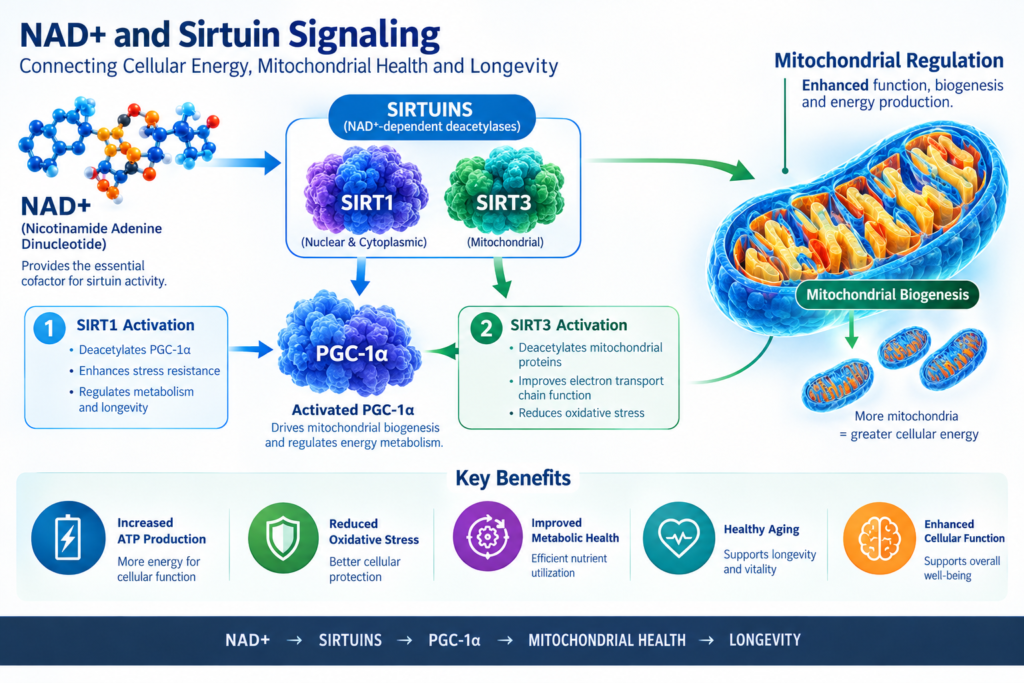
Sirtuins are a family of proteins that depend on NAD+ to perform important cellular functions. In mammals, the family includes seven members: SIRT1 through SIRT7.
These proteins are involved in processes such as gene regulation, metabolism, stress responses, and mitochondrial function. Several sirtuins remove chemical groups called acyl groups from proteins. Many of these reactions consume NAD+ and generate nicotinamide as a byproduct.
For this reason, NAD+ availability can influence sirtuin activity. Nevertheless, NAD+ levels are only one part of a larger system. Sirtuin activity also depends on factors such as the enzyme involved, the cell type, the location within the cell, and the availability of suitable targets.
What do SIRT1 through SIRT7 do?
SIRT1 is primarily associated with the nucleus and cytoplasm. It regulates transcription factors and proteins involved in metabolic signaling and stress responses.
SIRT2 is mainly found in the cytoplasm, although it can also act in other cellular compartments. Researchers investigate its role in protein regulation, cell division, and metabolism.
SIRT3, SIRT4, and SIRT5 are primarily associated with mitochondria. They help regulate mitochondrial enzymes and metabolic processes. Their specific functions differ, and each has a distinct set of molecular targets.
SIRT6 and SIRT7 are primarily associated with the nucleus. They participate in chromatin regulation, genome maintenance, transcription, and other processes involving nuclear function.
Together, these seven proteins illustrate why NAD+ research extends beyond ATP production.
Why NAD+ availability matters for sirtuins
Because sirtuins use NAD+ as a substrate, researchers investigate how changes in NAD+ metabolism influence their activity.
However, a higher NAD+ level does not automatically activate every sirtuin equally. Different proteins operate in different locations and respond to different biological conditions.
Consequently, scientists study NAD+ availability alongside enzyme activity, gene expression, metabolic status, and cellular stress.
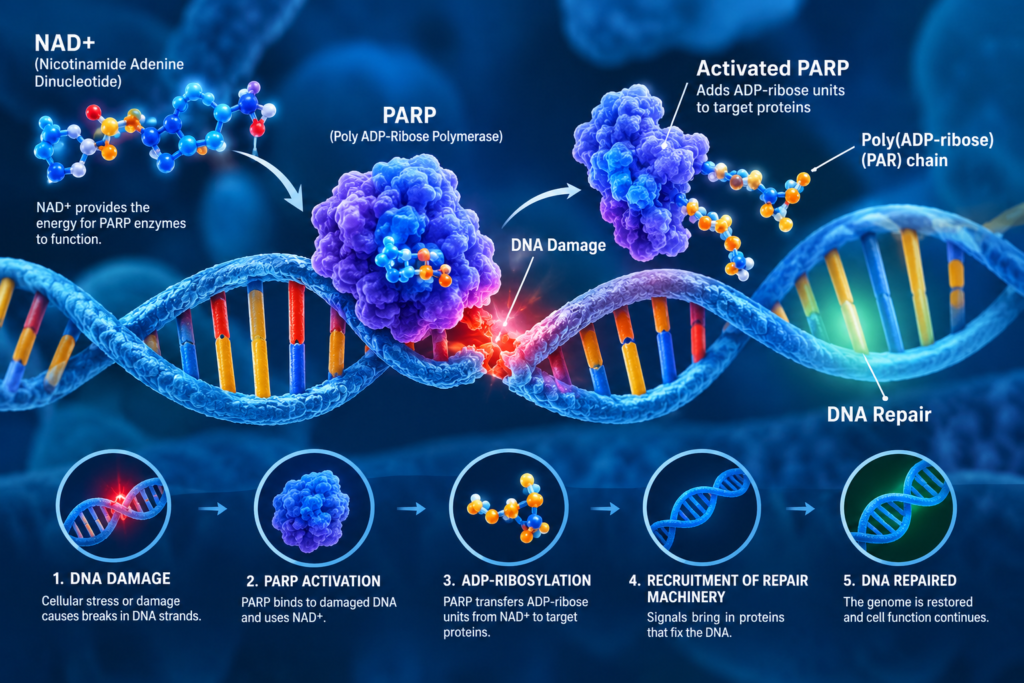
NAD+ Research Fact 2: PARP Enzymes and DNA Repair
Cells experience DNA damage from normal metabolic activity and environmental factors. To preserve genetic information, they rely on repair systems that identify damage and coordinate appropriate responses.
Poly (ADP-ribose) polymerases, commonly called PARPs, are a family of enzymes involved in several cellular processes. PARP1 and PARP2 are particularly important in responses to certain types of DNA damage.
These enzymes use NAD+ to add ADP-ribose units to proteins. This process, known as ADP-ribosylation, helps organize cellular responses to DNA damage and influences the recruitment of repair-related proteins.
How NAD+ connects to DNA repair
When certain forms of DNA damage occur, PARP enzymes may become activated. Their activity can consume NAD+ as they carry out ADP-ribosylation.
This creates an important connection between NAD+ metabolism and DNA repair. Cells need NAD+ for both metabolic reactions and the activity of several signaling enzymes.
Nevertheless, DNA repair is not controlled by NAD+ alone. It involves many proteins, signaling pathways, and repair mechanisms. The effect of NAD+ availability depends on the biological context.
NAD+ and cellular stress responses
Researchers investigate how NAD+ metabolism changes during cellular stress and how these changes relate to DNA damage responses.
They also examine how cells balance NAD+ production with consumption by enzymes such as PARPs and sirtuins.
These studies may help clarify the relationships between energy metabolism, genome maintenance, and cellular aging. However, laboratory findings do not automatically establish a health benefit or a treatment effect in humans.
NAD+ Research Fact 3: Mitochondrial Function and Energy Production
Mitochondria help cells convert energy from nutrients into ATP. They also participate in cellular signaling, metabolic regulation, and processes related to cell survival.
NAD+ contributes to mitochondrial function through its role in metabolic reactions. In pathways such as the citric acid cycle, NAD+ accepts electrons and becomes NADH. NADH then supplies electrons to the mitochondrial respiratory chain.
This system depends on several components working together. These include metabolic enzymes, mitochondrial membranes, electron transport proteins, oxygen availability, and ATP synthase.
The NAD+/NADH balance
NAD+ and NADH are two forms of the same coenzyme. Their balance helps regulate oxidation-reduction reactions throughout the cell.
The balance can differ between cellular compartments. For example, the mitochondrial NAD pool is regulated separately from the cytosolic pool, although metabolic shuttles connect their functions.
As a result, a measurement of total cellular NAD+ may not fully describe what is happening inside mitochondria.
Researchers therefore examine NAD+ concentrations, NADH levels, the NAD+/NADH ratio, and the activity of relevant metabolic pathways.
Why mitochondrial research matters
Changes in mitochondrial metabolism can affect how cells generate ATP and respond to different energy demands.
However, mitochondrial function is not determined by NAD+ alone. Nutrient availability, oxygen, mitochondrial structure, enzyme activity, and cellular signaling also matter.
This is why NAD+ research often examines several connected measurements rather than relying on a single biomarker.
NAD+ Research Fact 4: Mitochondrial Biogenesis and Cellular Adaptation
Mitochondrial biogenesis is the process through which cells build and maintain their mitochondrial components. It involves producing mitochondrial proteins, replicating mitochondrial DNA, and coordinating activity between nuclear and mitochondrial genes.
One important regulator is PGC-1α, a protein associated with the control of genes involved in energy metabolism and mitochondrial adaptation. Other factors, including nuclear respiratory factors and mitochondrial transcription factor A (TFAM), participate in this process.
Where NAD+ fits into mitochondrial biogenesis
NAD+-dependent signaling pathways can influence proteins involved in metabolism and cellular adaptation. For example, researchers study interactions between SIRT1, PGC-1α, and related regulatory networks.
SIRT3 is also investigated because it regulates mitochondrial proteins involved in metabolism and antioxidant defense.
These connections make NAD+ relevant to mitochondrial biogenesis research. However, it is important to distinguish an effect on a signaling pathway from a demonstrated increase in functional mitochondria.
Mitochondrial biogenesis is a coordinated biological process, and its measurement requires appropriate markers and functional assessments.
Biogenesis is not the same as better mitochondrial function
An increase in mitochondrial content does not necessarily mean that energy production becomes more efficient. Mitochondrial quality, structure, and respiratory capacity also influence performance.
For this reason, researchers may measure mitochondrial DNA, relevant gene expression, protein abundance, oxygen consumption, and ATP production.
Taken together, these measurements provide a more complete picture of mitochondrial adaptation than any single marker can provide.
NAD+ Research Fact 5: NAD+ Precursors, NR, and NMN
Cells obtain NAD+ through several metabolic pathways. They can recycle components of NAD+ or produce it from available precursors.
Two compounds frequently discussed in NAD+ research are nicotinamide riboside (NR) and nicotinamide mononucleotide (NMN).
NR and NMN are related to vitamin B3 metabolism. Researchers study their roles in NAD+ biosynthesis and how their availability affects cellular NAD+ pools.
Importantly, NR and NMN are not peptides. They are small molecules involved in NAD+ metabolism. NAD+ itself is a dinucleotide coenzyme, not a peptide.
How NAD+ precursor pathways work
Cells use multiple routes to maintain NAD+.
The salvage pathway recycles nicotinamide into NAD+ through a series of enzymatic reactions. NR can enter NAD+ synthesis through pathways involving nicotinamide riboside kinases and NMN. NMN can then be converted into NAD+ by NMN adenylyltransferase enzymes.
Other pathways use different starting materials, including tryptophan and nicotinic acid.
The relative contribution of each pathway varies by tissue, metabolic state, and biological conditions.
What does precursor research tell us?
Studies investigate whether particular precursors change NAD+ levels in cells, tissues, or human participants. They also examine how these changes relate to metabolic markers and other biological outcomes.
However, raising a measurable NAD+ pool does not automatically demonstrate improved mitochondrial function, slower aging, or a clinical benefit.
The effects of a precursor depend on factors such as its metabolism, dose used in a study, participant characteristics, and the outcome being measured.
Therefore, it is important to distinguish changes in NAD+ biomarkers from evidence of meaningful health outcomes.
NAD+ Research Fact 6: NAD+ Metabolism and Cellular Aging
NAD+ has become a major topic in aging research because its metabolism is connected to energy production, stress responses, and enzymes that regulate cellular processes.
Some studies report changes in NAD+ metabolism with age. However, these changes are not identical across tissues, species, or experimental settings.
Aging is also a complex biological process. It involves changes in many systems, including DNA maintenance, protein quality control, inflammation, metabolism, and cellular communication.
Does NAD+ decline with age?
Research has reported age-related changes in NAD+ levels in some tissues and experimental models. Yet the size and consistency of these changes vary.
Age-related NAD+ metabolism is influenced by both NAD+ synthesis and NAD+ consumption. Enzymes such as CD38 and PARPs, along with sirtuins and other metabolic pathways, can affect the balance.
Consequently, scientists investigate how NAD+ availability interacts with other features of cellular aging.
What remains uncertain?
Research on NAD+ and aging includes cell studies, animal experiments, and human trials. These types of evidence answer different questions.
Cell and animal studies can help identify mechanisms. Human studies are needed to assess whether specific interventions produce meaningful and lasting effects in people.
Even when an intervention changes an NAD+ biomarker, researchers must still determine whether it changes a relevant functional outcome.
Therefore, NAD+ should be understood as an important research subject, not a proven stand-alone solution for aging.
NAD+ Research Fact 7: How Scientists Measure NAD+ and Mitochondrial Pathways
Reliable NAD+ research requires accurate measurement and careful interpretation. Scientists may measure NAD+ and NADH separately, examine enzyme activity, and assess mitochondrial function.
Sample collection and processing are especially important because NAD+ metabolites can change during handling. Validated analytical methods and appropriate controls help improve the reliability of results.
Common research measurements
| Research target | What scientists examine | Why it matters |
|---|---|---|
| NAD+ and NADH | Concentrations and relative balance | Helps characterize cellular redox metabolism |
| Sirtuin activity | Enzyme activity and target-protein changes | Helps assess NAD+-dependent signaling |
| PARP activity | ADP-ribosylation and related markers | Helps investigate DNA damage responses |
| Mitochondrial respiration | Oxygen consumption and respiratory capacity | Helps evaluate energy metabolism |
| ATP production | Cellular ATP levels or production rates | Helps assess cellular energy status |
| Mitochondrial biogenesis | Relevant proteins, genes, and mitochondrial DNA | Helps study mitochondrial adaptation |
No single measurement answers every research question. For example, NAD+ concentration alone does not establish how much ATP a cell produces or whether its DNA repair mechanisms are functioning normally.
Likewise, changes in gene expression do not necessarily demonstrate a corresponding change in protein activity.
Researchers therefore combine biochemical, molecular, and functional methods when investigating NAD+ pathways.

NAD+ Research, Cellular Signaling, and the Wider Scientific Picture
NAD+ sits at the intersection of several important biological systems. It supports oxidation-reduction reactions, provides a substrate for sirtuins and PARPs, and participates in pathways associated with mitochondrial metabolism.
These connections explain why NAD+ appears in research on cellular energy, DNA maintenance, and aging.
However, biological pathways rarely operate in isolation. NAD+ availability interacts with nutrient metabolism, enzyme activity, cellular compartmentalization, and other regulatory systems.
Why context matters in NAD+ studies
A result from one cell type may not apply to another. Similarly, a result observed in an animal model may not translate directly to humans.
Researchers must also distinguish correlation from causation. When two biological measurements change together, that does not prove that one change caused the other.
Careful study design, suitable comparison groups, reproducible measurements, and independent confirmation all help strengthen scientific conclusions.
NAD+ and future research questions
Several questions remain active areas of investigation:
- How do NAD+ levels and NAD+ metabolism change across different tissues during aging?
- Which NAD+ synthesis and recycling pathways matter most under different conditions?
- How do sirtuins and PARPs compete for or respond to available NAD+?
- What is the relationship between NAD+ biomarkers and measurable mitochondrial function?
- Which findings from laboratory studies can be reproduced in well-designed human research?
These questions demonstrate why NAD+ remains relevant to molecular biology and metabolism research.
NAD+ Research: Quality, Documentation, and Scientific Interpretation
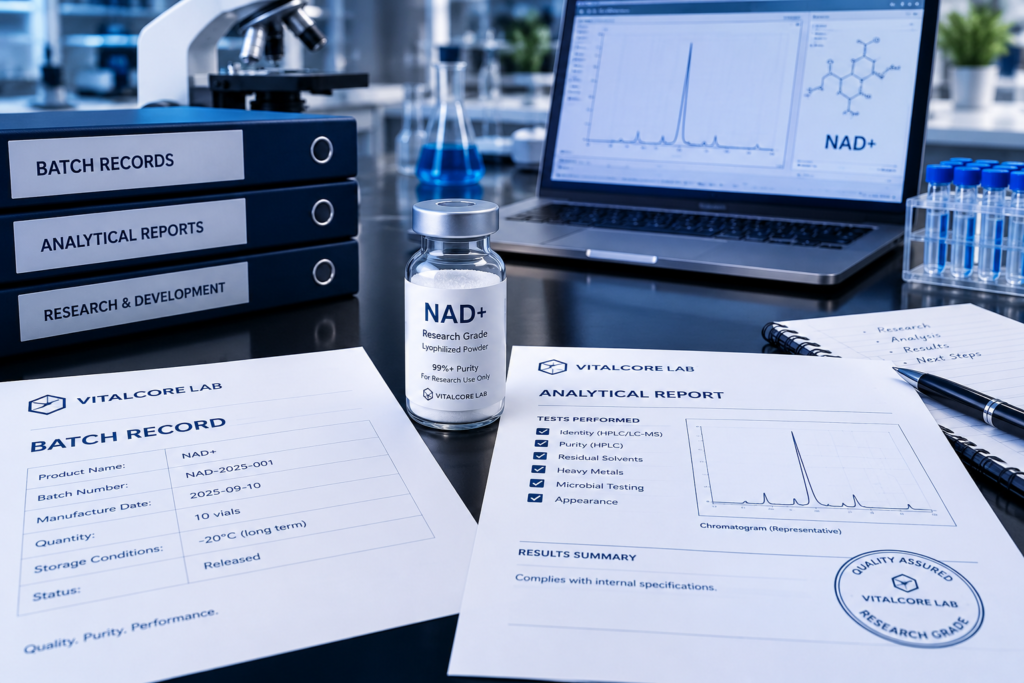
Good scientific research depends on more than an interesting biological mechanism. It also depends on the quality of the materials, the accuracy of analytical methods, and the clarity of the supporting documentation.
For research involving NAD+ or related compounds, investigators should consider the identity of the material, its purity where relevant, analytical methods, storage requirements, and batch-specific documentation.
Why analytical documentation matters
A certificate of analysis (COA), when available and appropriate, can provide information about a tested material and the analytical methods used.
However, the value of a COA depends on its scope. Researchers should check the material identity, batch number, test method, reported results, and the identity of the testing laboratory where applicable.
A purity result alone does not prove biological activity, effectiveness, or suitability for every experimental application.
Interpreting findings responsibly
Scientific reports should distinguish established biochemical functions from hypotheses and early-stage findings.
For example, the role of NAD+ in electron transfer is well established. By contrast, claims that a specific NAD+ precursor reverses human aging or guarantees improved mitochondrial function require much stronger evidence than a change in a laboratory biomarker.
Clear distinctions help readers understand both the significance and the limits of current research.
Frequently Asked Questions About NAD+ Research
What is NAD+?
NAD+ is a coenzyme involved in cellular energy metabolism and numerous enzyme reactions. It supports electron transfer and serves as a substrate for enzymes such as sirtuins and PARPs.
What is the connection between NAD+ and mitochondria?
NAD+ accepts electrons during metabolic reactions and becomes NADH. NADH then contributes electrons to the mitochondrial respiratory chain, helping support ATP production.
How does NAD+ relate to sirtuins?
Sirtuins are NAD+-dependent enzymes involved in gene regulation, metabolism, and cellular stress responses. Their activity depends on NAD+ availability and other biological factors.
What is the role of PARP enzymes?
Certain PARP enzymes use NAD+ to add ADP-ribose units to proteins. This activity contributes to DNA damage responses and other cellular processes.
Are NR and NMN peptides?
No. Nicotinamide riboside and nicotinamide mononucleotide are small molecules associated with NAD+ biosynthesis. They are not peptides.
Does increasing NAD+ prove that aging has been reversed?
No. A change in NAD+ levels does not by itself establish slower aging, improved health, or a clinical benefit. Those outcomes require separate evidence.
Is NAD+ the only factor controlling mitochondrial energy?
No. Mitochondrial energy production depends on multiple factors, including metabolic substrates, oxygen, enzyme activity, membrane integrity, and the electron transport chain.
Conclusion: Why NAD+ Research Matters
NAD+ is a central component of cellular metabolism. It supports electron transfer, helps power mitochondrial ATP production, and serves as a substrate for proteins involved in cellular signaling and DNA damage responses.
Its relationship with sirtuins, PARPs, and mitochondrial biogenesis makes it an important subject in research on metabolism and aging. In addition, NR and NMN provide useful examples of how scientists investigate the pathways that maintain cellular NAD+.
Nevertheless, the science requires careful interpretation. Changes in NAD+ levels do not automatically translate into better mitochondrial function or slower human aging. Researchers must assess biochemical markers alongside functional outcomes and well-designed studies.
For Vital Core Lab readers, understanding these mechanisms provides a stronger foundation for evaluating new findings in cellular energy and mitochondrial biology. Continued research will help clarify which NAD+-related mechanisms are most important and how laboratory findings translate into meaningful biological outcomes.
Scientific note: This article is educational and discusses biological research. It does not establish the safety or effectiveness of any intervention or provide medical advice.



Excellent article on NAD+ dynamics! When evaluating NAD+ in cellular signaling or redox models, do you find researchers getting better outcomes combining it with precursor pathway studies (like NMN/NR) or running isolated high-purity NAD+ protocols? Looking forward to more articles from Vital Core Lab!
Thank you for taking the time to share your thoughts! When evaluating redox dynamics, high-purity NAD+ offers rapid intracellular bioavailability, whereas precursors like NMN or NR feed the salvage pathway for sustained biosynthesis over time. Many advanced research frameworks now explore dual protocols to optimize both immediate systemic availability and long-term enzyme kinetics. We appreciate your engagement and have more deep dives on cellular energy coming up