🧠 Semax vs. Selank: Understanding BDNF, Focus, and Stress Research
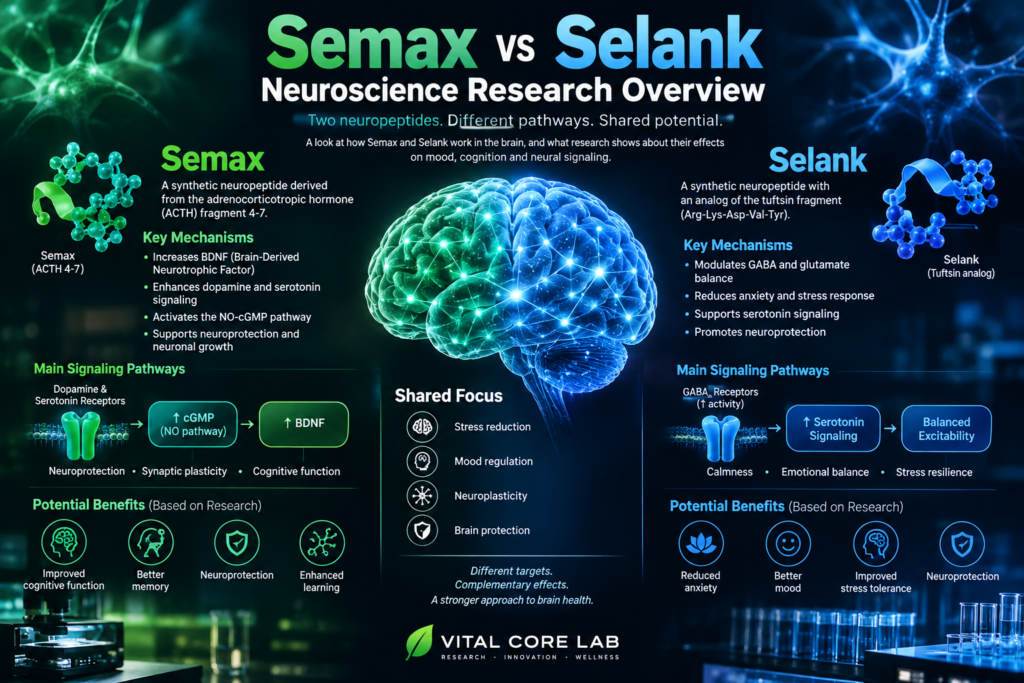
Semax vs Selank is an increasingly discussed comparison in neuroscience research. Both are synthetic peptide-related compounds developed in Russia, and both have attracted interest because of their potential effects on processes linked to brain function. However, they have different research histories and proposed mechanisms.
Semax is commonly investigated in relation to neurotrophic signaling, including brain-derived neurotrophic factor (BDNF). Selank has received attention for research into stress-related signaling, emotional behavior, and neurotransmitter systems. These areas overlap, but the compounds should not be treated as interchangeable.
At Vital Core Lab, our goal is to make complex scientific topics easier to understand. This guide reviews the backgrounds of Semax and Selank, explains the pathways researchers investigate, and highlights the limits of current evidence.
Importantly, interest in a compound does not establish that it improves memory, concentration, or mental health in people. Research findings depend on the study design, model, dose, and outcome measured. Both compounds require careful scientific evaluation.
🔬 What Is Semax? Exploring BDNF and Neurotrophic Signaling
Semax is a synthetic peptide derived from a fragment of adrenocorticotropic hormone (ACTH). It was developed and studied primarily in Russia. Researchers have investigated its possible relationship with neurotrophic factors, transmission, and other processes involved in nervous system function.
One major area of interest is brain-derived neurotrophic factor, commonly known as BDNF. This protein supports neuronal survival, synaptic function, and forms of neuroplasticity. Neuroplasticity describes the ability of the nervous system to change its connections and activity in response to experience or other signals.
How BDNF fits into Semax research
BDNF interacts with receptors, including tropomyosin receptor kinase B (TrkB). This signaling system is involved in pathways associated with neuronal maintenance and synaptic adaptation.
Semax research has explored whether the compound may influence BDNF-related activity and other molecular signals. However, a reported change in a biomarker does not automatically prove a meaningful improvement in human cognition.
Several questions remain important:
- Does an observed effect occur consistently across independent studies?
- Is the effect seen in animals, cell models, or human participants?
- Does a change in a signaling marker correspond to a measurable functional outcome?
- Are the effects sustained, and what adverse effects may occur?
These questions help separate a plausible biological mechanism from a demonstrated clinical benefit.
Semax and cognitive research
Researchers have examined Semax in relation to attention, memory, and neurological function. Some published research, particularly from Russia, has explored clinical or experimental applications. Nevertheless, study quality, independent replication, sample size, and the relevance of specific findings to broader populations must all be considered.
Semax should not be described as a proven cognitive enhancer for healthy people. Strong claims about improved intelligence, productivity, or long-term brain protection go beyond what can be concluded from limited evidence.
🌿 What Is Selank? Exploring Stress-Related Signaling
Selank is a synthetic peptide based on the structure of tuftsin, an endogenous peptide fragment associated with immune function. It was developed in Russia and has been studied for potential effects on anxiety-related behavior, stress responses, and nervous system signaling.
Selank research differs in emphasis from the BDNF-centered interest often associated with Semax. Researchers have investigated possible interactions with neurotransmitter systems and other mechanisms that may contribute to behavioral responses.
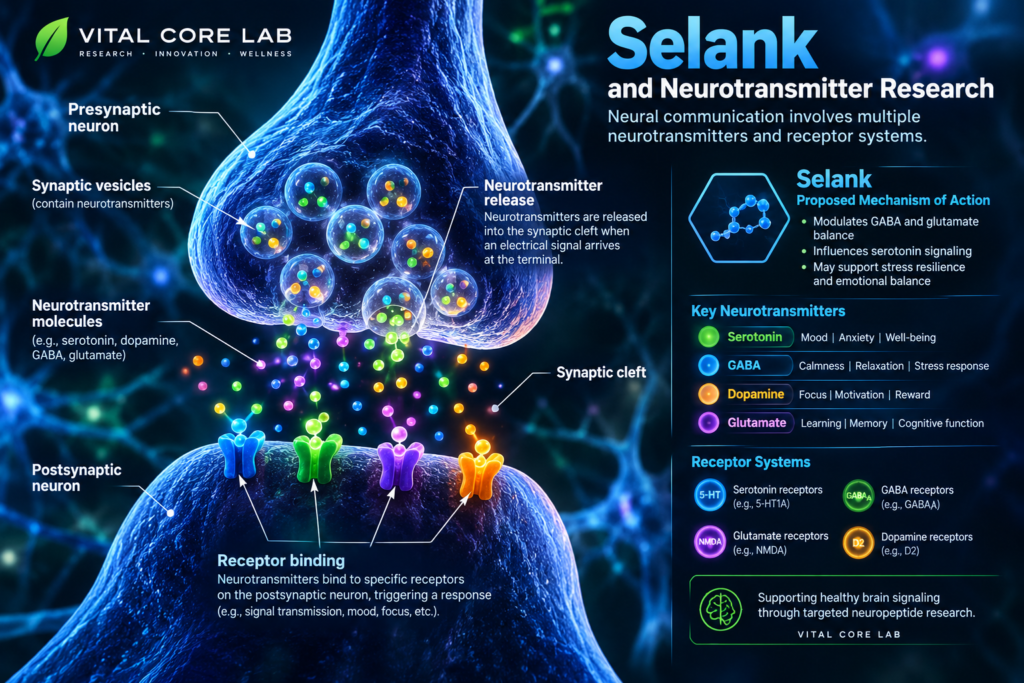
Selank and neurotransmitter systems
Neurotransmitters are chemical messengers that allow nerve cells to communicate. Systems involving gamma-aminobutyric acid (GABA), serotonin, and other signaling molecules play important roles in mood, arousal, and stress responses.
Some research has proposed that Selank may influence aspects of these systems. However, proposed mechanisms should not be confused with a fully established explanation of how the compound acts in humans.
It is also important not to reduce anxiety or stress to a single neurotransmitter. These experiences involve interacting brain networks, environmental factors, physiology, and individual differences.
Selank and stress-response research
Research interest in Selank includes anxiety-related behaviors and stress-associated processes. Some studies have investigated its effects in specific clinical or experimental settings, but the available evidence should be evaluated carefully before drawing broad conclusions.
In particular, evidence from a small study or a specific population may not apply to healthy adults generally. Findings also cannot establish that Selank is a substitute for approved mental health care.
For scientific communication, the most accurate description is that Selank is an investigational compound studied in relation to stress-related and neurochemical pathways.
📊 Semax vs. Selank: Key Research Differences
Although Semax and Selank are both associated with neuroscience research, their origins, areas of interest, and proposed mechanisms differ.
| Research feature | Semax | Selank | Background | Synthetic peptide based on an ACTH fragment | Synthetic peptide based on tuftsin | Common research focus | Neurotrophic signaling and neurological function | Stress-related behavior and neurotransmitter signaling | Pathways discussed | BDNF-related signaling and neuroplasticity | GABA-related and other neurochemical systems | Evidence base | Includes experimental and region-specific clinical research | Includes experimental and region-specific clinical research | Main limitation | Mechanisms and outcomes need broader independent validation | Mechanisms and outcomes need broader independent validation | General conclusion | Not established as a universal cognitive enhancer | Not established as a universal anxiety treatment |
|---|
This comparison describes research themes rather than proving that either compound produces a particular outcome. Research focus is not the same as demonstrated effectiveness.
🧬 What Is BDNF, and Why Does It Matter?
BDNF is a neurotrophic protein that helps regulate the development, maintenance, and adaptability of neurons. It is important in several processes associated with learning and memory.
BDNF and synaptic plasticity
Synapses are communication points between neurons. Their strength and organization can change over time. These changes are part of synaptic plasticity, a process involved in learning and memory.
BDNF can influence synaptic function through receptor-mediated pathways. This makes BDNF relevant to neuroscience research, including studies of neuronal adaptation and responses to injury.
However, BDNF is not a simple score for brain performance. Its effects depend on biological context, location, timing, and interactions with other signaling systems.
Does more BDNF always mean better cognition?
No. A biological system rarely follows such a simple rule. The presence or concentration of a biomarker alone cannot establish a beneficial effect. Researchers must assess the biological setting, the methods used to measure the marker, and functional outcomes.
Therefore, claims that Semax reliably boosts BDNF and thereby improves memory in everyone should be treated cautiously.

🧠 Neuroplasticity, Focus, and Memory: What the Science Can Tell Us
Neuroplasticity refers to changes in neural connections and function. It occurs throughout life and is influenced by learning, sleep, physical activity, stress, and many other factors.
Because Semax and Selank have been studied in relation to nervous system signaling, discussions sometimes connect them with attention, memory, or cognitive performance. Yet the presence of a plausible mechanism does not prove a measurable benefit.
How researchers measure cognition
Studies may use memory tests, attention tasks, reaction-time measures, questionnaires, or neurological assessments. Each method measures a different aspect of function.
A reliable conclusion requires appropriate controls, clear outcome measures, adequate sample sizes, and independent replication. Researchers must also account for factors such as sleep, baseline health, expectation effects, and other influences on performance.
Why research models matter
A result in a cell model cannot directly establish an effect in a living person. Likewise, animal findings may help researchers investigate mechanisms but cannot guarantee human safety or effectiveness.
Human studies also vary in quality. Small samples, lack of blinding, and limited follow-up can make findings uncertain. This is why balanced reviews distinguish preliminary results from well-established evidence.
🧪 How to Evaluate Semax and Selank Studies
A useful research review looks beyond a headline or an isolated result. It asks whether the study provides enough information to support the conclusion.
Study design and independent replication
First, examine whether the research was conducted in cells, animals, or humans. Then review the number of participants, comparison groups, blinding, and length of follow-up.
Next, look for independent studies that reach similar conclusions. A result repeated by different research teams is generally more informative than a single finding, although replication alone does not resolve every question.
Safety and reporting quality
A complete review considers adverse events, exclusions, limitations, and conflicts of interest. It also examines whether the researchers reported negative or inconclusive results.
The absence of reported adverse effects in a small study does not prove that a compound is safe. Rare events and long-term risks may be difficult to identify without larger, longer studies.

⚖️ Safety, Regulatory Status, and Research Limitations
Semax and Selank should not be assumed to have the same regulatory status in every country. Approval, permitted uses, product standards, and import rules can differ by jurisdiction and may change over time.
Neither compound should be presented as an established treatment for anxiety, memory disorders, neurological disease, or other medical conditions based solely on mechanistic research or preliminary studies.
Potential risks may include unknown adverse effects, product-quality concerns, uncertain interactions, and limited information about long-term exposure. The extent of these risks depends on the compound, formulation, and context.
For that reason, laboratory research should use appropriately characterized materials and follow relevant institutional and legal requirements. Research materials should not be represented as approved medicines when that status has not been established.
People considering a substance for personal medical use should consult a qualified healthcare professional rather than relying on promotional claims or experimental research.
🔍 Semax vs. Selank: Common Questions
Are Semax and Selank the same compound?
No. They have different peptide origins and distinct research histories. Semax is commonly discussed in relation to neurotrophic signaling, while Selank is often studied in relation to stress-associated and neurochemical pathways.
Is Semax proven to improve memory?
Current evidence does not justify describing Semax as a proven memory enhancer for the general population. Findings must be interpreted according to the study design, population, and measured outcomes.
Is Selank a proven treatment for anxiety?
Selank has been investigated for anxiety-related effects, but this does not establish it as a proven or approved treatment in every jurisdiction. Evidence and regulatory status must be evaluated separately.
What does BDNF do in the brain?
BDNF is involved in neuronal maintenance and synaptic plasticity. It supports processes relevant to learning and memory, but a change in BDNF alone does not prove a cognitive benefit.
Can animal studies establish human safety?
No. Animal studies can provide valuable information about biological mechanisms and possible risks, but they cannot establish human safety or effectiveness by themselves.
📚 Conclusion: Understanding Semax vs. Selank Research
Semax vs Selank is a useful comparison for understanding two different areas of experimental neuroscience. Semax is frequently discussed in relation to BDNF and neurotrophic signaling, while Selank has been investigated for stress-related behavior and neurotransmitter systems.
Both compounds raise scientific questions worth examining. However, proposed mechanisms, preliminary findings, and demonstrated clinical benefits are not interchangeable.
A responsible assessment considers study quality, independent replication, safety reporting, and regulatory status. It avoids treating a research hypothesis as a guaranteed result.
At Vital Core Lab, we believe clear scientific education should help readers distinguish what researchers are investigating from what the evidence has actually established.
Research note: This article is for scientific education only. It is not medical advice and does not recommend the use of experimental compounds for self-treatment.