BPC-157 Explained: What Researchers Study About This Peptide
BPC-157 is a peptide that has attracted growing interest in laboratory research. BPC-157 research has focused on several biological processes, including cellular signaling, tissue biology, vascular responses, and gastrointestinal research. As interest in peptide science continues to grow, BPC-157 has become one of the peptides frequently discussed in experimental research.
But what exactly is BPC-157? What are researchers studying? And why has this peptide received so much scientific attention?
This guide explains the current research interest surrounding BPC-157 in simple terms. It looks at its scientific background, proposed biological activity, research areas, and the questions researchers are still investigating.
Research note: BPC-157 is discussed here as a laboratory research peptide. This article does not provide medical advice, treatment instructions, dosing instructions, or protocols for human use.
What Is BPC-157?
BPC-157 is a synthetic peptide that has been studied in experimental biological research. The name refers to a sequence associated with a larger body-protective peptide concept that has been investigated in laboratory settings.
Peptides are short chains of amino acids. They can participate in many biological processes. Some peptides act as signaling molecules. Others can interact with receptors, proteins, membranes, or cellular pathways.
BPC-157 has gained attention because experimental research has explored its possible relationship with several biological systems.
However, it is important to separate research findings from established clinical conclusions.
A compound can produce an interesting result in an experimental model without proving that the same effect occurs in humans.
That distinction is especially important when discussing BPC-157.
Why Is BPC-157 Getting So Much Research Attention?
There are several reasons.
First, researchers are interested in peptides because of their ability to interact with biological systems in specific ways.
Second, BPC-157 has appeared in experimental research involving different types of tissue and cellular processes.
Finally, the peptide has generated interest across multiple research fields rather than being associated with only one biological question.
Researchers have therefore investigated BPC-157 in areas such as:
- Tissue biology
- Cellular signaling
- Gastrointestinal research
- Vascular research
- Inflammation-related pathways
- Oxidative stress research
- Connective-tissue research
- Experimental recovery models
- Molecular and receptor-related research
These areas make BPC-157 an interesting subject for continued laboratory investigation.
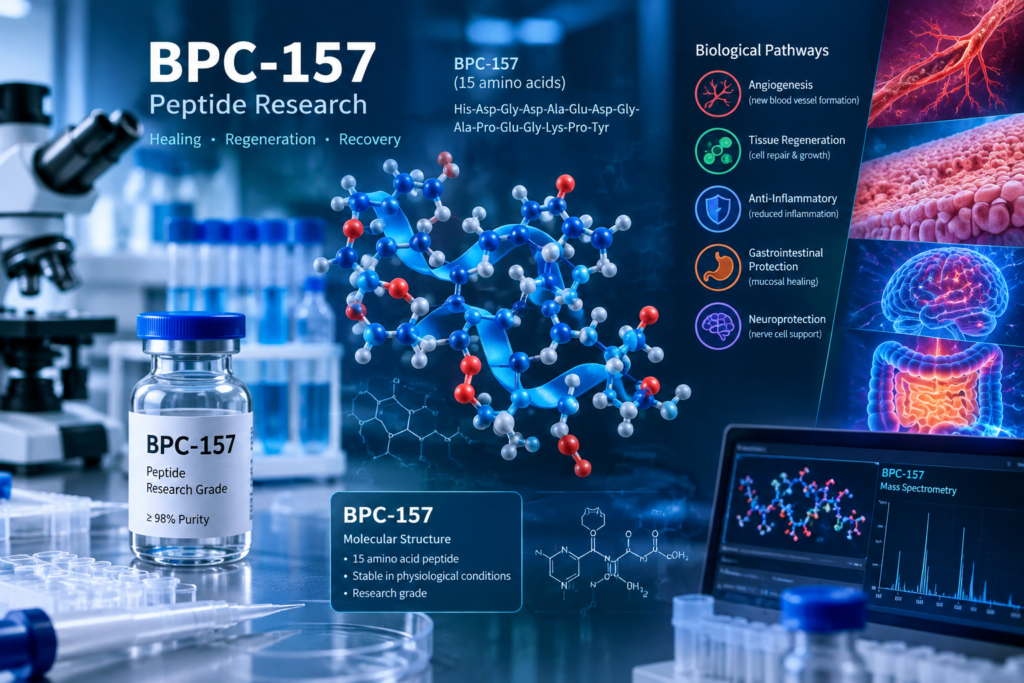
How Does BPC-157 Relate to Peptide Research?
To understand why researchers study BPC-157, it helps to understand how peptide research works.
A peptide is not simply a small version of a protein. Its structure can influence how it interacts with other biological molecules.
Researchers can investigate these interactions using different experimental models.
For example, scientists may examine:
Cellular responses
Researchers can study how cells respond when exposed to a particular peptide under controlled conditions.
These experiments can provide information about signaling pathways and molecular activity.
Tissue models
Laboratory models can also be used to investigate how certain compounds relate to tissue-level processes.
This does not automatically mean that the compound produces the same response in people. Instead, it gives researchers a starting point for further investigation.
Molecular signaling
Another important area is signaling.
Cells communicate through complex networks. Peptides may influence specific signaling processes, depending on their structure and biological environment.
BPC-157 has therefore become interesting to researchers examining how peptide compounds interact with biological pathways.
What Are Researchers Studying About BPC-157?
There is no single research question surrounding BPC-157.
Instead, researchers have investigated several different areas.
This is one reason the peptide continues to attract scientific interest.
1. Tissue Biology
One of the most discussed areas of BPC-157 research involves tissue biology.
Researchers have examined experimental models related to different types of tissue.
The goal is not simply to ask whether a tissue changes.
Instead, researchers want to understand why a biological response might occur.
They may examine cellular activity, molecular signaling, vascular responses, and other biological markers.
This approach can help scientists understand how a peptide interacts with a biological system.
2. Gastrointestinal Research
BPC-157 has also been studied in experimental gastrointestinal models.
The gastrointestinal system contains many different cell types and signaling pathways. It also interacts closely with vascular, immune, and nervous-system processes.
Because of this complexity, researchers are interested in understanding how experimental compounds behave within gastrointestinal research models.
BPC-157 has therefore appeared in research examining gastrointestinal biology.
However, laboratory findings should not be interpreted as proof that BPC-157 is an established treatment for gastrointestinal conditions.
More research is needed to determine the significance of experimental findings.
3. Vascular and Blood-Vessel Research
Another area of interest involves vascular biology.
Blood vessels are essential for transporting oxygen, nutrients, hormones, and other substances throughout the body.
Researchers can examine how experimental compounds relate to vascular signaling and blood-vessel biology.
BPC-157 has been investigated in experimental models involving these processes.
This has contributed to interest in the peptide among researchers studying tissue and cellular responses.
Importantly, research findings in animal or laboratory models do not establish a proven human effect.
That is why researchers continue to investigate the underlying mechanisms.

BPC-157 and Cellular Signaling
Cellular signaling is one of the most important concepts in peptide research.
Cells constantly receive and send signals.
These signals can influence:
- Cell activity
- Protein production
- Gene expression
- Cellular communication
- Metabolic processes
- Tissue responses
Researchers studying BPC-157 are interested in whether the peptide interacts with specific biological signaling systems.
This is where laboratory research becomes especially important.
Rather than simply observing an outcome, scientists can investigate the molecular steps behind that outcome.
For example, researchers may examine whether certain signaling molecules increase or decrease after experimental exposure.
They may also compare treated and untreated experimental models.
This helps researchers develop hypotheses about possible mechanisms.
Understanding the Proposed Mechanisms
The biological mechanisms associated with BPC-157 remain an area of ongoing investigation.
Researchers have proposed relationships involving several signaling systems and biological processes.
However, not every proposed mechanism has been equally established.
Some findings come from animal research.
Others come from laboratory models.
Still others are based on molecular observations.
Therefore, it is important to use careful language.
Instead of saying that BPC-157 proves a particular effect, scientific writing should describe what researchers are investigating.
This distinction helps keep peptide research accurate and responsible.
BPC-157 Research and Oxidative Stress
Oxidative stress is another concept that appears in experimental biology.
Cells naturally produce reactive molecules during normal biological activity.
The body has systems that help manage these molecules.
Researchers can study oxidative stress by examining different cellular markers.
BPC-157 has been included in experimental research examining biological responses associated with oxidative stress.
This does not mean BPC-157 should be viewed as an established antioxidant treatment.
Instead, it means researchers are interested in how the peptide may interact with biological processes associated with cellular stress.
That distinction is important.
Research can identify an interesting biological signal without establishing a practical application.
Why Researchers Use Experimental Models
A major part of understanding BPC-157 research is knowing how experimental science works.
Researchers often begin with controlled laboratory models.
These models allow scientists to examine specific biological questions.
For example, researchers may want to know:
- Does a peptide interact with a specific pathway?
- Does cellular behavior change?
- Are certain molecular markers affected?
- Does the response depend on the experimental environment?
- Are the findings consistent across different models?
These questions can gradually build scientific knowledge.
However, laboratory research is only one stage of scientific investigation.
A result observed in an experimental model does not automatically translate into a human outcome.
That is why further research is necessary.
BPC-157 Research vs. Human Clinical Evidence
This is one of the most important points to understand.
There is a significant difference between experimental research and clinical evidence.
Experimental research can provide useful information about biological activity.
Clinical research is designed to determine whether a compound is safe and effective for a particular use in people.
These are different questions.
For BPC-157, much of the scientific discussion has centered around experimental research.
Therefore, readers should be cautious about online claims that describe BPC-157 as a proven solution for a specific medical condition.
Scientific evidence needs to be evaluated according to the quality, design, and limitations of the research.
Key Areas of BPC-157 Research
The following table summarizes major research areas associated with BPC-157.
| Research Area | What Researchers Investigate | Why It Matters |
|---|---|---|
| Tissue Biology | Cellular and tissue responses | Helps researchers understand biological activity |
| Gastrointestinal Research | Experimental gastrointestinal models | Provides insight into peptide-related biological responses |
| Vascular Biology | Blood-vessel and signaling processes | Helps examine vascular mechanisms |
| Cellular Signaling | Molecular communication pathways | May reveal how biological responses occur |
| Oxidative Stress | Cellular stress markers | Helps researchers study cellular responses |
| Connective-Tissue Research | Experimental tissue models | Provides information for further investigation |
What Makes BPC-157 Different From Many Other Peptides?
There are many peptides being investigated today.
Some focus heavily on metabolic pathways.
Others are studied for receptor activity, cellular signaling, or structural biology.
BPC-157 is notable because researchers have investigated it across several biological areas.
That broader research interest makes it useful for studying how peptide compounds can interact with complex biological systems.
At the same time, broad research interest should not be confused with proven clinical effectiveness.
In science, the number of research questions surrounding a compound does not automatically determine whether that compound is clinically useful.
Evidence quality matters more.

What Are Researchers Still Trying to Understand?
Despite the amount of interest around BPC-157, many questions remain.
Researchers continue to investigate the biological mechanisms behind experimental observations.
Important questions include:
How does BPC-157 interact with biological pathways?
Understanding molecular interactions is essential.
Researchers want to identify which pathways may be involved and whether those pathways are directly or indirectly affected.
Are experimental findings consistent?
Scientific findings become stronger when they can be repeated.
Researchers therefore need consistent results across different experiments and models.
What happens at the molecular level?
Observing a biological change is only the beginning.
Scientists also want to understand the molecular explanation behind that change.
How relevant are laboratory findings to humans?
This is one of the biggest questions.
Animal models and laboratory systems can provide useful information. However, they cannot fully reproduce human biology.
Human research is therefore necessary to determine clinical relevance.
BPC-157 and the Future of Peptide Research
Peptide research continues to expand.
New analytical tools allow scientists to examine molecular interactions in greater detail.
At the same time, advances in biotechnology make it easier to investigate peptide structure and biological activity.
BPC-157 remains part of this broader research landscape.
Future research may provide more information about its molecular mechanisms, biological interactions, and potential research applications.
However, good science requires patience.
Researchers need reproducible data.
They need appropriate experimental controls.
They also need well-designed studies that can answer specific questions.
For this reason, the future of BPC-157 research will depend not simply on how much attention the peptide receives, but on the quality of evidence produced.
How to Evaluate BPC-157 Information Online
The internet contains a large amount of information about BPC-157.
Unfortunately, not all of it is reliable.
Some pages describe experimental findings as established facts.
Others make claims that go beyond the available research.
A better approach is to ask a few basic questions.
Is the claim supported by research?
Look for actual scientific evidence rather than promotional statements.
What type of study was performed?
An animal study, cell study, observational study, and controlled human trial provide different levels of evidence.
Does the article distinguish research from treatment?
Reliable scientific content should clearly separate experimental findings from medical claims.
Are limitations discussed?
Good research reporting includes limitations.
If an article only discusses potential benefits while ignoring limitations, readers should be cautious.

BPC-157 as a Research Peptide
For laboratory researchers, the value of a research peptide depends heavily on documentation and product consistency.
Researchers need to know what material they are working with.
That is why product information can be important.
Useful documentation may include:
- Product identity
- Peptide name
- Stated purity
- Lot or batch information
- Analytical documentation
- Storage information
- Product specifications
- Research-use information
Clear documentation makes it easier to understand the material being studied.
It also supports better laboratory record keeping.
For research suppliers, transparency is therefore an important part of responsible peptide distribution.
Why Purity Information Matters
Purity is an important consideration in analytical and laboratory research.
Researchers want to minimize uncertainty around the material being evaluated.
Analytical testing can help characterize a peptide sample.
Depending on the testing method, researchers may evaluate different characteristics of a sample.
A Certificate of Analysis, commonly called a COA, can provide useful batch-specific information.
However, a COA should be viewed as documentation about a particular batch rather than as proof of a medical effect.
That distinction is essential.
Storage and Handling Considerations
Research peptides can be sensitive to environmental conditions.
Researchers should always follow the storage and handling information supplied with the specific product.
Factors such as temperature, moisture, light, and handling conditions can affect laboratory materials.
Because storage requirements can vary between products and formulations, researchers should rely on the applicable product documentation rather than assuming that every peptide has identical requirements.
Good laboratory practice also includes maintaining appropriate records.
This can help researchers track materials and experimental conditions over time.

Frequently Asked Questions About BPC-157
What is BPC-157?
BPC-157 is a synthetic peptide that has been investigated in experimental research. Researchers have studied it in areas including tissue biology, cellular signaling, gastrointestinal models, vascular research, and oxidative stress.
Why are researchers studying BPC-157?
Researchers are interested in BPC-157 because experimental studies have explored several biological pathways and systems. Its broad research profile makes it an interesting subject for continued laboratory investigation.
Is BPC-157 well studied in humans?
The available research should be evaluated carefully, particularly when comparing experimental findings with human clinical evidence. Experimental findings do not automatically establish human effectiveness or safety.
What does BPC-157 research focus on?
Research has examined areas such as tissue biology, vascular processes, gastrointestinal models, cellular signaling, and other biological responses.
Does BPC-157 have an established medical use?
This article does not establish BPC-157 as a medical treatment. Research findings should not be interpreted as evidence that the peptide is approved or established for treating a particular condition.
Why are COAs important for research peptides?
A Certificate of Analysis can provide batch-specific analytical information. This can help researchers document and characterize the material used in laboratory work.
Final Thoughts: Why BPC-157 Remains an Interesting Research Topic
BPC-157 continues to attract attention because researchers have investigated the peptide across several areas of experimental biology.
Research has explored tissue biology, cellular signaling, gastrointestinal models, vascular processes, oxidative stress, and other biological systems.
However, scientific interest should not be confused with clinical proof.
That distinction matters.
The strongest way to understand BPC-157 is to look at the research itself, consider the type of study performed, and recognize the limitations of experimental models.
As peptide science continues to develop, future studies may provide a clearer picture of how BPC-157 interacts with biological systems.
For now, BPC-157 remains an interesting subject for laboratory research and scientific investigation.
The goal of good peptide research is not simply to ask what a compound might do. It is to understand how, why, and under what experimental conditions a biological response occurs.