



HGH Fragment 176-191 Overview
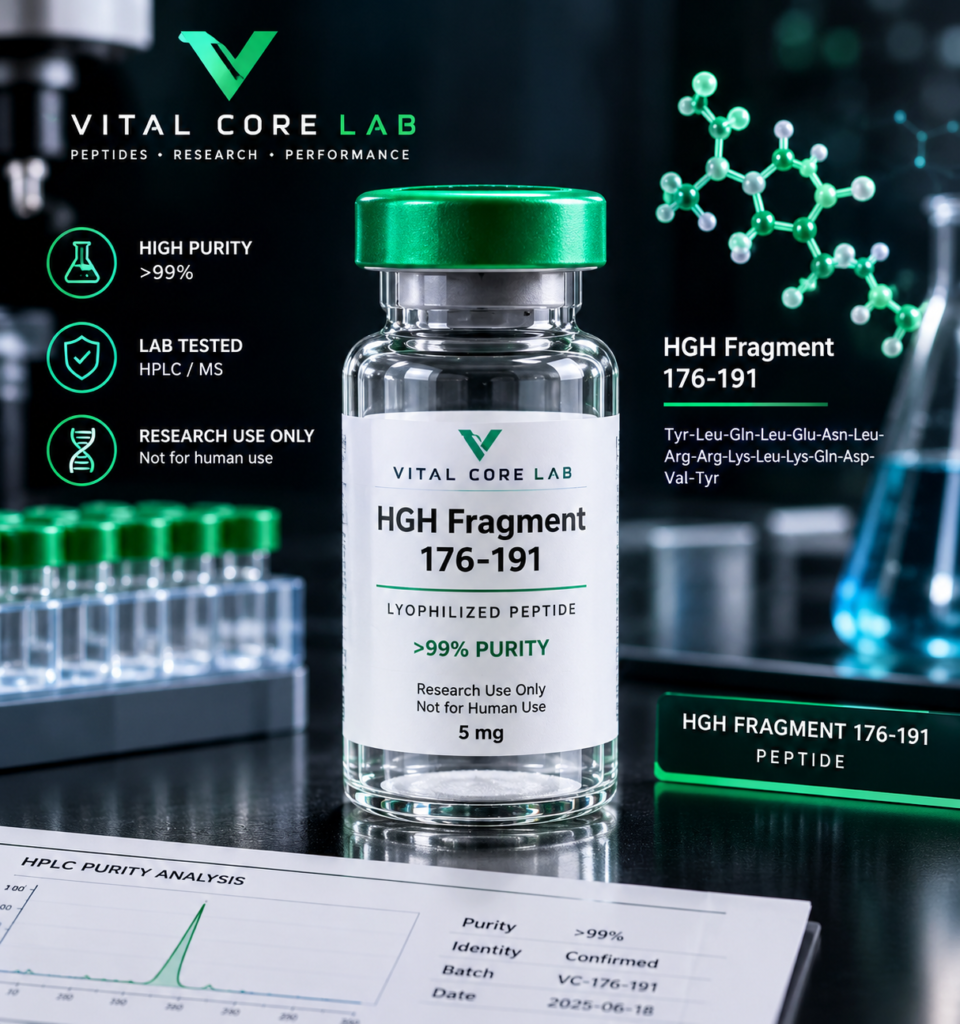
HGH Fragment 176-191 is a defined peptide fragment corresponding to amino acids 176 through 191 of human growth hormone. This short sequence is derived from the C-terminal region of the larger HGH 191 amino-acid chain. Because of its specific sequence, HGH Fragment 176-191 is commonly studied as a distinct peptide rather than as complete human growth hormone.
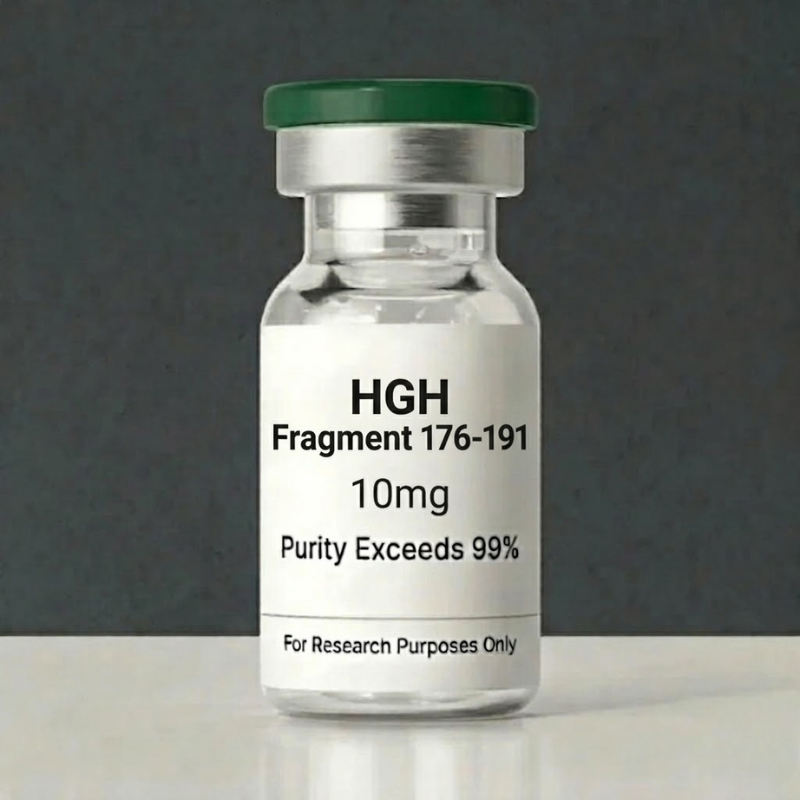
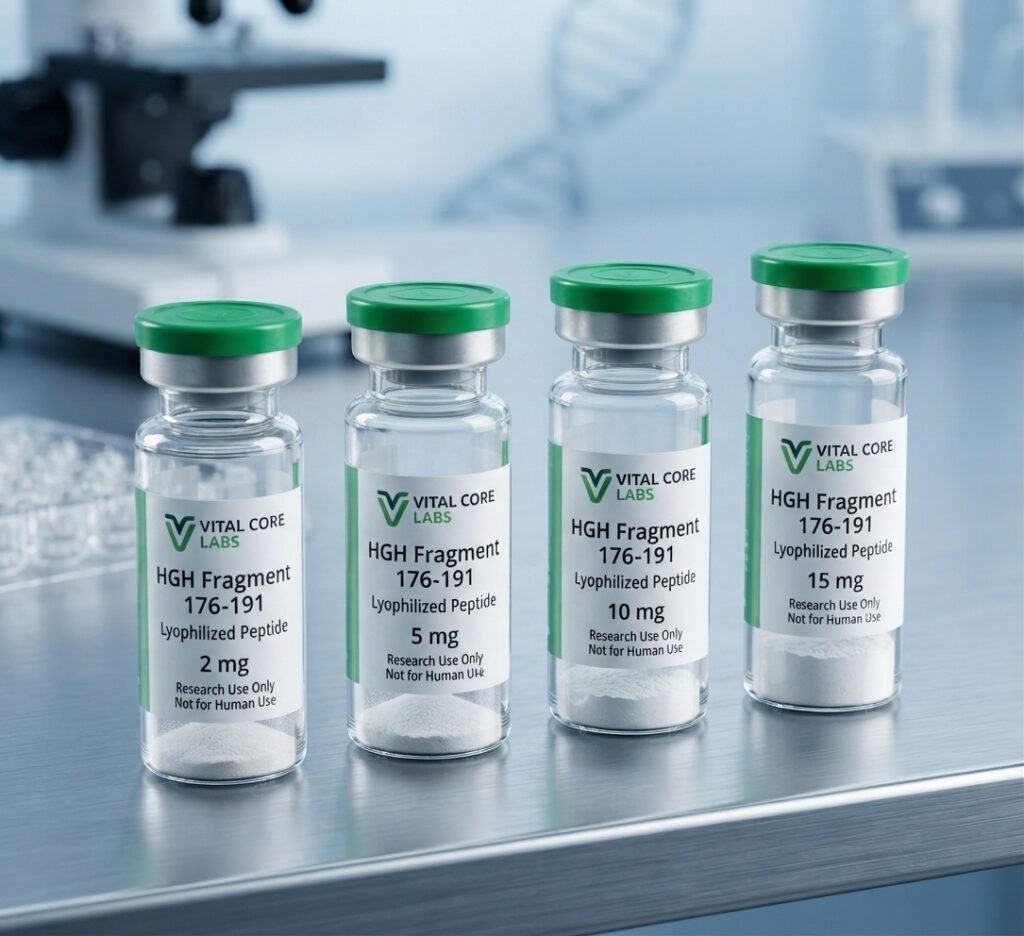
The peptide is supplied by Vital Core Lab in 2mg to 15mg vial formats with a stated purity of greater than 99%. Each format provides a clearly identified quantity for laboratory and analytical applications.
HGH Fragment 176-191 has attracted scientific interest because researchers can examine a smaller, structurally defined section of the growth hormone molecule. This makes the fragment useful when a study requires a peptide with a specific amino-acid sequence rather than the complete 191-amino-acid protein.
The product is presented as a lyophilized peptide powder. Lyophilization helps provide a stable solid format for storage and handling when maintained under appropriate conditions.
🧬 HGH Fragment 176-191 Peptide Identity
HGH Fragment 176-191 represents a 16-amino-acid segment from human growth hormone. Its identity is defined by its position within the parent HGH sequence.
Studying a peptide fragment can be useful for researchers who want to isolate a particular region of a larger protein. Instead of working with the entire growth hormone molecule, scientists can focus on the properties associated with this shorter sequence.
The distinction is important. HGH Fragment 176-191 is not the same product as full-length HGH 191AA. Full-length HGH contains the complete 191-amino-acid sequence, while this fragment represents only residues 176 through 191.
This smaller structure also provides a useful model for peptide characterization. Researchers may examine characteristics such as molecular identity, purity, peptide composition, and analytical behavior.
HGH Fragment 176-191 and Peptide Structure
Peptide structure is an important part of understanding HGH Fragment 176-191. The sequence contains 16 amino acids arranged in a defined order. That sequence gives the peptide its molecular identity.
Researchers working with peptide fragments often pay close attention to sequence accuracy. Even a small change in amino-acid composition can create a different peptide with different structural characteristics.
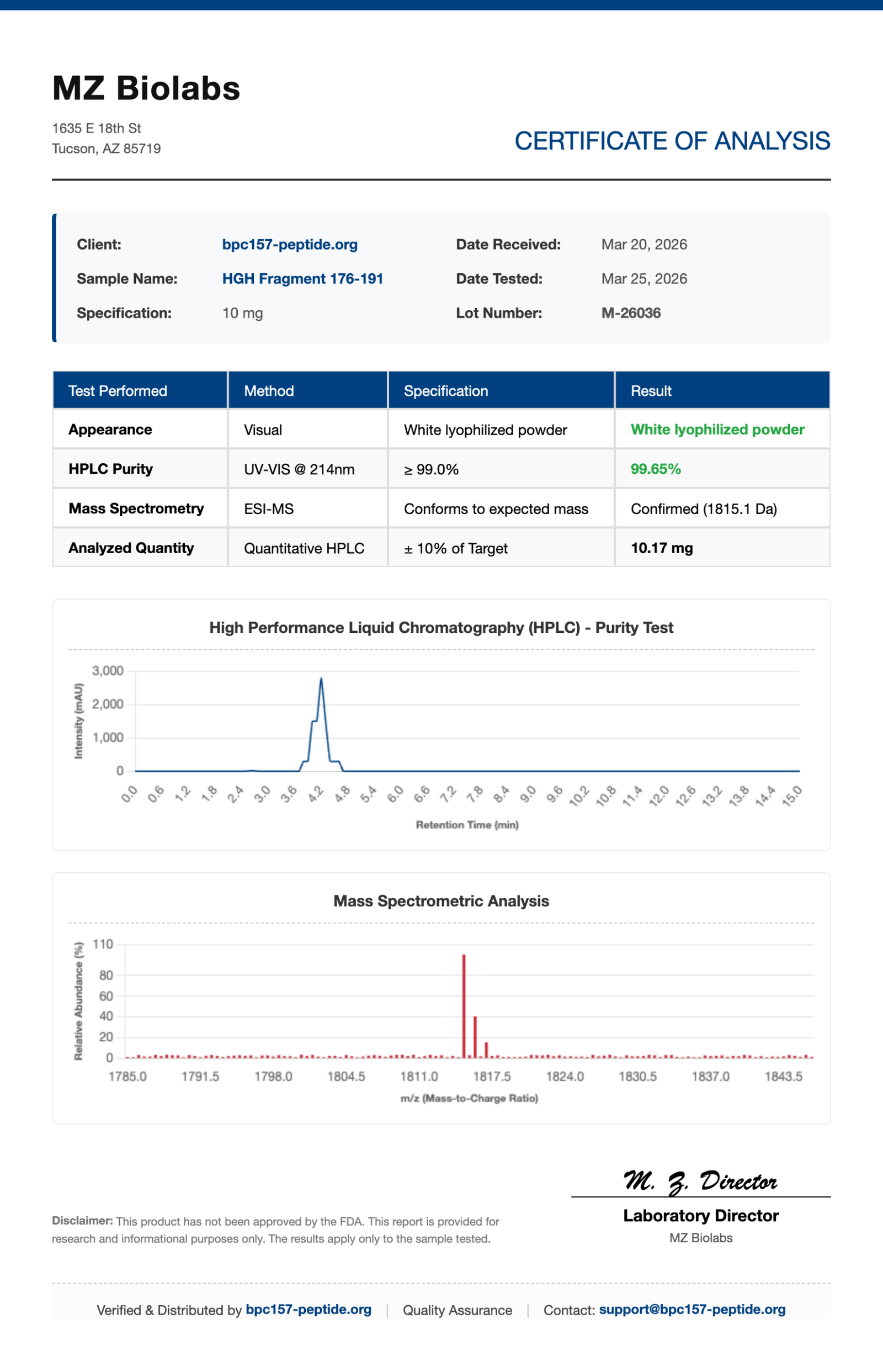
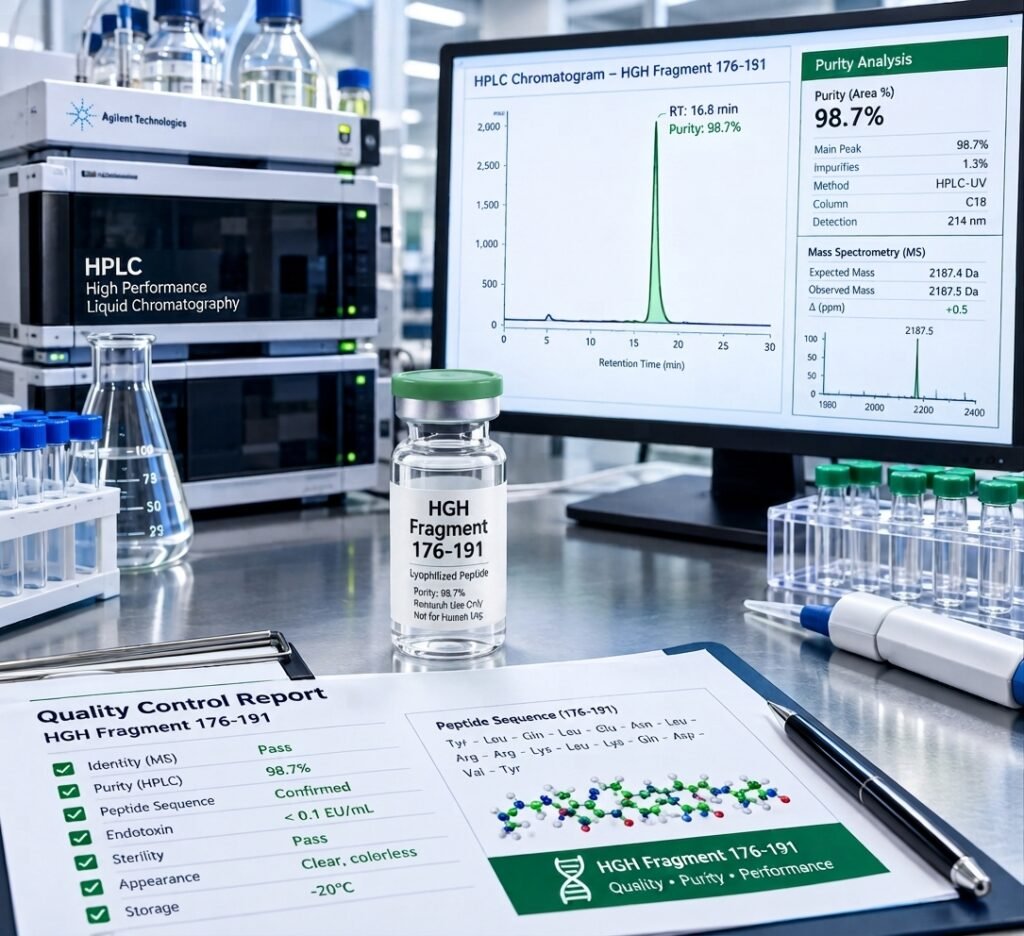
For this reason, analytical characterization is an important part of peptide quality assessment. Techniques such as mass spectrometry and chromatographic analysis can help confirm molecular identity and evaluate purity.
The stated >99% purity specification provides a useful quality benchmark for researchers selecting peptide materials. However, researchers should always review the applicable batch documentation and analytical data for the specific vial or lot being used.
🔬 Why Peptide Sequence Matters
A peptide sequence is more than simply a list of amino acids. The order of those amino acids determines the molecular structure of the peptide.
HGH Fragment 176-191 therefore provides a defined molecular target for analytical and experimental work. Its shorter sequence can also make it easier to compare with related peptide fragments or parent proteins.
At the same time, the fragment should be treated as its own molecular entity. Information about full-length HGH should not automatically be applied to HGH Fragment 176-191.
This distinction helps maintain clear scientific documentation. It also makes product records easier to organize when several peptide materials are being evaluated at the same time.
📋 HGH Fragment 176-191 Product Specifications
The available HGH Fragment 176-191 formats range from 2mg through 15mg per vial. This provides several quantity options for different laboratory workflows.
| Specification | Product Detail |
|---|---|
| Product | HGH Fragment 176-191 |
| Peptide region | Amino acids 176–191 |
| Sequence length | 16 amino acids |
| Format | Lyophilized peptide powder |
| Available quantity | 2mg – 15mg |
| Stated purity | >99% |
| Packaging | Sealed peptide vial |
| Intended setting | Laboratory and analytical applications |
The product format is designed around clear identification and straightforward handling. Each vial should remain properly labeled so that the peptide identity, quantity, and batch information can be tracked throughout its use.
HGH Fragment 176-191 Purity and Quality
Purity is one of the most important considerations when selecting a peptide. A high-purity material can help reduce the presence of unwanted peptide-related impurities and other components that could interfere with analytical work.
Vital Core Lab lists HGH Fragment 176-191 with a purity specification of >99%. This specification should be considered alongside the relevant batch documentation and analytical results.
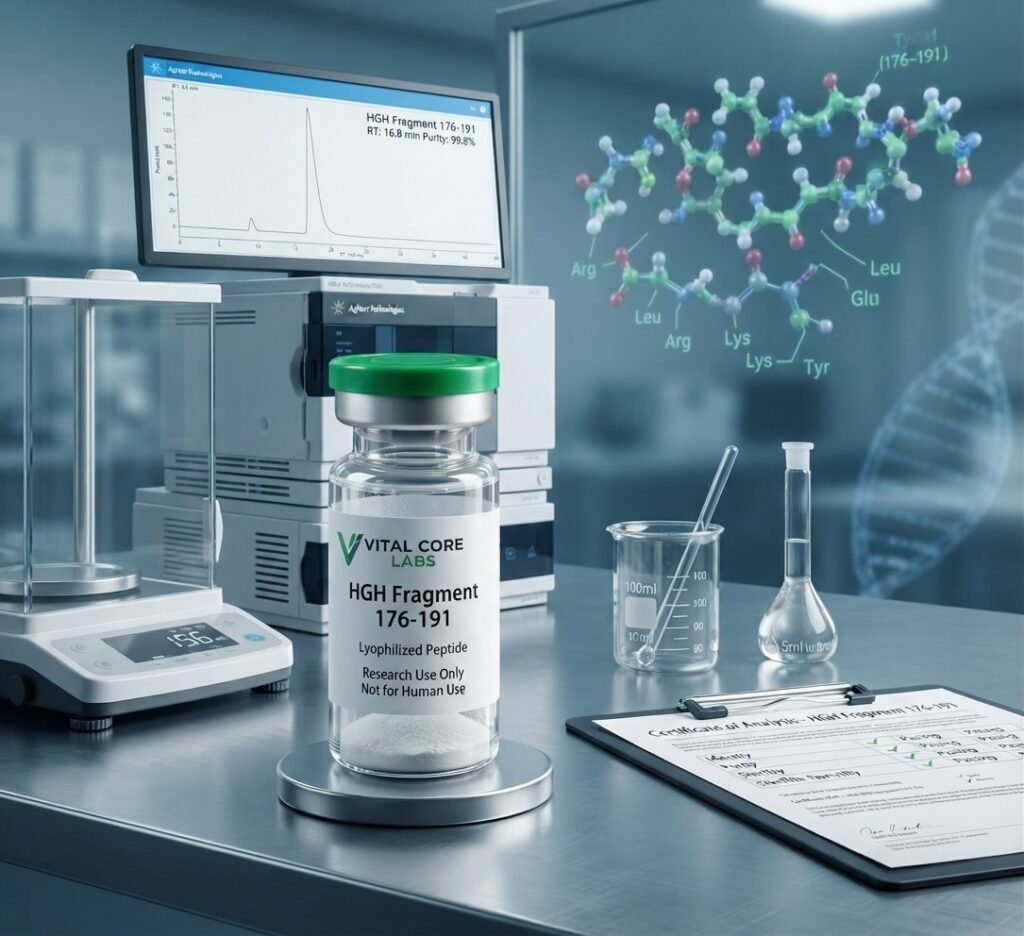
Quality evaluation may include several analytical approaches. Depending on the material and testing program, researchers may review chromatographic purity, molecular mass confirmation, appearance, and other available analytical measurements.
It is also important to distinguish between a stated product specification and a specific batch result. Product specifications describe the expected quality standard, while batch documentation provides information about an individual production lot.
🧪 Analytical Evaluation of HGH Fragment 176-191
Analytical peptide evaluation can involve multiple complementary techniques.
High-performance liquid chromatography, often abbreviated as HPLC, may be used to assess chromatographic purity. Mass spectrometry can help verify molecular mass and support identity confirmation.
Together, these methods provide a more complete picture of peptide quality.
For laboratories that maintain detailed sample records, recording the product name, batch information, quantity, storage conditions, and analytical documentation can improve traceability.
🧫 HGH Fragment 176-191 in Laboratory Studies
HGH Fragment 176-191 can serve as a defined peptide material for laboratory investigations involving peptide chemistry, molecular characterization, and comparative analysis.
Because the fragment represents a specific portion of the HGH sequence, it can be useful when researchers want to investigate that sequence independently.
For example, laboratory work may involve examining peptide identity, stability, analytical behavior, or interactions under controlled experimental conditions. The exact application depends on the study design and the analytical method being used.
Researchers can also compare HGH Fragment 176-191 with related peptide sequences. Such comparisons may help illustrate how sequence length and molecular composition influence peptide characteristics.
Importantly, these applications should be considered within controlled laboratory settings. Product information should not be interpreted as a statement of clinical performance or as a recommendation for human administration.
HGH Fragment 176-191 Compared With Full-Length HGH
Although HGH Fragment 176-191 originates from the human growth hormone sequence, it should not be confused with full-length HGH.
Full-length HGH 191AA contains 191 amino acids. HGH Fragment 176-191 contains only the final 16 amino acids represented by positions 176 through 191.
That difference creates an important distinction in product identity.
The full-length protein has a much larger molecular structure. In contrast, the fragment provides a shorter and more specifically defined peptide sequence.
This makes HGH Fragment 176-191 useful for studies where researchers need to examine a peptide fragment independently from the complete protein.
📊 Fragment vs. Full-Length HGH
| Feature | HGH Fragment 176-191 | Full-Length HGH 191AA |
|---|---|---|
| Molecular type | Peptide fragment | Complete protein |
| Sequence region | Residues 176–191 | Residues 1–191 |
| Sequence length | 16 amino acids | 191 amino acids |
| Structural size | Smaller peptide | Larger protein |
| Product identity | HGH C-terminal fragment | Complete HGH sequence |
| Analytical focus | Fragment characterization | Full-protein characterization |
This comparison helps prevent confusion when organizing peptide inventories. It also makes product selection more precise when a study requires a particular molecular sequence.
🔬 HGH Fragment 176-191 Research Characteristics
The scientific value of a peptide often begins with its clearly defined molecular identity.
HGH Fragment 176-191 has a specific sequence and a specific position within the larger HGH molecule. This allows researchers to study the fragment as an independent peptide.
Peptide characterization can include physical observations as well. Researchers may document the appearance of the lyophilized material before analytical preparation. Color, texture, vial condition, labeling, and other visible characteristics can be recorded as part of standard laboratory documentation.
Storage is equally important. Peptides should be maintained according to the applicable product documentation and laboratory procedures. Exposure to unsuitable temperature, moisture, or repeated handling can affect sample integrity.
Therefore, careful storage and documentation are valuable parts of maintaining peptide quality.
HGH Fragment 176-191 Storage and Handling
Proper storage helps maintain the condition of peptide materials over time.
The lyophilized format is a dry solid preparation. Researchers should follow the storage recommendations supplied with the product and maintain the vial under appropriate controlled conditions.
It is also useful to minimize unnecessary exposure to environmental factors. Moisture, excessive heat, and repeated temperature changes can create avoidable risks for peptide stability.
A good storage process should include clear labeling and batch tracking. This becomes particularly useful when several concentrations or vial sizes are stored together.
📦 Maintaining Sample Traceability
Sample traceability is a simple but valuable laboratory practice.
Researchers can record the product name, vial quantity, batch or lot identifier, date received, storage location, and relevant analytical documentation.
These records help maintain consistency between the physical vial and the associated product information.
Clear records can also simplify later analytical review. When a sample is moved between storage areas or laboratory workflows, the identity and batch information remain connected.
HGH Fragment 176-191 and Scientific Documentation
Good documentation supports reproducible laboratory work.
When using HGH Fragment 176-191, researchers may document the starting material, experimental conditions, analytical equipment, observations, and results. This creates a clear record of how the peptide was handled during a study.
Batch-specific documentation can be especially useful when comparing results from different peptide lots.
Purity should also be interpreted correctly. A high purity percentage does not mean that every possible analytical characteristic is identical between batches. Instead, it provides one important quality measure within a broader analytical profile.
For this reason, researchers should consider the complete available documentation when evaluating peptide materials.
🧬 HGH Fragment 176-191 Molecular Research Context
The HGH molecule has been studied extensively in molecular biology and endocrinology. However, a peptide fragment represents a narrower research target.
HGH Fragment 176-191 allows investigators to focus on the sequence corresponding to the C-terminal region of HGH. This can support comparative peptide studies and molecular investigations where a shorter sequence is preferred.
Short peptides can also be useful in analytical method development. Their defined composition provides researchers with a clear molecular target for identification and measurement.
Furthermore, peptide fragments can be compared with other fragments from the same parent protein. Such comparisons can help researchers understand how sequence position relates to molecular characteristics.
The key point is that HGH Fragment 176-191 should be evaluated according to its own structure and analytical properties.
🧪 Product Format and Vial Selection
Vital Core Lab offers HGH Fragment 176-191 in 2mg–15mg vial quantities.
Different vial sizes can support different laboratory workflows. Smaller quantities may be suitable for limited analytical work, while larger quantities may provide additional material for projects requiring more sample.
Researchers should select the quantity based on the needs of the planned work rather than assuming that a larger vial is always preferable.
The vial should remain clearly identified throughout storage and handling. This is particularly important when multiple peptide products are maintained in the same laboratory environment.
HGH Fragment 176-191 Quality-Focused Selection
Selecting peptide material involves more than looking at the product name.
Researchers may consider sequence identity, stated purity, vial quantity, packaging, documentation, and storage requirements.
The >99% purity specification is one of the primary product characteristics for HGH Fragment 176-191. However, batch-level analytical documentation remains important when a project requires detailed verification.
A quality-focused approach also means maintaining clear sample records. This can reduce confusion between related peptide materials and support better laboratory organization.
At Vital Core Lab, the product presentation is designed to provide clear information about the peptide identity and available vial formats.
🔎 HGH Fragment 176-191 Product Information
HGH Fragment 176-191 is a defined peptide fragment derived from the C-terminal portion of human growth hormone.
Its identity is based on amino acids 176 through 191. The product is supplied as a lyophilized powder in vial quantities from 2mg to 15mg, with a stated purity of greater than 99%.
The peptide can be considered for controlled laboratory and analytical applications involving peptide characterization, molecular analysis, comparative studies, and related scientific workflows.
As with other specialized peptide materials, researchers should review the product documentation and follow appropriate laboratory procedures for storage, handling, and analysis.
🧬 HGH Fragment 176-191: Clear Peptide Identification
Clear product identification makes laboratory work easier.
HGH Fragment 176-191 is specifically named according to its position within the HGH sequence. This provides an immediate indication that the product is a fragment rather than the complete 191-amino-acid protein.
The 176-191 designation is therefore an important part of the product identity.
Likewise, the stated purity and vial quantity provide useful information when comparing peptide materials. Researchers can use these specifications when organizing samples, planning analytical work, and maintaining inventory records.
The result is a straightforward product profile that focuses on molecular identity, quality specifications, and practical laboratory information.
🧫 Laboratory Presentation of HGH Fragment 176-191
A professional laboratory presentation should communicate accuracy and clarity.
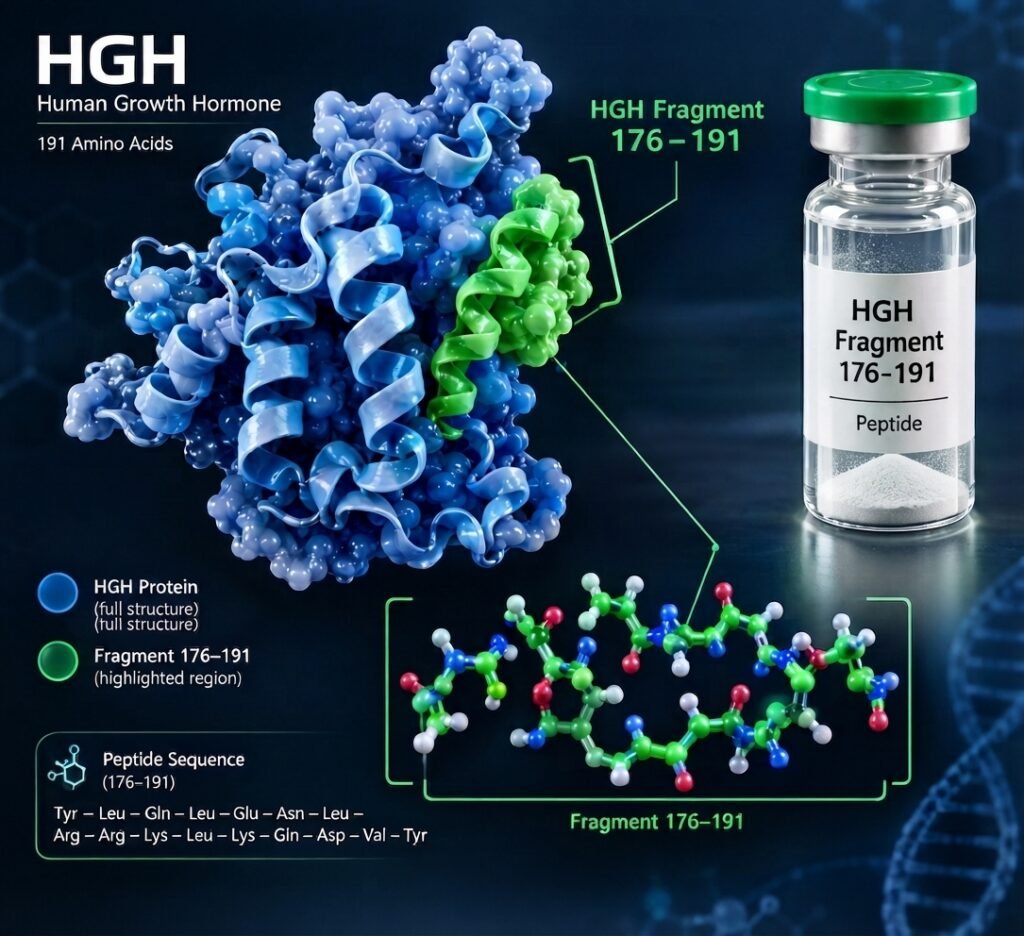
The HGH Fragment 176-191 vial can be represented alongside common analytical equipment, clean laboratory surfaces, peptide documentation, or molecular graphics. These visuals reinforce the scientific identity of the product without making unsupported claims about its effects.
Product imagery should also maintain consistency across the Vital Core Lab catalog. Consistent vial colors, labels, backgrounds, and composition can make the store look more professional.
For HGH Fragment 176-191, a green vial lid and clean scientific setting provide a recognizable Vital Core Lab appearance.
📌 HGH Fragment 176-191 Key Takeaways
HGH Fragment 176-191 is a 16-amino-acid peptide fragment corresponding to residues 176–191 of human growth hormone.
Its defined sequence makes it distinct from full-length HGH 191AA. The product is supplied in lyophilized form and is available in vial quantities ranging from 2mg to 15mg.
The listed purity is greater than 99%, providing a clear quality specification for the product.
Furthermore, the peptide can be used in controlled laboratory workflows involving molecular characterization, analytical testing, peptide comparison, and related scientific investigations.
Researchers should always distinguish the properties of the fragment from those of full-length HGH. They should also rely on the applicable product documentation and batch-specific analytical information when evaluating a particular vial.
With clear labeling, appropriate storage, and careful documentation, HGH Fragment 176-191 can be maintained as a well-defined peptide material for laboratory use.
⚗️ Product Quality and Responsible Use
Specialized peptide materials require careful handling and accurate documentation.
HGH Fragment 176-191 is presented as a laboratory and analytical product. It should be handled according to applicable laboratory procedures, product documentation, and relevant regulations.
The information provided on this page describes the molecular identity and product characteristics. It is not intended to establish clinical efficacy, therapeutic use, or dosing recommendations.
For professional laboratories, the most useful product information is often the simplest: exact identity, sequence region, purity specification, vial quantity, and supporting documentation.
That approach keeps the product information clear while allowing researchers to make informed decisions about material selection.
Vital Core Lab provides HGH Fragment 176-191 in clearly identified 2mg–15mg vial formats with a stated >99% purity specification.
Reviews
There are no reviews yet.