Retatrutide Explained: What Is the Triple Agonist and How Does It Work?
Retatrutide is one of the most closely studied compounds in current metabolic research. Retatrutide research focuses on a unique mechanism involving three hormone receptors. These are the GLP-1, GIP, and glucagon receptors. This is why Retatrutide is described as a triple agonist. The combination of GLP-1 GIP glucagon signaling gives researchers a different model for studying metabolic pathways than compounds that act on only one or two receptors. As research continues, Retatrutide is being investigated across several areas of metabolic biology, including glucose regulation, energy balance, body composition, and other physiological processes.
🧪 Research note: Retatrutide is an investigational compound. This article is intended for scientific education and research discussion. It does not provide instructions for personal use, administration, dosing, or treatment.
What Is Retatrutide?
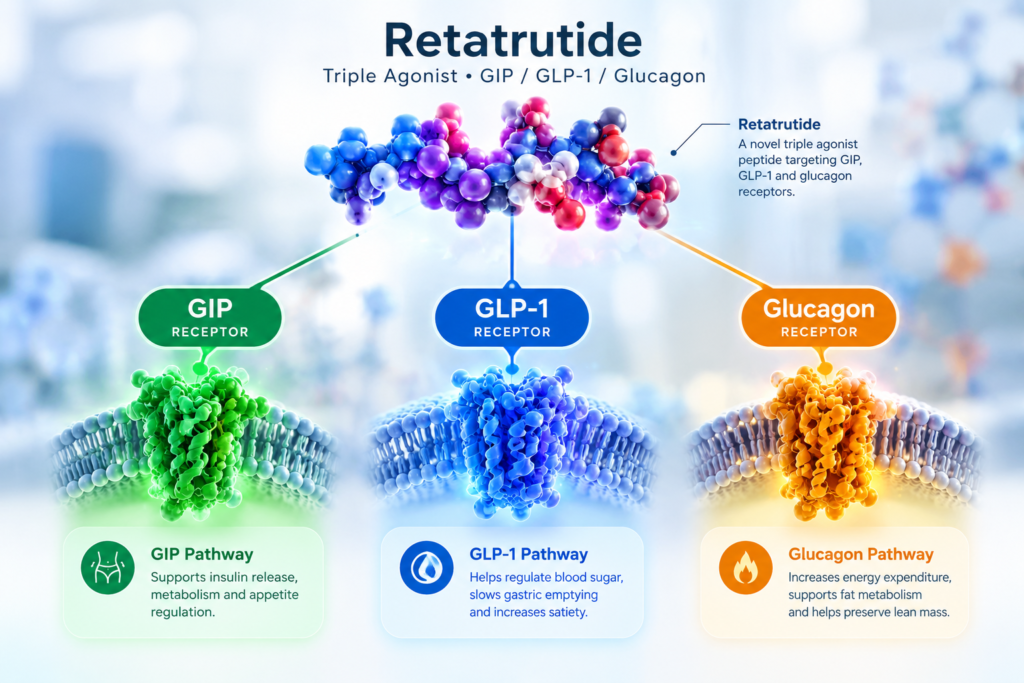
Retatrutide, also known by the development name LY3437943, is an investigational peptide-based molecule designed to activate three hormone receptor pathways.
Those pathways are:
- GIP — glucose-dependent insulinotropic polypeptide
- GLP-1 — glucagon-like peptide-1
- Glucagon
Together, they form the foundation of the Retatrutide triple agonist mechanism.
This makes Retatrutide different from a traditional single-receptor agonist.
Instead of studying one signaling pathway, researchers can examine the interaction of three pathways within one molecular system.
That is the central reason Retatrutide has attracted so much scientific interest.
Retatrutide Research at a Glance
| Research Feature | Description |
|---|---|
| Compound | Retatrutide |
| Development name | LY3437943 |
| Research category | Multi-receptor agonist |
| Primary targets | GIP, GLP-1, glucagon receptors |
| Mechanism | Triple receptor agonism |
| Research areas | Metabolic and physiological signaling |
| Development status | Investigational |
| Common description | Triple agonist |
Retatrutide is currently being studied in clinical research programs. It is not the same thing as an approved, generally available medicine. Lilly’s September 2026 information states that Retatrutide remains investigational and is not yet available for public use.
Why Is Retatrutide Called a Triple Agonist?
The word agonist describes a compound that activates a receptor.
Retatrutide is called a triple agonist because it activates three receptor systems.
These are:
GIP receptor + GLP-1 receptor + glucagon receptor
Each pathway has its own biological role.
Therefore, the scientific interest is not simply about activating three receptors. Researchers are interested in how these signals interact.
This creates a more complex research model.
GLP-1 Receptor Signaling
GLP-1 is a naturally occurring hormone involved in nutrient-responsive signaling.
GLP-1 receptor activity has been studied in relation to:
- Glucose regulation
- Pancreatic signaling
- Gastrointestinal processes
- Appetite-related signaling
- Energy balance
Because of these functions, GLP-1 is already an important area of metabolic research.
Retatrutide adds two additional receptor pathways to this signaling environment.
GIP Receptor Signaling
GIP is another nutrient-responsive hormone.
It has an important role in glucose-dependent signaling and pancreatic function.
However, GIP research is broader than glucose alone.
Scientists also investigate GIP signaling in relation to:
- Nutrient handling
- Adipose biology
- Energy metabolism
- Insulin-related signaling
- Interactions with other metabolic pathways
Therefore, GIP provides a second component of the Retatrutide research model.
Glucagon Receptor Signaling
Glucagon adds the third pathway.
Glucagon is strongly associated with energy availability and hepatic metabolism.
Its signaling can influence processes involved in glucose production and the use of metabolic substrates.
This makes glucagon an especially interesting component of a multi-receptor research model.
How Does Retatrutide Work?
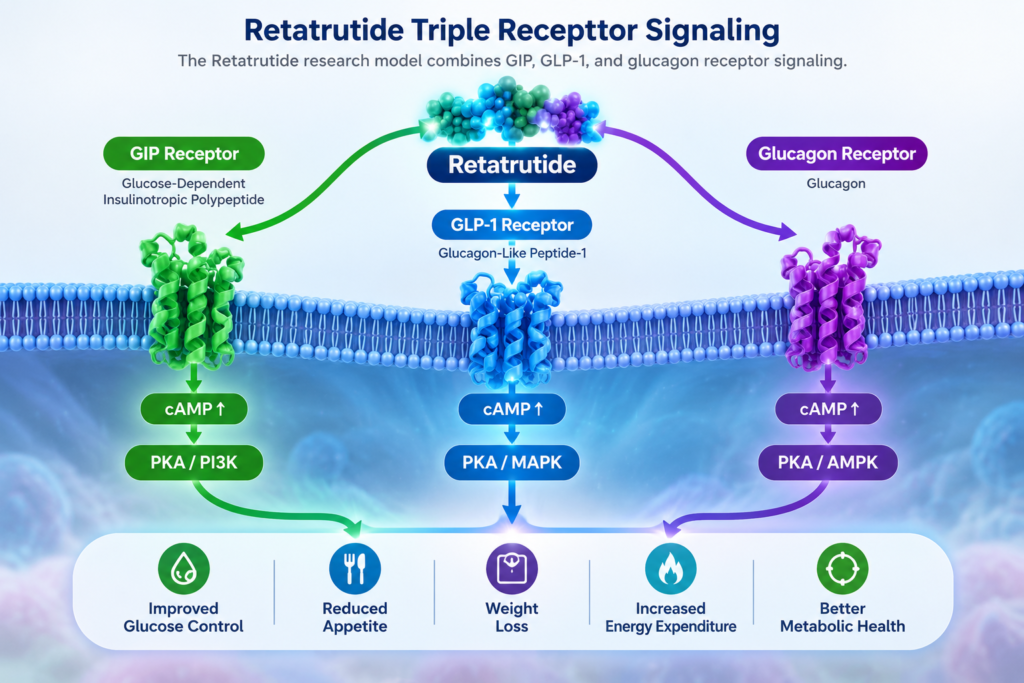
The simplest way to understand Retatrutide is to separate its three receptor pathways.
Each pathway contributes a different biological signal.
However, Retatrutide research is particularly interested in what happens when these pathways are activated together.
1. GLP-1 Signaling
The GLP-1 pathway responds to nutrient-related signals.
Researchers study this pathway because it participates in several physiological processes.
These include glucose-dependent signaling, gastrointestinal activity, pancreatic responses, and appetite-related biology.
Consequently, GLP-1 forms an important part of the Retatrutide mechanism.
2. GIP Signaling
The GIP pathway provides another nutrient-responsive signal.
GIP receptor activity has been studied extensively in relation to glucose-dependent insulin signaling.
However, its role is not limited to one biological process.
Researchers are also investigating how GIP interacts with energy metabolism and other hormone pathways.
This interaction is particularly relevant when studying multi-receptor compounds.
3. Glucagon Signaling
Glucagon provides the third signal.
This pathway is closely connected with hepatic metabolism and energy availability.
Researchers are interested in how glucagon receptor activity may interact with GLP-1 and GIP signaling.
Therefore, the three pathways should not be viewed as completely separate systems.
They form a connected research model.
Understanding the GLP-1 GIP Glucagon Combination
The phrase GLP-1 GIP glucagon is useful because it summarizes the three major receptor targets.
A simplified model looks like this:
GLP-1 → nutrient and metabolic signaling
GIP → nutrient-responsive and glucose-dependent signaling
Glucagon → hepatic and energy-related signaling
Retatrutide brings these three signals together.
This does not mean that the pathways produce identical effects.
Instead, each receptor contributes a different biological signal.
The research question is whether their combined activation produces a distinct physiological response.
That is the scientific idea behind the triple agonist model.
What Makes the Triple Agonist Approach Different?
Single-receptor and multi-receptor compounds provide different research models.
A single agonist allows researchers to focus on one major receptor pathway.
A dual agonist allows two pathways to be studied together.
Retatrutide introduces a third pathway.
| Research Model | Receptor Targets | Main Concept |
|---|---|---|
| Single agonist | One receptor | Focused receptor signaling |
| Dual agonist | Two receptors | Combined pathway signaling |
| Triple agonist | Three receptors | Broader multi-receptor signaling |
| Retatrutide | GIP + GLP-1 + glucagon | Triple receptor model |
The key point is that receptor count alone does not explain biological activity.
Receptor distribution, signaling strength, tissue response, metabolism, and other factors all matter.
Therefore, researchers need controlled experiments to understand the complete picture.
Retatrutide Research and Energy Balance
Energy balance is an important area of Retatrutide research.
The body continuously regulates the relationship between energy intake, energy storage, and energy expenditure.
Several hormonal systems participate in this process.
GLP-1 and GIP are involved in nutrient-responsive signaling.
Glucagon plays important roles in energy availability and hepatic metabolism.
Because Retatrutide interacts with all three pathways, researchers can investigate how their combined activity relates to energy regulation.
This makes Retatrutide a particularly interesting model for metabolic research.
However, it is important to separate scientific findings from marketing claims.
A research study may identify an association or biological effect without establishing that a compound should be used as a treatment.
That distinction is essential when discussing investigational compounds.
What Does Current Retatrutide Research Show?
Retatrutide has progressed through multiple stages of clinical research.
Earlier Phase 2 research produced substantial changes in body weight and several metabolic measurements in adults with obesity.
More recently, the scientific evidence has expanded with Phase 3 research.
On September 29, 2026, The New England Journal of Medicine published results from the Phase 3 TRIUMPH-1 trial. The randomized, double-blind study included 2,339 adults with obesity without diabetes and evaluated Retatrutide against placebo over 80 weeks.
The published mean percentage changes in body weight were:
| Study Group | Mean Change at 80 Weeks |
|---|---|
| Retatrutide 4 mg | −17.6% |
| Retatrutide 9 mg | −23.7% |
| Retatrutide 12 mg | −25.0% |
| Placebo | −3.9% |
The trial also evaluated participants with knee osteoarthritis and obstructive sleep apnea. The publication reported improvements in the relevant study outcomes, while gastrointestinal events were among the most common adverse events.
These results are important because they add large-scale Phase 3 evidence to the existing Retatrutide research base.
At the same time, they should be understood in the context of the study design and population.
Clinical trial findings are not the same as permission to market an investigational compound for personal use.
Retatrutide and Metabolic Research
Retatrutide research goes beyond one measurement.
Scientists can examine multiple biological markers to better understand the compound’s effects.
Research areas can include:
- Glucose-related measurements
- Insulin-related signaling
- Lipid metabolism
- Body composition
- Energy balance
- Hormonal signaling
- Receptor activity
- Metabolic adaptation
Looking at multiple endpoints gives researchers a more complete picture.
For example, a change in body weight alone does not explain which biological pathways contributed to that change.
Researchers therefore examine different measurements together.
This approach helps separate direct observations from possible mechanisms.
Why Is Glucagon Important?
One of the most interesting features of Retatrutide is its glucagon receptor activity.
GLP-1 and GIP are already well-known areas of metabolic research.
Glucagon adds another dimension.
The glucagon pathway has important connections with hepatic glucose regulation and energy metabolism.
Therefore, researchers are investigating whether glucagon signaling can complement the signals associated with GLP-1 and GIP.
This is one reason the term triple agonist is so important.
Retatrutide is not simply another GLP-1-focused research compound.
Its mechanism involves three distinct receptor targets.
Retatrutide Research and Receptor Interactions
Receptor interaction is an important part of pharmacology research.
A molecule can interact with several receptor systems, but those receptors may behave differently across tissues.
Therefore, researchers need to consider more than receptor activation alone.
Important questions include:
How strongly does the compound interact with each receptor?
Different receptor interactions can contribute different signals.
Where are the receptors expressed?
Tissue distribution can influence biological responses.
How long does receptor activity persist?
Pharmacokinetic behavior can influence exposure over time.
How do the pathways interact?
One pathway may influence the activity of another.
These questions help explain why multi-receptor compounds require detailed research.

What Are Scientists Still Studying?
Despite the growing amount of data, Retatrutide research is not finished.
Several questions remain important.
Long-Term Research
Researchers need long-term data to better understand sustained exposure and outcomes.
Body Composition
Body weight does not tell the entire story.
Researchers can also investigate changes in fat mass, lean mass, and other components of body composition.
Metabolic Adaptation
The body can adapt to changes in hormonal signaling.
Understanding this adaptation is an important research question.
Receptor Balance
Scientists continue to investigate how the relative activity of GIP, GLP-1, and glucagon pathways contributes to the overall response.
Broader Clinical Outcomes
Later-stage trials are also examining Retatrutide across additional populations and research endpoints.
Lilly’s current development program includes studies involving areas such as type 2 diabetes, obesity, knee osteoarthritis, obstructive sleep apnea, chronic low back pain, cardiovascular and renal outcomes, and metabolic dysfunction-associated steatotic liver disease.

Retatrutide Is Not the Same as a “GLP-3”
The term “GLP-3” sometimes appears online when people discuss Retatrutide.
However, this is not the formal scientific name for the compound.
Lilly specifically describes “GLP-3” as an informal and scientifically inaccurate nickname used to describe triple hormone receptor agonists. Retatrutide targets GIP, GLP-1, and glucagon receptors.
Therefore, scientific content should use the proper terminology.
The better description is:
Retatrutide — a GIP, GLP-1, and glucagon receptor triple agonist.
This is clearer and more scientifically precise.
Research-Use Positioning and Scientific Information
When discussing Retatrutide as a research product, scientific accuracy is especially important.
A research article can discuss:
- Molecular identity
- Receptor targets
- Published research
- Biological pathways
- Analytical characterization
- Research applications
- Purity and documentation
- Scientific literature
- Experimental models
However, research information should not be presented as instructions for personal administration.
This distinction is important.
In 2026, FDA warning letters continued to address websites that used research-only language while simultaneously providing information that suggested human use. For example, FDA cited claims about weight loss, metabolic benefits, dosing, and injection-related materials as evidence relevant to intended use.
Therefore, responsible research communication should focus on what scientists are studying, rather than telling consumers how to use an investigational compound.

Frequently Asked Questions About Retatrutide
What is Retatrutide?
Retatrutide is an investigational molecule designed to activate the GIP, GLP-1, and glucagon receptors.
It is therefore classified as a triple receptor agonist.
What does “triple agonist” mean?
It means the compound interacts with three receptor systems.
For Retatrutide, those are:
GIP + GLP-1 + glucagon
What does GLP-1 GIP glucagon mean?
It refers to the three receptor pathways targeted by Retatrutide.
GLP-1 stands for glucagon-like peptide-1.
GIP stands for glucose-dependent insulinotropic polypeptide.
Glucagon is a separate metabolic hormone and receptor pathway.
Why is Retatrutide important in research?
Retatrutide provides a model for studying coordinated activity across three metabolic receptor systems.
This makes it useful for investigating multi-pathway metabolic signaling.
Is Retatrutide approved for public use?
Retatrutide remains investigational. As of September 2026, Lilly states that it is not yet available for public use and continues to be studied in Phase 3 clinical trials.
Is Retatrutide the same as a GLP-1 agonist?
Not exactly.
Retatrutide activates the GLP-1 receptor, but it also activates GIP and glucagon receptors.
Therefore, describing it only as a GLP-1 agonist leaves out two important parts of its mechanism.
What is the main focus of Retatrutide research?
Research includes metabolic signaling, energy balance, glucose-related biology, body composition, receptor interactions, and several clinical research outcomes.
The research program continues to expand.
Retatrutide Research: Key Points to Remember
Here are the main points from this article:
Here are the main points from this article:
| Key Point | Explanation |
|---|---|
| Retatrutide | Investigational multi-receptor compound |
| GIP | One of the three receptor targets |
| GLP-1 | One of the three receptor targets |
| Glucagon | Third receptor target |
| Triple agonist | Describes the three-receptor mechanism |
| Research focus | Metabolic and physiological signaling |
| Current status | Investigational |
| 2026 development | Phase 3 research continues |
The most important concept is simple:
Retatrutide is not defined by one receptor.
Its scientific identity comes from the combination of GIP, GLP-1, and glucagon receptor activity.
Final Takeaway: Why Retatrutide Matters
Retatrutide represents an important example of the growing interest in multi-receptor metabolic research.
Its defining feature is its triple agonist mechanism.
Instead of focusing on one receptor, Retatrutide activates three:
GIP + GLP-1 + glucagon
Each pathway has its own biological role.
Together, they create a complex research model for studying metabolic signaling.
The scientific evidence has also continued to develop.
The September 2026 Phase 3 TRIUMPH-1 publication added important data from 2,339 adults with obesity and an 80-week study period. The researchers reported significant changes in body weight and additional study outcomes, while gastrointestinal events were among the most common adverse events.
At the same time, Retatrutide remains an investigational compound.
That distinction matters.
Research findings can help scientists understand receptor biology, metabolic pathways, and physiological responses. However, research findings should not automatically be presented as personal-use recommendations or treatment instructions.
For research-focused readers, the most useful way to understand Retatrutide is therefore through its molecular identity, receptor activity, scientific literature, analytical characterization, and ongoing clinical research.
As research continues, scientists will learn more about how GIP, GLP-1, and glucagon signaling interact.
And that is ultimately what makes Retatrutide such an interesting subject of modern peptide and metabolic research.
Scientific takeaway: Retatrutide is an investigational triple receptor agonist that activates GIP, GLP-1, and glucagon pathways. Its unique multi-receptor mechanism continues to be studied across metabolic and physiological research.