
Epithalon (Epitalon) & Telomerase Activation: Cellular Longevity & Biological Aging
Introduction: Why Epithalon Research Is Attracting Attention 🧬
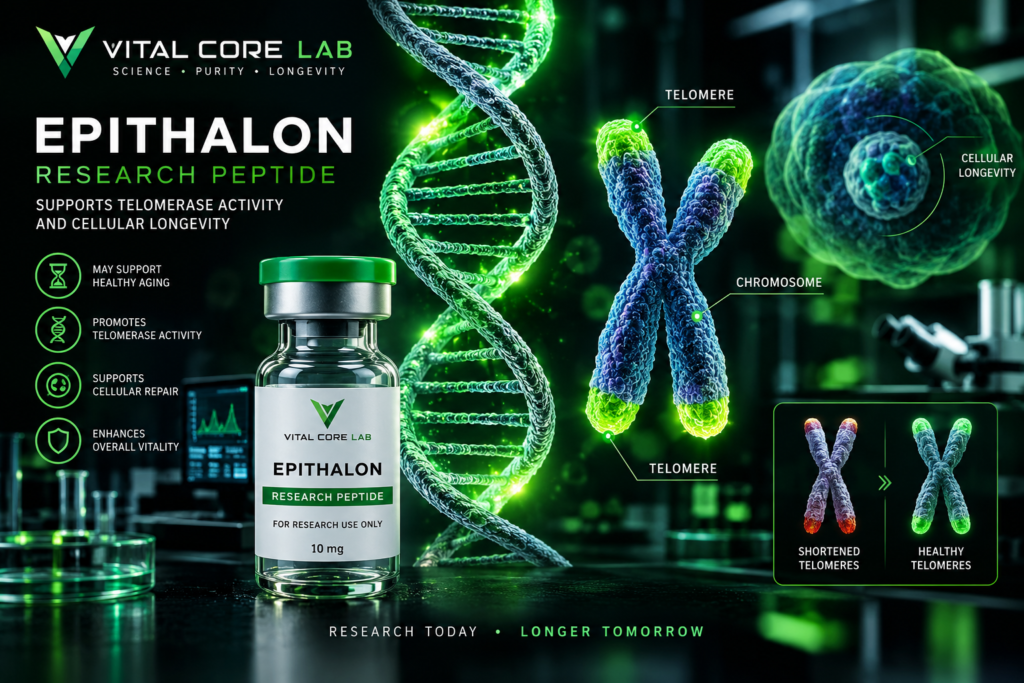
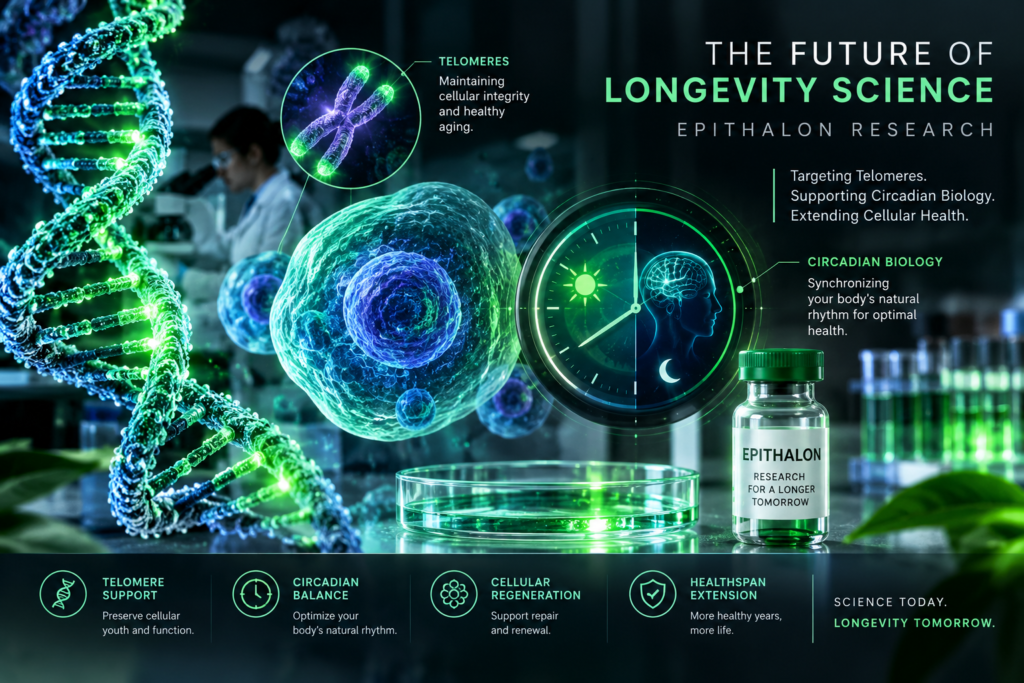
Epithalon (also written as Epitalon) is a synthetic peptide that has attracted scientific interest in research related to cellular aging, telomeres, telomerase activity, and circadian biology. Researchers studying longevity are interested in how cells respond to aging, how genetic material is maintained, and how biological rhythms change over time.
As interest in longevity science grows, Epithalon research has become part of a wider discussion about the mechanisms associated with biological aging. However, it is important to separate scientific hypotheses from proven outcomes. Research into a compound does not automatically establish that it can extend human lifespan, reverse aging, or prevent age-related disease.
To understand why Epithalon is being investigated, it helps to examine several connected topics. These include telomere attrition, telomerase, cellular senescence, pineal gland biology, melatonin regulation, and circadian rhythms.
This article explores these concepts in clear language. It also explains the current limitations of Epithalon research and the questions scientists must answer before drawing reliable conclusions about its potential role in longevity science.
What Is Epithalon (Epitalon)? 🔬
Epithalon is a synthetic tetra-peptide commonly described by the amino acid sequence Ala-Glu-Asp-Gly. It has been discussed in experimental research concerning the pineal gland, aging-related processes, and biological rhythms.
The pineal gland is a small endocrine structure in the brain. One of its best-known functions is producing melatonin, a hormone involved in coordinating the body’s daily and seasonal biological rhythms.
Because pineal function and circadian regulation can change with age, researchers have explored whether compounds associated with pineal biology may influence particular aging-related mechanisms.
However, a proposed biological connection is not the same as a demonstrated effect. Epithalon should not be described as a proven human longevity treatment, and its effects cannot be established solely from laboratory observations or animal studies.
Why Is Epithalon Studied in Longevity Research?
Longevity research investigates the biological processes that influence how cells function and how organisms change over time. Epithalon has been discussed in this field because of proposed relationships with telomere biology and pineal-related functions.
Researchers may investigate questions such as:
- Does Epithalon produce measurable changes in specific cellular markers?
- Are any observed effects reproducible across independent experiments?
- Do results differ between cell types or experimental models?
- Are reported effects connected to a clearly established molecular mechanism?
- Can findings from experimental models be confirmed in well-designed human studies?
These questions matter because biological aging is complex. No single cellular marker can fully describe a person’s overall aging process.
Telomeres Explained: The Protective Ends of Chromosomes
Telomeres are repetitive DNA sequences and associated proteins found at the ends of linear chromosomes. They help protect chromosome ends and support the normal handling of genetic material during cell division.
You can think of telomeres as protective structures at the ends of shoelaces. The comparison is not exact, but it helps explain why chromosome ends need special protection.
Each time many types of cells divide, their telomeres may become shorter. The amount of shortening varies with cell type, age, environmental factors, and the activity of enzymes that maintain telomeres.
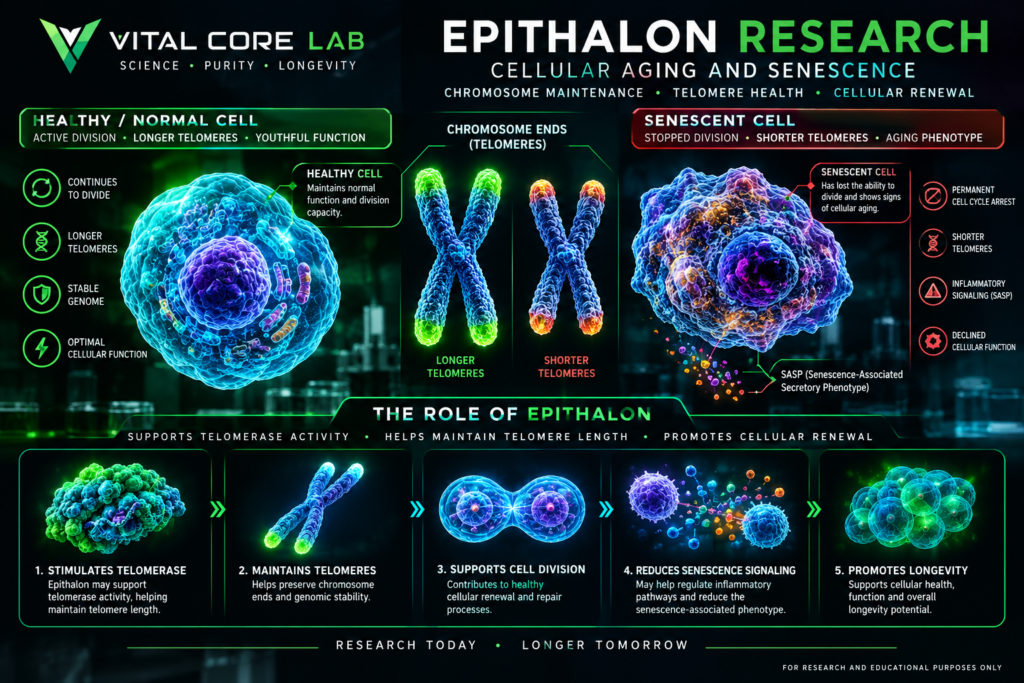
Over time, critically short or dysfunctional telomeres can contribute to a cellular stress response. In some circumstances, this response can lead to cellular senescence or programmed cell death.
What Is Telomere Attrition?
Telomere attrition refers to the progressive shortening or loss of telomere function. It is one of the biological processes studied in connection with aging.
Several factors can influence telomere maintenance:
- Cell division: Repeated cell division can contribute to telomere shortening.
- Oxidative stress: Certain forms of cellular damage may affect telomere integrity.
- Cell type: Different cells have different patterns of division and telomere maintenance.
- Telomerase activity: Some cells can use telomerase to maintain or extend telomeres.
- Biological conditions: Genetics, inflammation, and other cellular processes may influence measured telomere characteristics.
Importantly, telomere shortening is not a universal clock that predicts every aspect of human aging. Telomere length varies among individuals and tissues. It should therefore be interpreted alongside other biological measures.
Why Telomeres Matter in Cellular Longevity
Researchers study telomeres because chromosome stability is important for healthy cell function. When telomeres become dysfunctional, cells may activate protective mechanisms that limit further division.
These mechanisms can help prevent damaged cells from continuing to divide. However, the accumulation of senescent cells can also affect tissue function.
The relationship is therefore complicated. Longer telomeres are not automatically proof of better health, and shorter telomeres do not provide a complete picture of biological age.
In longevity science, the goal is to understand how telomere maintenance interacts with DNA repair, cellular senescence, metabolism, immune function, and other processes.
Telomerase Activation and Epithalon Research
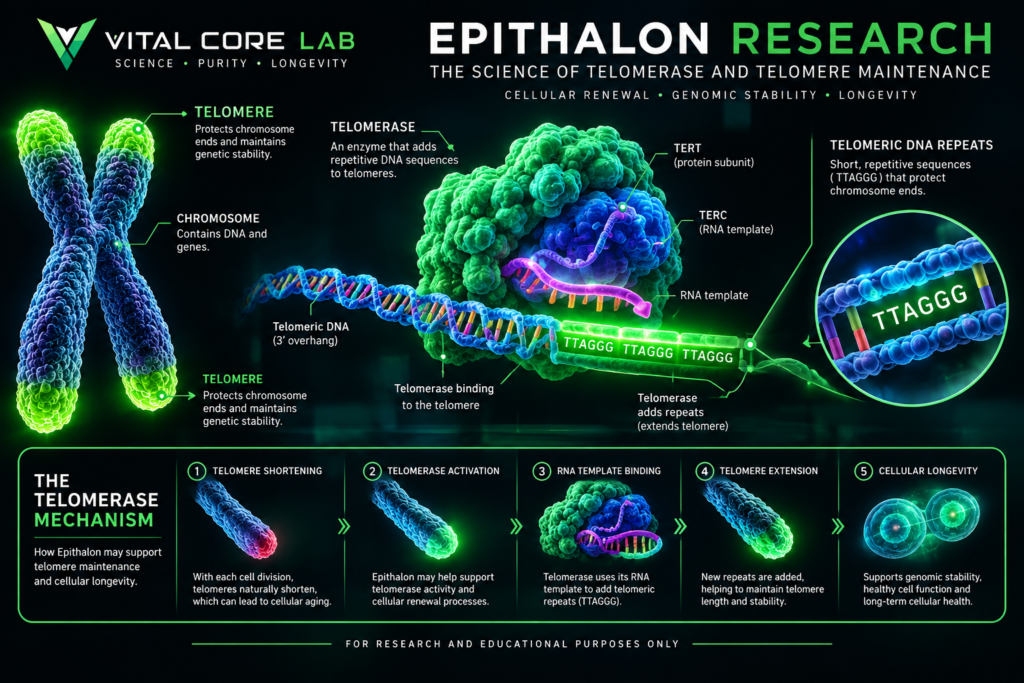
Telomerase is an enzyme complex that can add repeated DNA sequences to telomeres. It contains a catalytic component and an RNA template that guides the addition of DNA repeats.
Telomerase is active in certain cell populations, including many stem and germ cells. Its activity is limited or tightly regulated in many ordinary somatic cells.
Because telomerase can maintain telomeres, scientists study its role in cell division, tissue maintenance, and aging-related biology.
How Does Telomerase Work?
During chromosome replication, the ends of linear DNA molecules present a technical challenge. Telomerase can help address this problem by extending telomeric DNA in cells where the enzyme is active.
The process involves several stages:
- Telomerase associates with a chromosome’s telomere.
- Its RNA component provides a template for adding DNA repeats.
- The telomere can be extended under suitable biological conditions.
- Other cellular processes complete and protect the chromosome end.
The outcome depends on the cell’s biological state, telomerase regulation, and other maintenance mechanisms.
Does Epithalon Activate Telomerase?
Epithalon has been discussed in experimental literature concerning telomerase activity and telomere-related changes. Nevertheless, the strength, reproducibility, and biological relevance of reported findings must be assessed carefully.
A claim that a peptide activates telomerase requires direct evidence. Scientists would need to measure enzyme activity, establish appropriate controls, verify results, and determine whether changes in telomere biology are caused by the compound rather than other experimental factors.
It is also essential to distinguish between laboratory observations, animal findings, and clinical evidence in humans. These categories answer different questions and cannot be treated as interchangeable.
Even if an experiment demonstrates a change in telomerase activity, that result alone does not prove that a compound slows human aging or extends lifespan.
Epithalon, the Pineal Gland, and Circadian Rhythms 🌙
The pineal gland plays an important role in the body’s timing system through the production of melatonin. Melatonin levels typically rise in darkness and fall with light exposure, although the exact pattern depends on an individual’s circadian timing and other factors.
Circadian rhythms are internal biological cycles that repeat approximately every 24 hours. They help coordinate sleep and wakefulness, hormone secretion, body temperature, metabolism, and other functions.
Because circadian organization can change with age, researchers investigate how biological timing interacts with cellular maintenance and other aging-related processes.
Understanding Melatonin Regulation
Melatonin is best known for its role in signaling biological night. Light information received by the eyes helps regulate the central circadian clock, which influences melatonin production by the pineal gland.
Melatonin is not simply an anti-aging hormone. It is one component of a larger regulatory system that coordinates biological timing.
Changes in sleep patterns, light exposure, daily routines, and health can influence circadian rhythms. However, a change in melatonin production does not necessarily mean that telomeres have been preserved or that cellular aging has slowed.
What Is the Proposed Connection Between Epithalon and Circadian Biology?
Epithalon has been discussed in relation to pineal gland function and biological rhythms. Researchers interested in this area may examine whether a measurable effect occurs in circadian markers, hormone patterns, or other indicators of biological regulation.
Such investigations require careful experimental design. Researchers must consider the timing of measurements, light conditions, age, sleep schedules, and other factors that influence biological rhythms.
Most importantly, proposed effects should not be presented as established human benefits without adequate evidence.
A compound’s association with pineal biology does not, by itself, prove that it improves sleep, restores youthful hormone patterns, or changes the rate of aging.
Cellular Senescence and Biological Aging
Cellular senescence is a state in which a cell stops dividing but remains metabolically active. It can occur after different forms of cellular stress, including DNA damage and dysfunctional telomeres.
Senescence has both protective and potentially harmful roles. In some circumstances, it helps prevent damaged cells from multiplying. However, senescent cells may also release signaling molecules that influence nearby cells and tissues.
The effects depend on the cell type, the surrounding environment, and the duration of the response.
Why Is Senescence Important in Longevity Research?
Scientists study cellular senescence because the accumulation of senescent cells has been associated with several features of aging biology.
Research questions include:
- How do senescent cells influence tissue function?
- Which molecular signals maintain the senescent state?
- How do immune systems identify and remove these cells?
- Can laboratory markers reliably distinguish senescent cells from other cell states?
- How do telomere dysfunction and other forms of cellular stress contribute?
Epithalon research may be discussed within this wider context, but it is important not to assume that effects on telomeres necessarily translate into effects on senescence.
The connection must be tested directly. Scientists need suitable cellular markers, controls, repeat experiments, and evidence that observed changes have biological significance.
Epithalon Research Compared With Established Aging Mechanisms
Longevity science covers many biological processes. Telomere maintenance is only one area of investigation, and circadian regulation is another.
The following table summarizes the major concepts relevant to Epithalon research. It describes scientific topics rather than established benefits of the peptide.
| Research area | What scientists investigate | Important limitation |
|---|---|---|
| Telomere attrition | Changes in chromosome-end length and function | Telomere length alone does not measure total biological age |
| Telomerase activity | Enzyme activity and telomere maintenance | Greater activity is not automatically beneficial in every cell |
| Pineal gland biology | Hormone production and regulation | A proposed connection does not establish a direct peptide effect |
| Circadian rhythms | Daily patterns in sleep, hormones, and physiology | Circadian changes do not independently prove slower cellular aging |
| Cellular senescence | Cell-cycle arrest and associated signaling | Senescence has both protective and potentially harmful roles |
| Epithalon research | Reproducible effects in appropriate experimental models | Findings require independent validation and adequate human evidence |
Why These Distinctions Matter
The table illustrates why a single observation cannot establish a broad anti-aging claim.
For example, a change in a laboratory marker may show that a biological process has changed under particular experimental conditions. It does not necessarily show that a tissue functions better, that a person feels younger, or that lifespan has increased.
Likewise, an effect observed in one type of cell may not occur in another. Different tissues have different rates of cell division, telomerase activity, and responses to stress.
Consequently, strong longevity research needs more than an interesting mechanism. It needs reproducible results and a clear explanation of how those results relate to meaningful biological outcomes.
What Does the Scientific Evidence Say About Epithalon?
Epithalon has been discussed in experimental research on aging and pineal-related biology. However, the evidence should be evaluated according to the type of study, its methods, its size, and whether its findings have been independently reproduced.
Laboratory Research
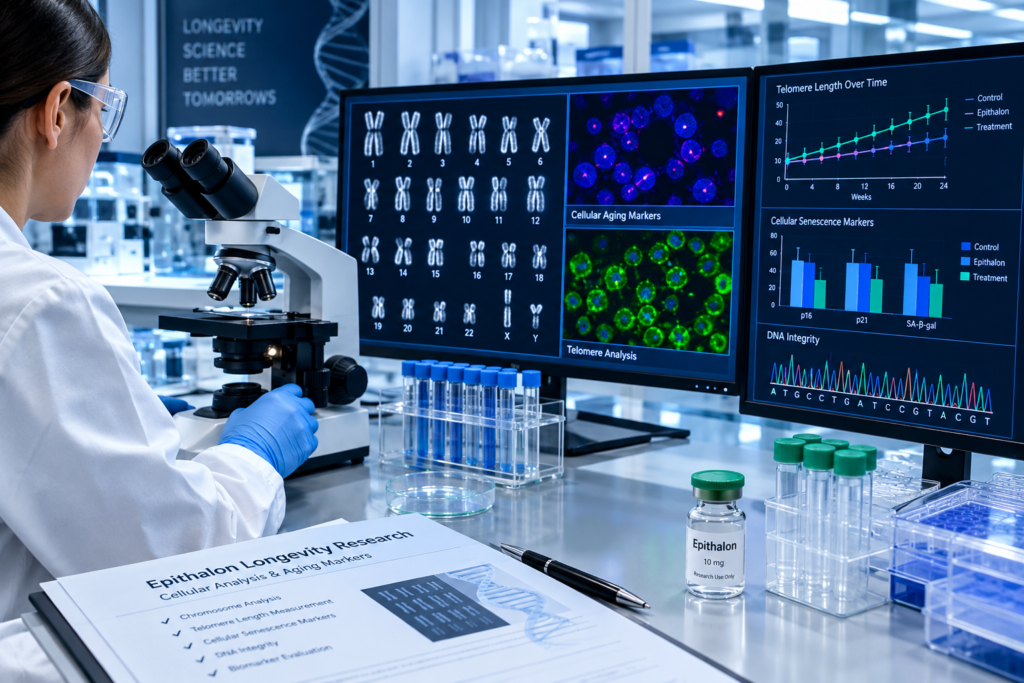
Laboratory studies can help identify molecular changes and explore potential mechanisms. Researchers may measure telomerase activity, telomere characteristics, gene expression, cellular stress responses, or circadian markers.
These studies are valuable for generating hypotheses. Nevertheless, laboratory conditions cannot reproduce every aspect of a living organism.
Results may depend on cell type, concentration, exposure conditions, measurement methods, and other experimental variables.
Animal Studies
Animal models can provide information about biological processes that cannot be fully examined in isolated cells. They may help researchers investigate how multiple systems interact over time.
However, animal findings do not automatically predict human outcomes. Species differ in physiology, lifespan, metabolism, and biological regulation.
Any claim based on animal research should therefore identify the model and avoid presenting the result as proven human efficacy.
Human Evidence
Human studies are needed to determine whether a compound has reproducible effects in people and to assess its safety.
Well-designed clinical research should include suitable comparison groups, clear outcome measures, adequate follow-up, transparent reporting, and appropriate ethical oversight.
For Epithalon, claims about extending human lifespan, reversing biological aging, preventing disease, or producing lasting improvements should not be treated as established without strong supporting clinical evidence.
A responsible review should also consider negative findings, study limitations, conflicts of interest, and whether independent research teams have reached similar conclusions.
How Researchers Can Evaluate Epithalon Studies
A scientific paper should be assessed by the quality of its evidence, not simply by the strength of its conclusions or the popularity of its subject.
Check the Study Design
First, determine whether the study used cells, animals, or human participants. Each type of research provides a different level of information.
Next, examine the number of participants or experimental samples, the presence of controls, and the methods used to measure outcomes.
Examine the Endpoints
Researchers should distinguish between a biochemical marker and a meaningful health outcome.
For example, telomerase activity is a measurable laboratory endpoint. It is not equivalent to a demonstrated reduction in biological age.
Similarly, a change in a circadian marker does not prove that a compound improves long-term health or extends lifespan.
Look for Independent Replication
Reproducibility is a central part of reliable science. If a finding appears in one small experiment, additional research is needed to establish how consistent it is.
Independent replication helps determine whether a reported result is robust, whether it depends on specific conditions, and whether alternative explanations have been ruled out.
Safety, Limitations, and Responsible Research ⚠️
Interest in longevity compounds should be accompanied by careful attention to safety and evidence quality.
A proposed mechanism does not establish that a peptide is safe. Nor does a product’s purity establish its clinical effectiveness.
Safety assessment depends on the compound, its characteristics, the study conditions, and the quality of the available evidence. The absence of reported problems in a small study does not prove that a substance is safe for long-term use.
Why Telomerase Requires Careful Interpretation
Telomerase is involved in normal chromosome maintenance, but its regulation also matters in cancer biology. Many cancer cells use telomerase to support continued division.
This does not mean that every intervention associated with telomerase causes cancer. It does mean that researchers must investigate the consequences of changing telomerase activity rather than assuming that more activity is always better.
Long-term safety, effects across different cell types, and possible unintended biological consequences require appropriate study.
Product Quality and Research Documentation
For laboratory research, product quality and documentation are important. Researchers should evaluate identity, purity, batch consistency, storage requirements, and the availability of appropriate analytical documentation.
A certificate of analysis can provide useful information about a particular batch, depending on the methods and results reported. However, a certificate alone does not establish clinical efficacy or prove that a product is suitable for human consumption.
Product specifications should be clear, and any available documentation should be interpreted within its stated scope.
Epithalon should not be presented as an established anti-aging treatment. This article is for scientific education and is not a substitute for medical advice. No dosing, injection, or treatment protocol is provided.
The Future of Epithalon and Cellular Longevity Research
Future research may help clarify whether Epithalon produces reproducible changes in telomere biology, circadian regulation, or other cellular processes.
Several areas deserve careful investigation.
Better Measurement of Telomere Biology
Researchers need reliable methods for measuring telomere length, telomerase activity, and chromosome-end function. Different measurement techniques can produce results that are not directly interchangeable.
Studies should clearly state what they measured and avoid treating one marker as a complete measure of aging.
Understanding Circadian Interactions
Biological rhythms are influenced by light exposure, sleep timing, hormone regulation, and the body’s internal clock. Studies examining Epithalon in this area should account for these factors.
Consistent measurement times and well-controlled conditions can help researchers determine whether observed changes are related to the compound or to ordinary daily variation.
Longer-Term and Independent Research
Aging develops over years and involves multiple biological systems. Short-term laboratory changes cannot establish long-term effects on human health or lifespan.
Independent studies, transparent methods, appropriate safety monitoring, and clinically meaningful outcomes will be important for evaluating any proposed longevity application.
Until stronger evidence is available, Epithalon is best discussed as an investigational subject rather than a proven means of slowing biological aging.
Frequently Asked Questions About Epithalon
H3: What is Epithalon?
Epithalon is a synthetic tetra-peptide studied in experimental discussions of pineal-related biology, telomeres, and aging-related processes. Its proposed effects should be distinguished from established clinical outcomes.
Is Epithalon the same as Epitalon?
Epithalon and Epitalon are alternative spellings commonly used when discussing the same peptide in scientific and commercial contexts. When reviewing research, check the compound’s stated identity and sequence rather than relying on spelling alone.
What is telomerase activation?
Telomerase activation refers to an increase in the activity of the enzyme complex that can extend telomeric DNA. Its effects depend on the cell type and biological context. Increased activity alone does not prove improved health or slower aging.
Can Epithalon reverse aging?
There is not sufficient robust human clinical evidence to conclude that Epithalon reverses aging or extends human lifespan. Claims of this kind require strong, reproducible evidence from appropriately designed studies.
Does Epithalon affect melatonin?
Epithalon has been discussed in relation to pineal gland biology and circadian regulation. However, claims about its effects on melatonin in humans should be evaluated against specific, reliable clinical evidence.
Why do researchers study telomeres?
Telomeres help protect chromosome ends. Their length and function are studied because telomere dysfunction can contribute to cellular stress and senescence. However, telomere length is only one part of the broader biology of aging.
Is Epithalon research the same as proven anti-aging treatment?
No. Experimental research explores biological questions, while a proven treatment requires adequate evidence of safety and effectiveness for a specific use. These are different standards.
Conclusion: Understanding Epithalon Through Evidence-Based Longevity Science
Epithalon research connects several important areas of biology, including telomere maintenance, telomerase activity, pineal gland function, circadian rhythms, and cellular senescence.
These topics help scientists explore how cells maintain chromosome integrity and respond to changes over time. However, the complexity of aging means that no single mechanism can fully explain biological longevity.
The central question is not simply whether a compound influences a laboratory marker. Researchers must determine whether the finding is reproducible, whether it has a clear biological explanation, whether it raises safety concerns, and whether it translates into meaningful outcomes in humans.
For now, Epithalon remains a subject of scientific interest rather than an established human longevity treatment. Careful research, transparent reporting, and realistic interpretation are essential to understanding its potential role in cellular aging science.
At Vital Core Lab, scientific education should support informed evaluation of research compounds without overstating what current evidence can establish.



Excellent deep dive into Epitalon! In longevity research models, do you see better telomerase activation data when evaluating Epithalon on its own versus running combined protocols with pineal gland bioregulators or NAD+ precursors? Appreciate the detailed insights, Vital Core Lab!
Thanks for the great question, Debbie! In longevity research models, standalone Epithalon consistently demonstrates remarkable telomerase activation. However, emerging observational data suggests that combining Epithalon with NAD+ precursors or targeted bioregulators provides broader multi-pathway support addressing both telomere maintenance and mitochondrial energy production simultaneously. We are working on a deeper dive into these combined cellular protocols soon.