
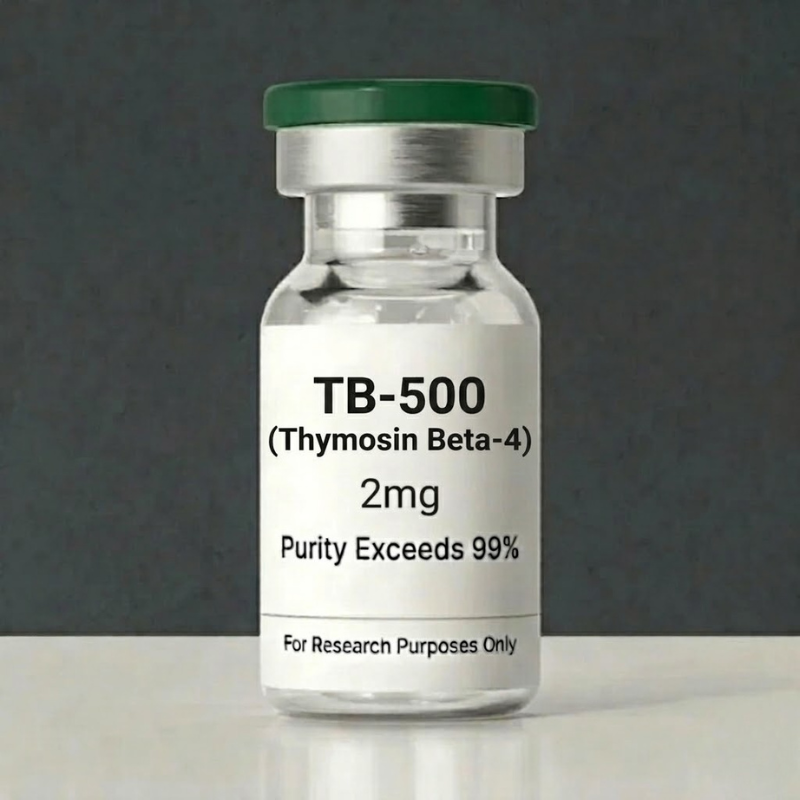



TB-500 | Thymosin Beta-4 | 2mg – 20mg | >99% Purity
🔬 TB-500 Thymosin Beta-4 Research Peptide
TB-500 is a peptide research material associated with Thymosin Beta-4 research. It is commonly discussed in molecular biology and cellular research because of the scientific interest surrounding Thymosin Beta-4 and its relationship with cellular structure, movement, and actin-associated processes.
At Vital Core Lab, TB-500 is presented strictly as a research-use material. The product is not intended for human consumption, veterinary use, diagnosis, treatment, cure, or prevention of any disease or medical condition.
The available product range includes 2mg, 5mg, 10mg, and 20mg options, with a stated purity of >99%.
For researchers, clear product identification is important. Therefore, the product information focuses on peptide identity, stated purity, analytical considerations, documentation, and laboratory research applications.
Furthermore, research involving peptide materials should always be performed under appropriate laboratory procedures. Researchers should establish their own validated methods and follow applicable institutional requirements.
🧪 Research Use Only: This product is supplied strictly for laboratory research and analytical purposes. It is not intended for human or veterinary use.
🧬 Understanding TB-500 Thymosin Beta-4
TB-500 is commonly associated with Thymosin Beta-4, a peptide that has been investigated in biological research.
The relationship between the terms deserves careful attention. Commercial peptide terminology does not always correspond perfectly to terminology used in scientific publications. Therefore, researchers should verify the identity and characterization of the specific material being studied.
Thymosin Beta-4 has been investigated in connection with cellular and molecular processes, including areas involving the actin cytoskeleton.
Actin is an important structural component of cells. It contributes to cellular organization and is involved in cellular movement. Because of these biological relationships, Thymosin Beta-4 research can be relevant to studies examining cellular behavior and molecular mechanisms.
However, scientific interest does not automatically establish a therapeutic application.
Instead, researchers should evaluate findings according to the specific experimental model, methodology, conditions, and analytical evidence involved.
This distinction is especially important when interpreting peptide literature.
A laboratory observation should remain a laboratory observation unless additional evidence supports a broader conclusion.
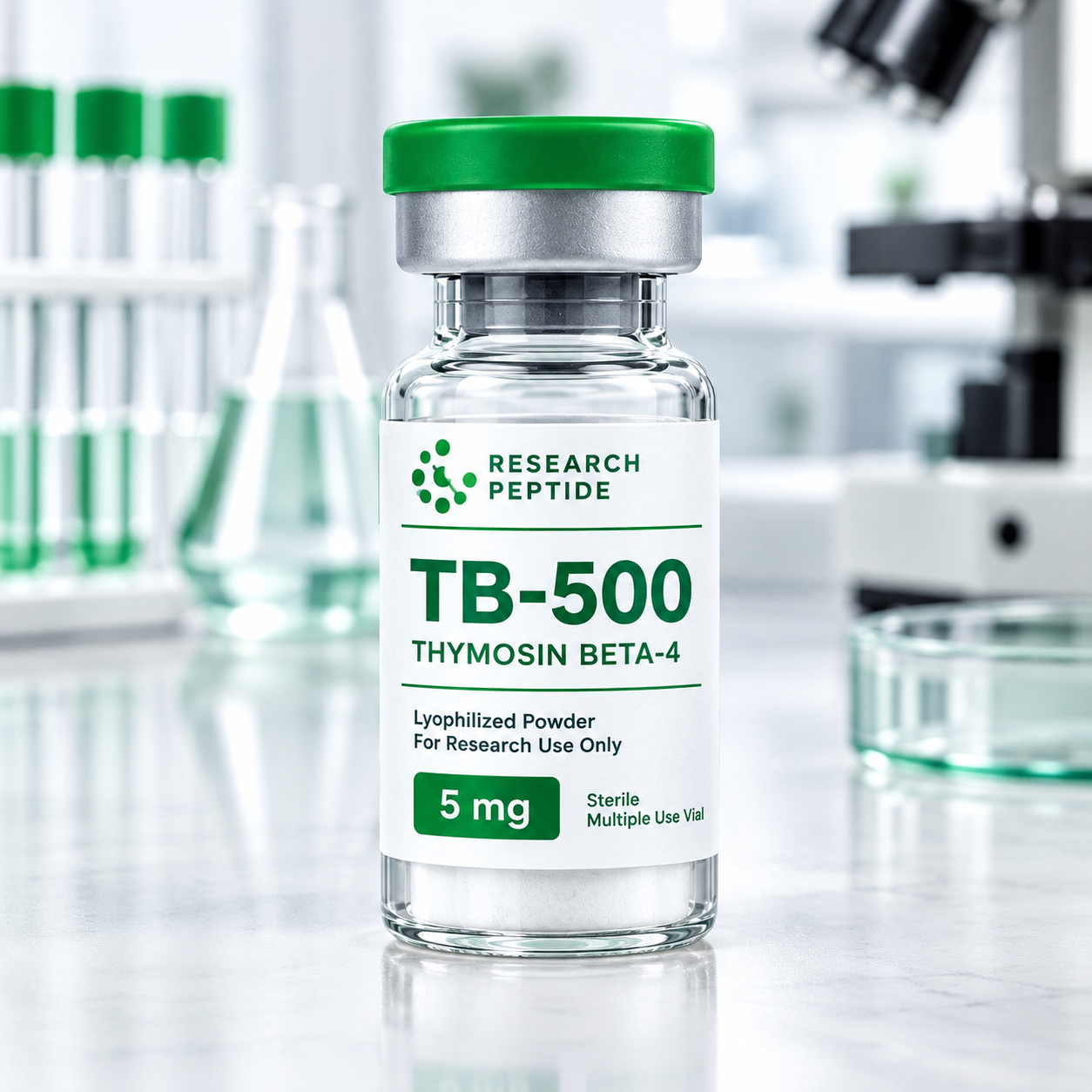
🔎 TB-500 Research Characteristics
Research peptides can be evaluated from several different perspectives.
First, researchers may consider the identity of the material. Next, they may review purity information and analytical documentation. After that, they can determine whether the material is appropriate for their specific research model.
For TB-500, these considerations are particularly useful because terminology surrounding Thymosin Beta-4-related research can vary.
A well-organized research evaluation can therefore include:
- Peptide identity
- Product quantity
- Stated purity
- Batch identification
- Analytical documentation
- Research objective
- Experimental model
- Laboratory methodology
- Storage requirements
- Recordkeeping
Each factor provides a different piece of information.
Consequently, researchers should avoid evaluating a peptide based on a single specification alone.
For example, a high stated purity is useful. However, purity does not provide a complete description of every characteristic of a research material.
Instead, purity should be considered alongside identity, analytical data, documentation, and the requirements of the intended research.
📊 TB-500 Product Specifications
| Specification | Details |
|---|---|
| Product Name | TB-500 |
| Associated Name | Thymosin Beta-4 |
| Available Quantities | 2mg – 20mg |
| Stated Purity | >99% |
| Product Type | Research Peptide |
| Intended Purpose | Laboratory Research |
| Research Area | Molecular and Cellular Research |
| Human Use | Not Intended |
These specifications provide a straightforward reference for researchers comparing peptide materials.
In addition, the specific batch documentation should be reviewed before the material is incorporated into a research workflow.
Batch-level information is valuable because it connects the material being studied with the documentation describing that material.
🧪 Why TB-500 Is Studied in Research
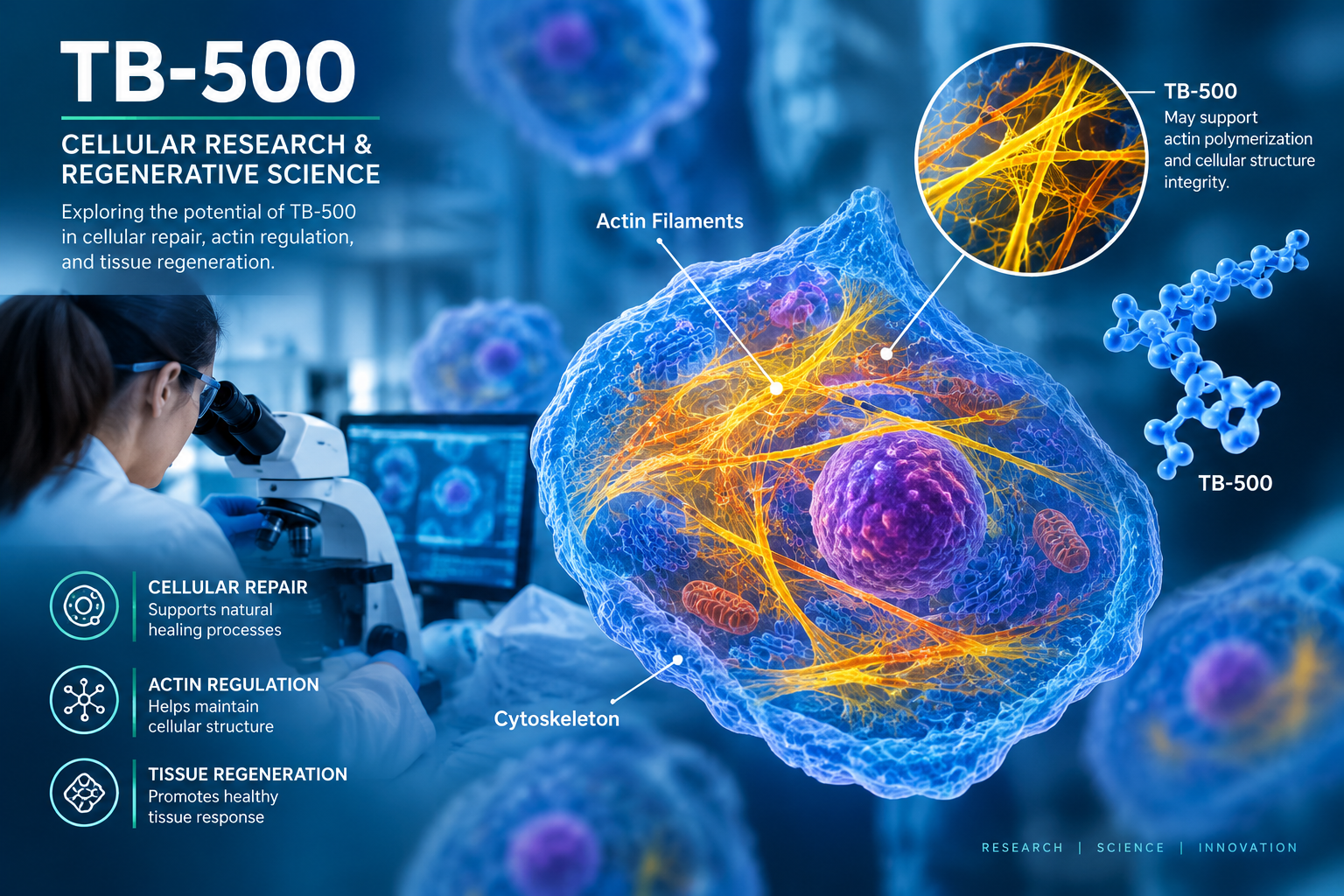
One area of scientific interest surrounding Thymosin Beta-4 involves its relationship with the actin cytoskeleton.
The actin cytoskeleton contributes to the internal organization of cells. It also plays a role in cellular movement and structural changes.
Because of this relationship, researchers can investigate Thymosin Beta-4-related biology using controlled experimental models.
For example, laboratory research may examine cellular morphology, molecular interactions, or cellular movement under defined conditions.
Importantly, these research areas should not be confused with claims about medical treatment.
Research investigates mechanisms and measurable observations. Clinical conclusions require separate evidence.
Therefore, TB-500 research is best described using precise scientific language.
Researchers may investigate a molecular process without assuming that the observed process represents a therapeutic effect.
This approach helps maintain scientific accuracy and improves the quality of research documentation.
🔬 TB-500 Thymosin Beta-4 in Molecular Biology Research
Molecular biology research often focuses on how biological molecules interact within controlled systems.
Peptides can be useful research materials in these settings because their molecular characteristics can be examined through analytical and experimental methods.
TB-500 may therefore be relevant to research projects examining peptide-related molecular behavior.
Depending on the research question, investigators may be interested in:
Molecular Characterization
Researchers can examine characteristics such as molecular identity and analytical profile.
Cellular Research
Controlled cellular models can be used to investigate biological processes associated with peptide research.
Protein and Cytoskeletal Research
Because Thymosin Beta-4 is associated with actin-related biology, researchers may investigate relevant molecular pathways and cellular structures.
Analytical Research
Laboratories can evaluate research materials using suitable analytical techniques to support identity and purity assessment.
Each application requires its own experimental design.
Therefore, there is no single research protocol that applies to every laboratory.
🧫 TB-500 and Cellular Research Models
Cell-based research provides researchers with a controlled environment for investigating biological processes.
When a peptide is studied in a cellular model, researchers can define experimental conditions and measure specific outcomes.
Depending on the study design, researchers may examine:
- Cell morphology
- Cellular organization
- Cell movement
- Cytoskeletal characteristics
- Molecular markers
- Protein interactions
- Experimental variability
- Changes under controlled conditions
These observations can then be compared with appropriate controls.
Furthermore, consistent experimental conditions help improve reproducibility.
Researchers should record the model used, experimental conditions, analytical methods, and relevant observations.
This makes later interpretation more reliable.
It also helps researchers distinguish genuine experimental trends from changes caused by methodology or environmental factors.
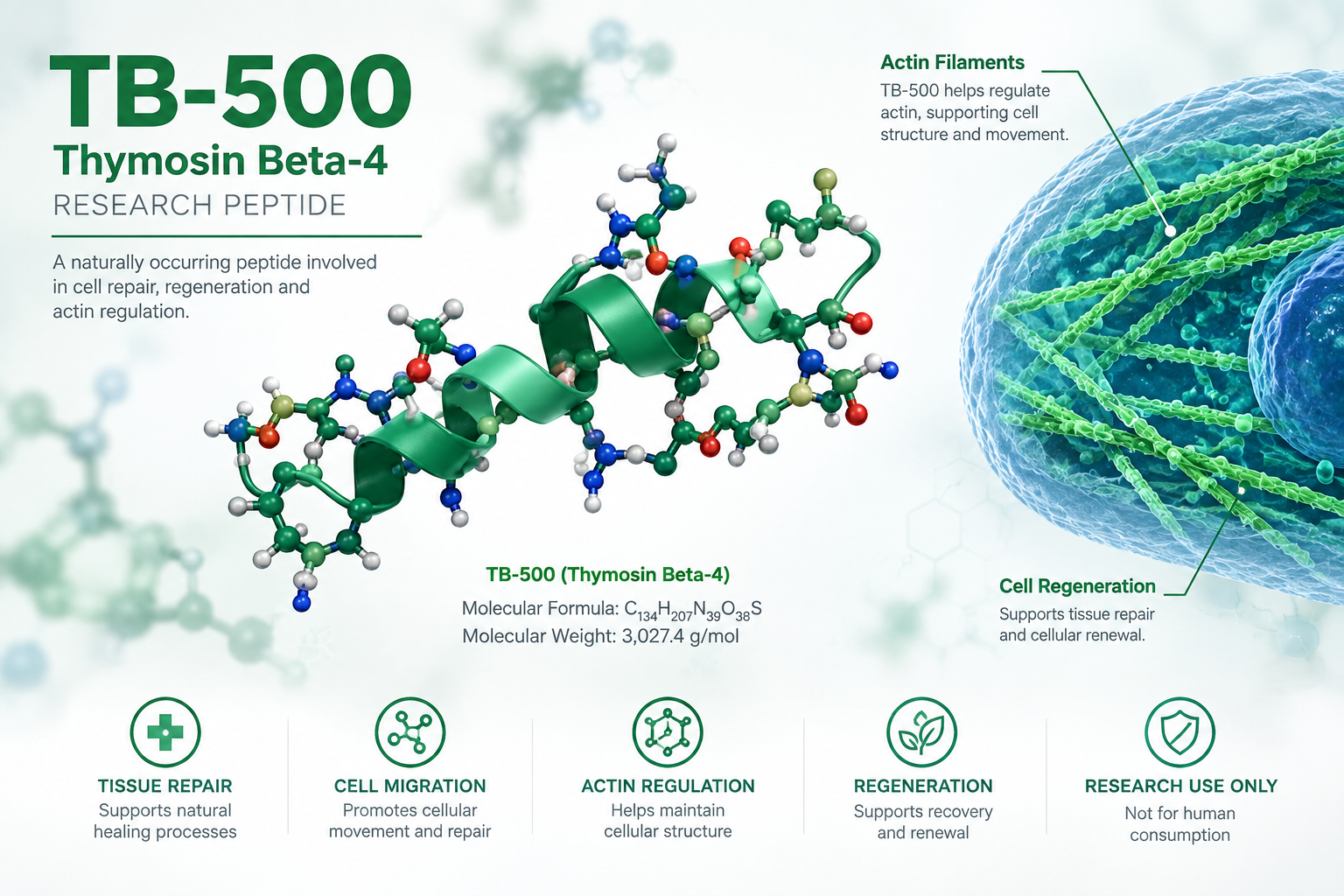
⚗️ Analytical Characterization of TB-500
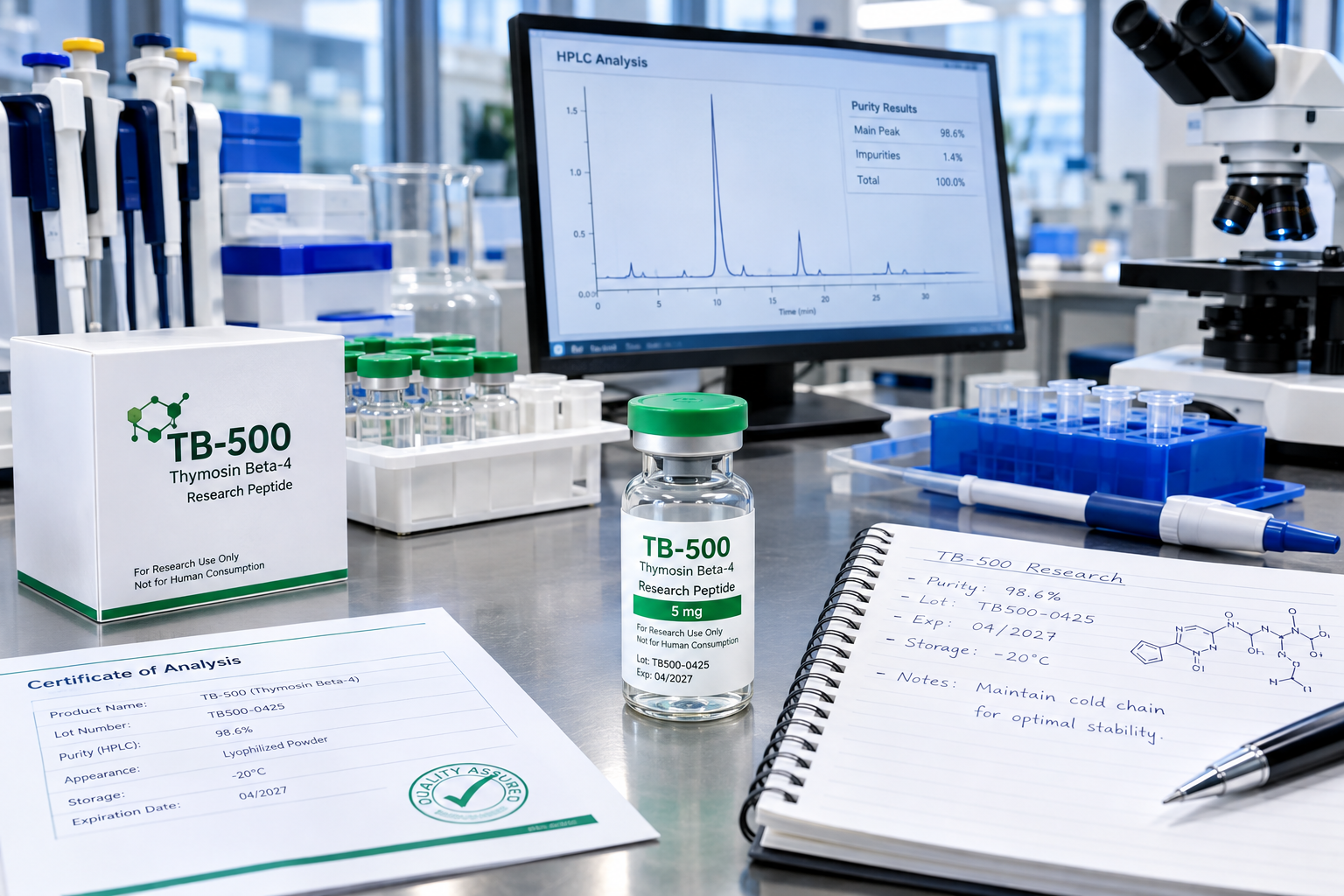
Analytical characterization is an important part of responsible peptide research.
The stated >99% purity specification provides useful information for researchers. However, the purity value should be interpreted within the context of the analytical method and available batch documentation.
Different analytical methods provide different types of information.
For example, chromatographic techniques can be used to examine sample composition and relative purity. Mass spectrometry can provide information relevant to molecular mass and identity.
Depending on the laboratory’s objectives, analytical characterization may therefore consider:
- Identity
- Molecular mass
- Relative purity
- Potential impurities
- Sample consistency
- Batch characteristics
- Analytical reproducibility
The exact analytical workflow should be selected according to the research question.
In addition, researchers should maintain records of the methods used to produce analytical results.
That documentation creates a stronger connection between the research material and the observations generated from it.
📋 TB-500 Purity and Quality Considerations
Purity is one of the most visible specifications when evaluating a research peptide.
TB-500 is listed with a stated purity of >99%.
Nevertheless, purity should not be treated as the only measure of research suitability.
A more complete evaluation can include product identity, batch information, analytical documentation, physical condition, and storage history.
This broader approach is useful because research quality depends on several factors.
For example, two materials may have similar stated purity values while having different documentation or analytical profiles.
Consequently, researchers should review all available information relevant to their specific study.
A well-documented research material makes it easier to track experimental inputs and interpret subsequent results.
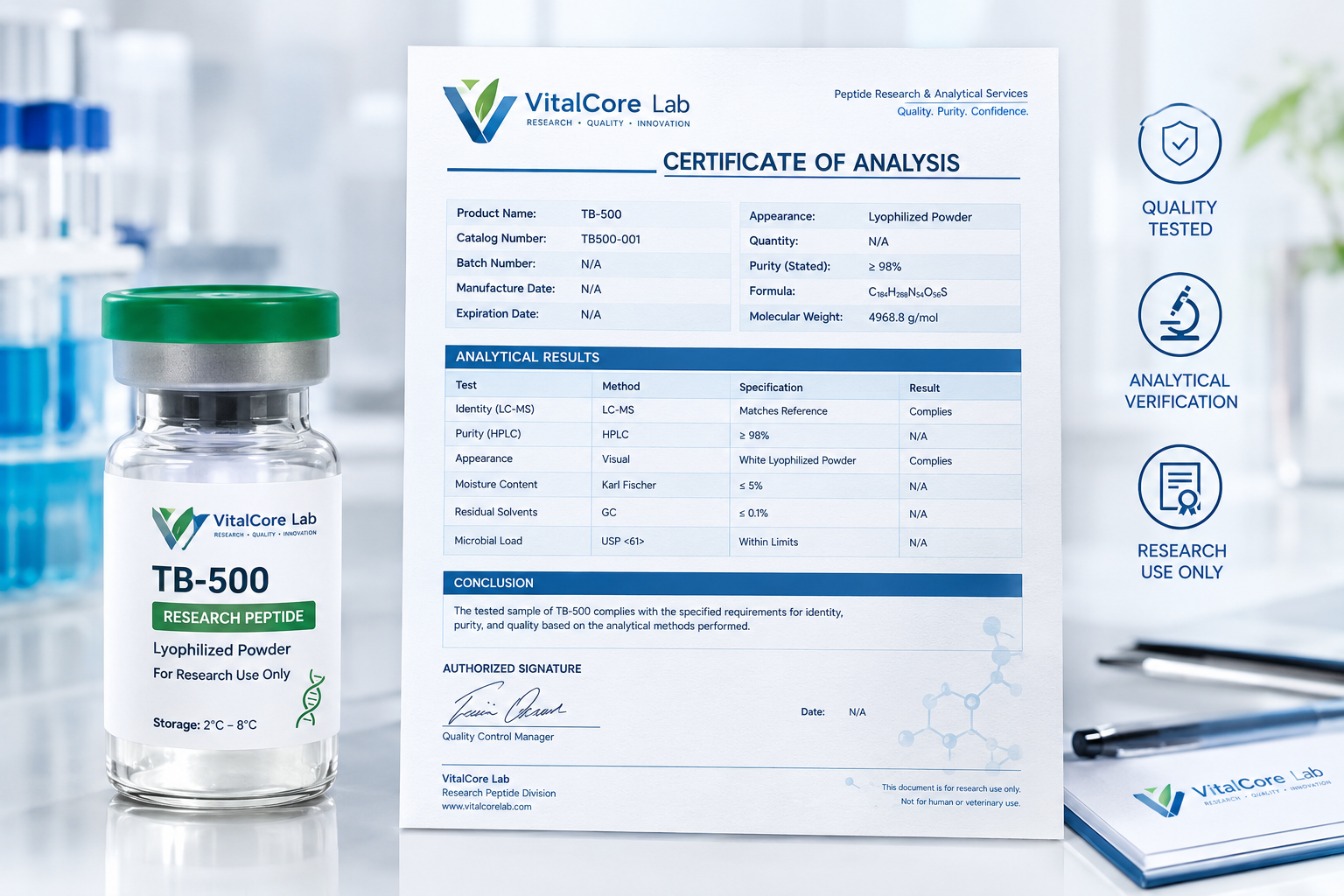
🧾 TB-500 Documentation and Batch Identification
Documentation is another important part of peptide research.
Researchers should be able to associate their material with appropriate product and batch information.
Useful records may include:
- Product name
- Batch or lot number
- Quantity
- Stated purity
- Date received
- Documentation provided
- Storage information
- Laboratory records
- Analytical results
Maintaining these records can improve traceability.
Furthermore, proper documentation makes future comparisons easier.
For example, if a researcher evaluates two different batches, clear records allow the researcher to distinguish material-related variables from experimental variables.
This can be especially useful in longer research projects.
🧬 TB-500 Research Applications
TB-500 can be positioned within several non-clinical research categories.
🔬 Molecular Research
Researchers may investigate peptide characteristics and molecular behavior within controlled laboratory environments.
🧪 Analytical Research
Analytical laboratories may examine identity, purity, molecular characteristics, and sample composition.
🧫 Cellular Research
Controlled cellular models can be used to investigate biological processes associated with Thymosin Beta-4 research.
📊 Comparative Research
Researchers may compare batches, samples, analytical results, or experimental conditions.
📋 Method Development
Research laboratories may investigate analytical approaches for peptide characterization and quality assessment.
These applications should always be guided by an appropriate scientific question.
The goal is not simply to obtain a result. Instead, the objective is to produce information that can be interpreted accurately within the limits of the experimental model.
⚠️ Research-Only Positioning
TB-500 should be treated as a research material.
It should not be presented as a medication, supplement, or therapeutic product.
Accordingly, this product description does not provide human-use instructions, administration instructions, dosing schedules, treatment protocols, or medical recommendations.
Instead, the information focuses on laboratory research.
This distinction also helps researchers understand how to interpret scientific literature.
A study involving a peptide does not automatically establish that the material is appropriate for clinical use.
Similarly, results from cellular models cannot automatically be applied to humans.
Therefore, research findings should always be interpreted according to the model and methodology used.
🧪 Laboratory Research Considerations
Before beginning a peptide research project, researchers should establish suitable laboratory procedures.
The specific approach will depend on the type of research being performed.
Analytical studies may require different procedures from cellular studies. Likewise, molecular characterization may require different equipment and controls from comparative experiments.
Therefore, researchers should determine their methodology before incorporating the material into the study.
A basic planning process can include:
- Define the research question.
- Select the appropriate experimental model.
- Confirm product identity.
- Review batch documentation.
- Establish analytical or experimental methods.
- Define appropriate controls.
- Record experimental conditions.
- Document observations.
- Evaluate results according to the study design.
This structured approach can improve consistency.
It can also make later analysis easier.
🔎 TB-500 and Scientific Literature
Scientific literature is an important resource when researching peptides.
However, researchers should examine publications carefully.
The exact material studied in a publication should be identified. Researchers should also review the experimental model, methodology, concentration conditions, controls, and measured outcomes.
This is particularly important with terminology involving TB-500 and Thymosin Beta-4.
Commercial product names and scientific terminology are not always interchangeable.
Therefore, a careful literature review can help researchers understand exactly what molecule or material was examined in a particular study.
It can also prevent overinterpretation.
For example, a result observed in an in-vitro model should not automatically be interpreted as evidence of a corresponding effect in humans.
Scientific conclusions must remain connected to the evidence supporting them.
🧪 TB-500 Laboratory Research Environment
A professional research environment requires more than the research material itself.
Researchers also need appropriate equipment, documentation, controls, and established laboratory procedures.
When studying TB-500, the surrounding research environment can influence the quality of the resulting data.
For that reason, researchers should maintain consistent conditions wherever practical.
Important considerations may include:
- Controlled experimental conditions
- Accurate recordkeeping
- Appropriate analytical equipment
- Sample identification
- Batch traceability
- Validated research procedures
- Appropriate controls
- Consistent measurement methods
Together, these elements support more reliable research.
📊 TB-500 Research Evaluation Checklist
Researchers can use a simple checklist when evaluating a research peptide.
| Research Area | What to Review |
|---|---|
| Identity | Product and batch identification |
| Purity | Stated purity and analytical information |
| Documentation | Available batch records |
| Research Model | Suitability for the planned study |
| Methodology | Appropriate laboratory procedures |
| Records | Experimental conditions and observations |
This checklist is intentionally straightforward.
Good research does not require complicated documentation for every situation. However, the essential information should be recorded consistently.
As a result, researchers can more easily understand their materials and compare observations over time.
🧠 Responsible Interpretation of TB-500 Research
Responsible interpretation is just as important as responsible experimentation.
Research results should be evaluated according to the evidence generated by the specific study.
For example, an observation in a cell model provides information about that model. It does not automatically establish the same outcome in another biological system.
Likewise, an analytical result provides information about the material under the conditions of that analytical method.
Therefore, researchers should avoid making conclusions that extend beyond the evidence.
This approach creates clearer scientific communication.
It also reduces confusion between laboratory research and clinical claims.
🔬 Why Research Documentation Matters
Research documentation provides a record of what was studied and how it was studied.
For TB-500 research, documentation can help connect the product to its specific batch and analytical information.
Moreover, good records make research easier to reproduce.
When researchers document the material, methodology, conditions, and observations, they create a stronger foundation for future analysis.
This is especially valuable when multiple experiments are performed.
Over time, consistent records can reveal patterns that may otherwise be difficult to identify.
Therefore, documentation is not simply administrative work. It is an important part of the research process.
🧪 TB-500 Research Peptide Summary
TB-500 is a peptide research material associated with Thymosin Beta-4 research.
Its scientific relevance includes research areas involving molecular biology, cellular organization, actin-associated processes, peptide characterization, and analytical investigation.
The Vital Core Lab product is available in 2mg to 20mg quantities and carries a stated purity of >99%.
Researchers should nevertheless evaluate the material using appropriate documentation and analytical information.
Furthermore, scientific literature should be interpreted carefully. The experimental model and methodology always matter.
Most importantly, TB-500 should remain positioned as a laboratory research material rather than a therapeutic product.
This research-focused approach provides clearer information for laboratories while avoiding unsupported medical conclusions.
🔬 Final TB-500 Research Perspective
Peptide research continues to provide valuable opportunities for studying molecular and cellular processes.
TB-500, in the context of Thymosin Beta-4 research, can be considered within controlled laboratory investigations involving peptide characterization and cellular biology.
However, responsible research requires precision.
Researchers should verify the identity of their material, review available documentation, establish appropriate experimental procedures, and record their observations carefully.
In addition, findings should remain within the limits of the research model.
The TB-500 | Thymosin Beta-4 | 2mg – 20mg | >99% Purity product is therefore presented by Vital Core Lab as a research-focused material for laboratory and analytical investigation.
🧪 Research use only. Not intended for human or veterinary use.
Reviews
There are no reviews yet.