



AICAR
🔬 AICAR for AMPK and Metabolic Research
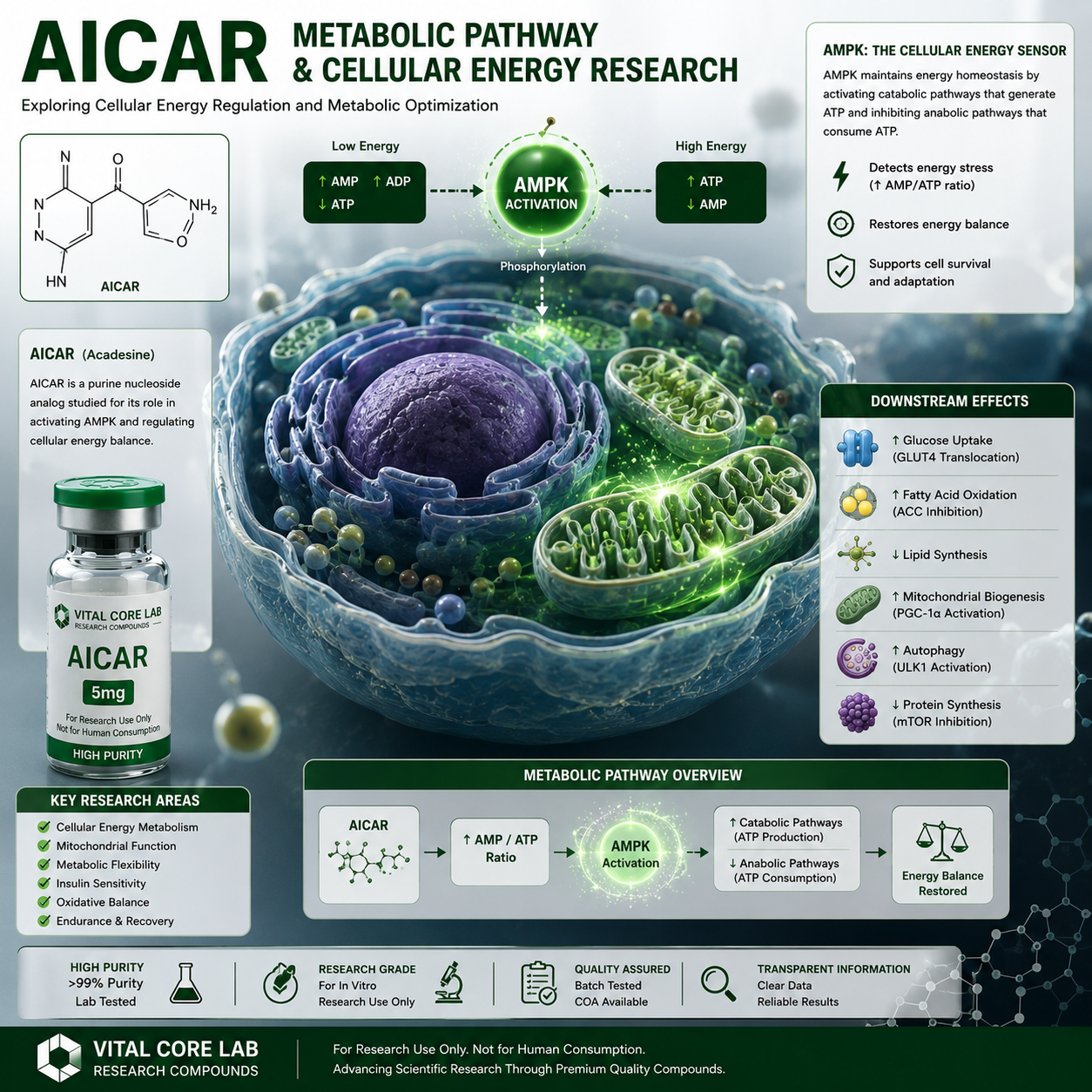
AICAR is a research compound studied in laboratory settings involving AMP-activated protein kinase (AMPK), cellular energy sensing, metabolic pathways, and related biochemical processes. It is also known as Acadesine or AICA-riboside.
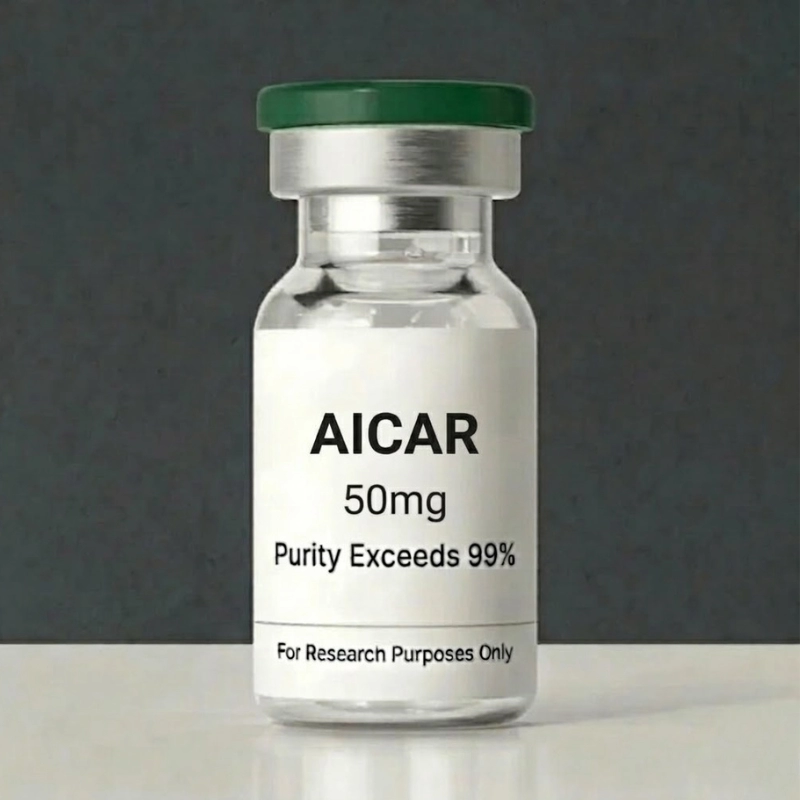
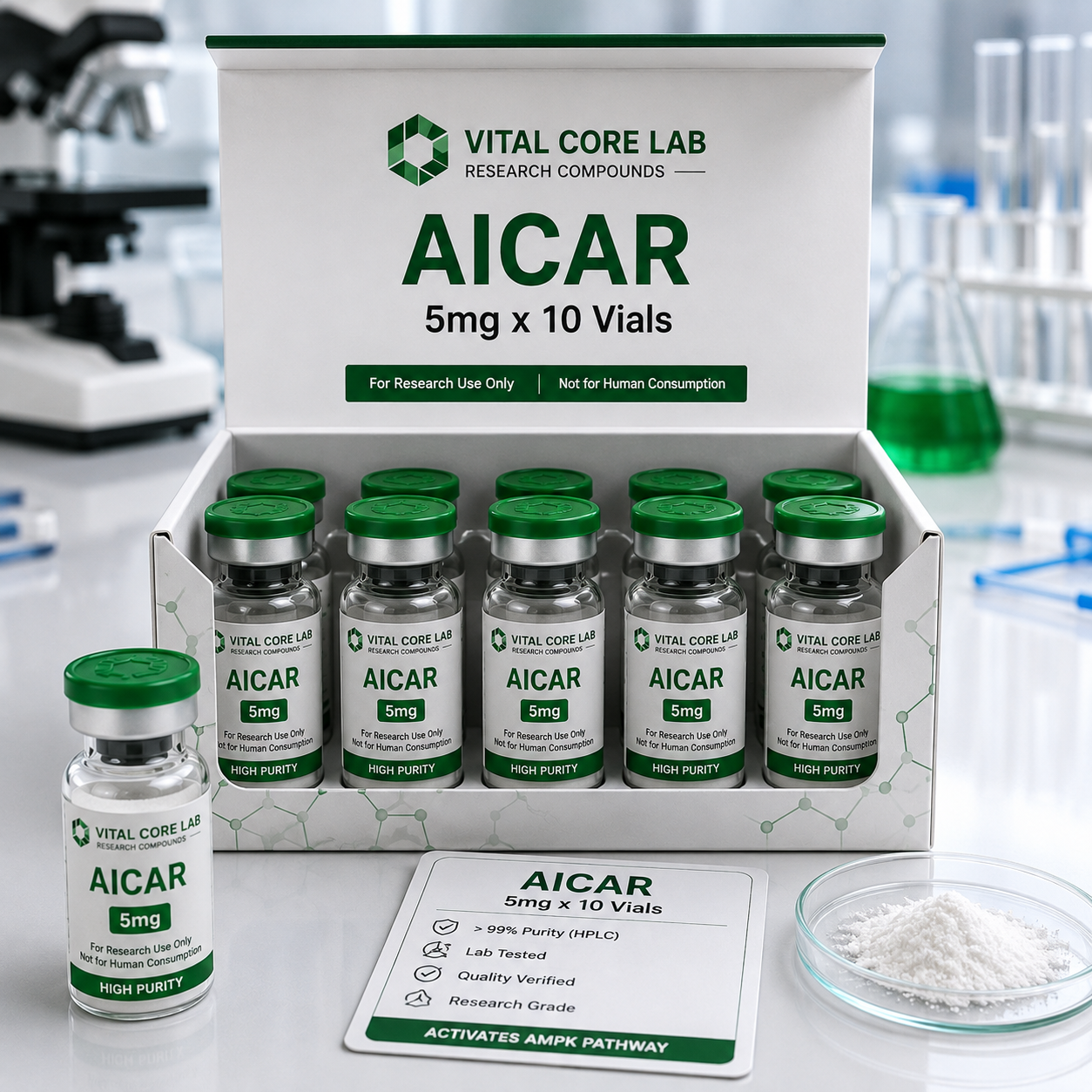
This AICAR product is supplied as a 5mg × 10 vials kit, providing ten individual vials for controlled laboratory research. Each vial contains 5mg, giving the kit a total listed content of 50mg.
Additionally, this product is listed at >99% purity, subject to applicable product and batch documentation. Therefore, researchers should review the available specifications and quality information before beginning experimental work.
AICAR is commonly used as an experimental research tool in studies involving cellular energy pathways. Furthermore, researchers may investigate its relationship with AMPK-related signaling, metabolic processes, cellular responses, and biochemical activity.
However, biological systems are complex. Therefore, results can vary depending on the research model, experimental design, exposure conditions, analytical methods, and controls used.
For this reason, every experiment should be carefully planned and documented.
⚠️ For research use only. Not for human or animal consumption.
🧪 AICAR Product Specifications
| Specification | Product Information |
|---|---|
| Product Name | AICAR |
| Alternative Names | Acadesine, AICA-riboside |
| Product Type | Research compound |
| Format | 5mg × 10 vials |
| Vials per Kit | 10 |
| Content per Vial | 5mg |
| Total Kit Content | 50mg |
| Purity Listing | >99%, subject to applicable documentation |
| Molecular Formula | C₉H₁₄N₄O₅ |
| Molecular Weight | 258.23 g/mol |
| CAS Number | 2627-69-2 |
| Research Focus | AMPK and metabolic signaling research |
| Intended Use | Laboratory and scientific research only |
⚗️ Understanding AICAR Research
🧬 AICAR and Cellular Energy Research
Cells constantly monitor and respond to changes in energy availability. Therefore, scientists study signaling systems that help regulate cellular energy status.
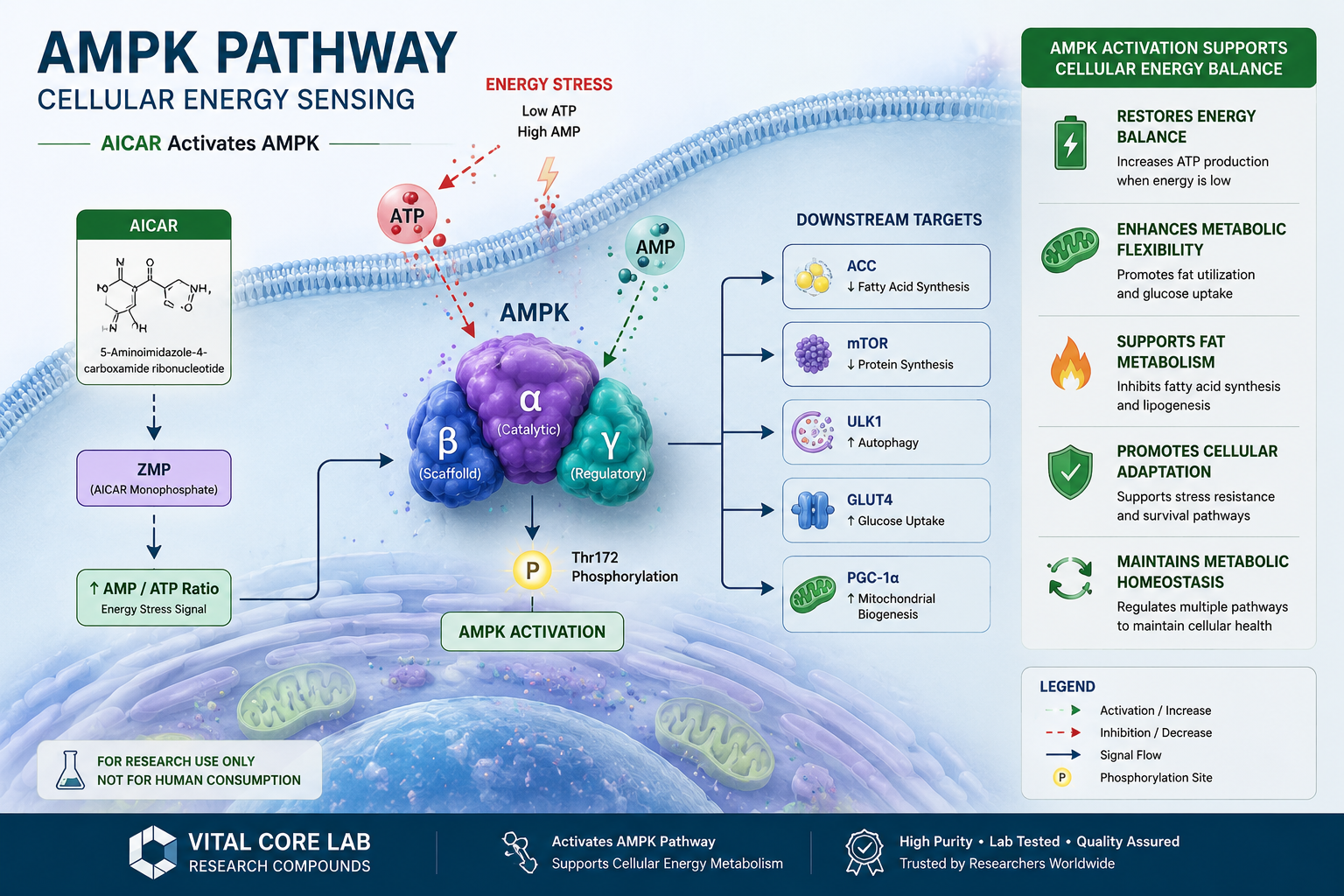
One important research target is AMP-activated protein kinase, commonly called AMPK. AMPK is involved in many cellular processes connected with energy sensing and metabolic regulation.
AICAR is widely used as an experimental compound in this research area. Once it enters cells, it can be converted into an AMP-related molecule that may influence AMPK-related signaling and other cellular processes.
As a result, AICAR research can provide useful experimental models for investigating cellular energy responses.
Researchers may study areas such as:
- AMPK-related signaling
- Cellular energy sensing
- Metabolic pathway regulation
- Glucose-related cellular responses
- Lipid metabolism research
- Mitochondrial research
- Skeletal muscle research
- Cellular stress responses
However, one experimental compound should not be used as the only method for assigning a specific biological mechanism.
Therefore, suitable controls and additional research methods may be important.
🔬 AICAR and AMPK Research
AICAR is closely associated with experimental research involving AMPK.
AMPK is an important cellular energy sensor. When researchers study changes in cellular energy conditions, they may examine AMPK-related signaling together with other biochemical markers.
Furthermore, AICAR can be used to investigate changes in selected cellular pathways under controlled laboratory conditions.
Researchers may examine:
- Phosphorylation markers
- Metabolic enzyme activity
- Cellular energy status
- Glucose-related pathways
- Lipid-related pathways
- Gene expression
- Cellular signaling
- Biochemical responses
However, an observed response does not automatically identify the exact pathway responsible.
For example, different experimental systems can produce different results. Likewise, cell type, tissue model, concentration, exposure time, and analytical method may affect the findings.
Therefore, researchers should interpret results according to the exact conditions used in each experiment.
⚙️ AICAR and Metabolic Research
🧪 AICAR Research in Metabolic Pathways
Metabolism involves many connected biological and biochemical processes. Cells must manage energy production, energy use, nutrient sensing, and molecular signaling.
Therefore, researchers study compounds such as AICAR when investigating how experimental systems respond to changes in metabolic conditions.
AICAR research may involve controlled studies of cellular energy pathways, metabolic markers, and AMPK-related signaling.
For example, researchers may investigate:
- Cellular glucose handling
- Energy sensing pathways
- Metabolic enzyme activity
- Nutrient-response signaling
- Cellular adaptation
- Mitochondrial metabolism
- Lipid-related pathways
Additionally, researchers may compare different experimental conditions to examine how selected markers respond.
However, results depend heavily on the research system.
For instance, findings from cultured cells may differ from findings in isolated tissue. Similarly, results from one laboratory model may not apply to another model.
Consequently, each study should clearly define its methods and limitations.
🔬 AICAR and Glucose Signaling Research
Glucose-related signaling is another important area of metabolic research.
Cells respond to changes in nutrient availability through complex signaling networks. Therefore, researchers may investigate how specific pathways respond under controlled conditions.
AICAR can be used as an experimental research compound in studies involving selected glucose-related pathways.
Possible research questions may involve:
- Cellular glucose uptake
- Metabolic signaling markers
- Energy-dependent enzyme activity
- AMPK-related responses
- Cellular nutrient sensing
- Biochemical pathway regulation
Furthermore, researchers may compare experimental groups with appropriate controls.
This can help identify differences in selected biochemical markers.
Nevertheless, findings must always be interpreted within the limits of the experimental design.
As a result, researchers should avoid applying conclusions beyond the specific conditions that were tested.
🧬 AICAR and Lipid Metabolism Research
Researchers also study AICAR in experimental models involving lipid metabolism and energy regulation.
Metabolic pathways are closely connected. Therefore, changes in one pathway may influence other cellular processes.
AICAR-related studies may investigate:
- Fatty acid metabolism
- Cellular lipid pathways
- Metabolic enzyme activity
- Energy utilization
- Cellular signaling
- Metabolic pathway interactions
Additionally, researchers may examine selected biochemical markers associated with cellular energy status.
However, these research contexts are not product promises.
They do not mean that this product produces weight loss or any guaranteed physiological outcome.
Instead, they describe broader scientific areas in which AICAR-related pathways may be investigated.
🧫 AICAR and Exercise Research
⚡ AICAR in Skeletal Muscle Research
AICAR has also been studied in research involving skeletal muscle metabolism and energy-related biological pathways.
Scientists investigate how skeletal muscle cells respond to changes in energy demand. Consequently, AMPK-related pathways remain an important subject in laboratory research involving muscle metabolism.
AICAR research may examine molecular responses connected with:
- Skeletal muscle metabolism
- Cellular energy sensing
- AMPK-related signaling
- Glucose-related pathways
- Lipid metabolism
- Mitochondrial biology
- Cellular adaptation
Furthermore, these studies can help researchers examine selected molecular and biochemical responses under controlled conditions.
However, laboratory research should not be confused with personal-use claims.
This product page does not claim that AICAR improves athletic performance, endurance, strength, recovery, or physical fitness.
Instead, the information describes research contexts only.
🧪 AICAR and Mitochondrial Research
Mitochondria are important sites of energy production and metabolic activity.
Therefore, researchers often investigate how cellular energy pathways interact with mitochondrial processes.
AICAR may be used in controlled studies involving metabolism, cellular energy regulation, and selected mitochondrial markers.
Possible research areas include:
- Cellular respiration
- Energy metabolism
- Mitochondrial signaling
- Metabolic adaptation
- Oxidative metabolism
- Cellular energy sensing
Additionally, researchers may compare changes in metabolic markers under different experimental conditions.
However, mitochondrial systems are highly complex.
Therefore, researchers should avoid assuming that every observed change results from one pathway alone.
Careful controls and appropriate analytical methods can help support more accurate interpretation.
📊 AICAR Research Information at a Glance
| Feature | Product Information |
|---|---|
| 🔬 Product | AICAR |
| 🧪 Alternative Names | Acadesine / AICA-riboside |
| 📦 Format | 5mg × 10 vials |
| ⚗️ Research Focus | AMPK and metabolic signaling |
| 🧬 Research Areas | Metabolic and cellular research |
| ⚡ Related Research | Energy sensing and muscle metabolism |
| 🧫 Research Setting | Controlled laboratory studies |
| ✨ Purity Listing | >99%, subject to documentation |
| 📄 Documentation | Review applicable batch information |
| ⚠️ Use Restriction | Research use only |
📄 AICAR Quality and Documentation
Quality information is important for responsible laboratory research.
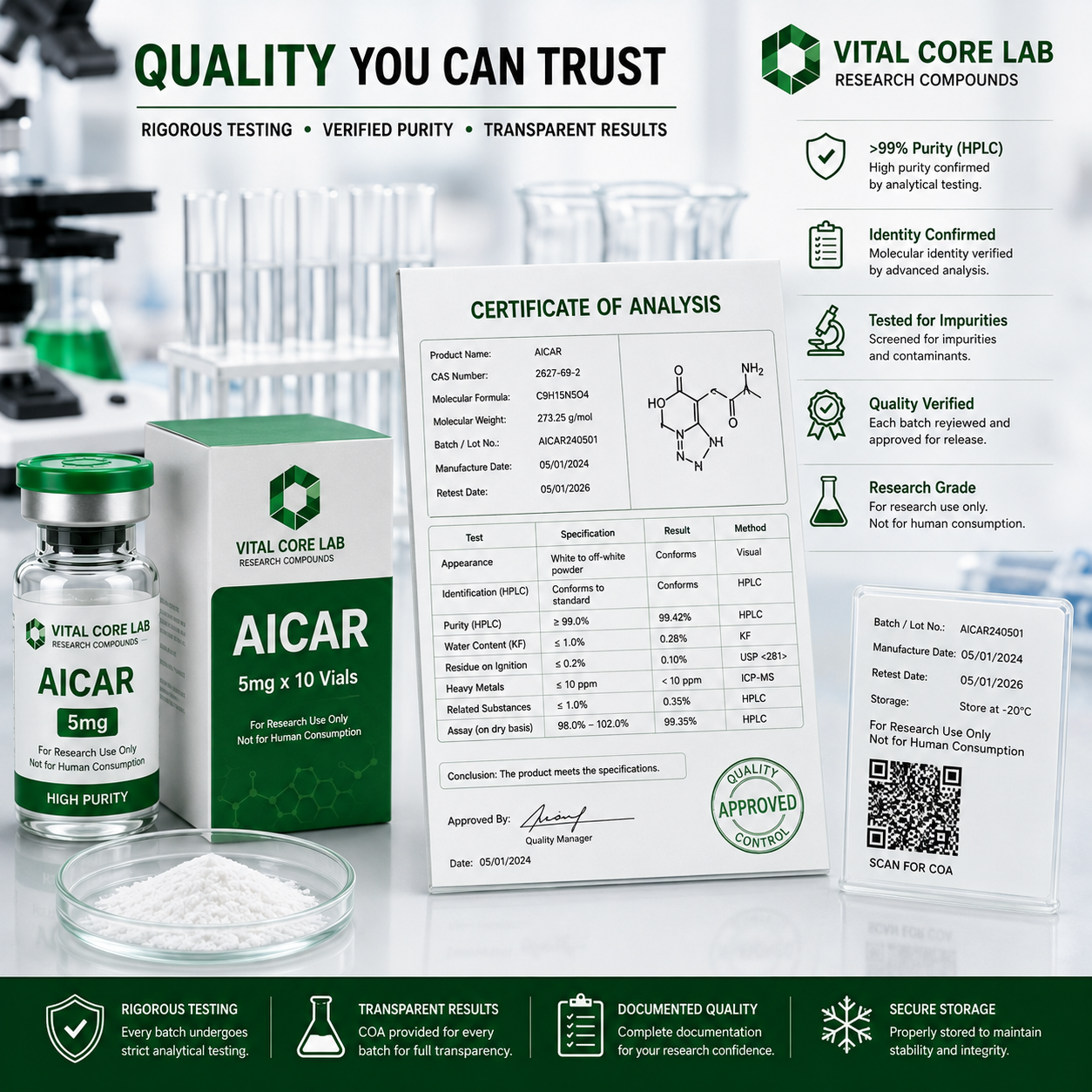
Therefore, researchers should review the documentation available for the specific product and batch before beginning experimental work.
Depending on the available records, documentation may include:
- Product identity
- Batch or lot number
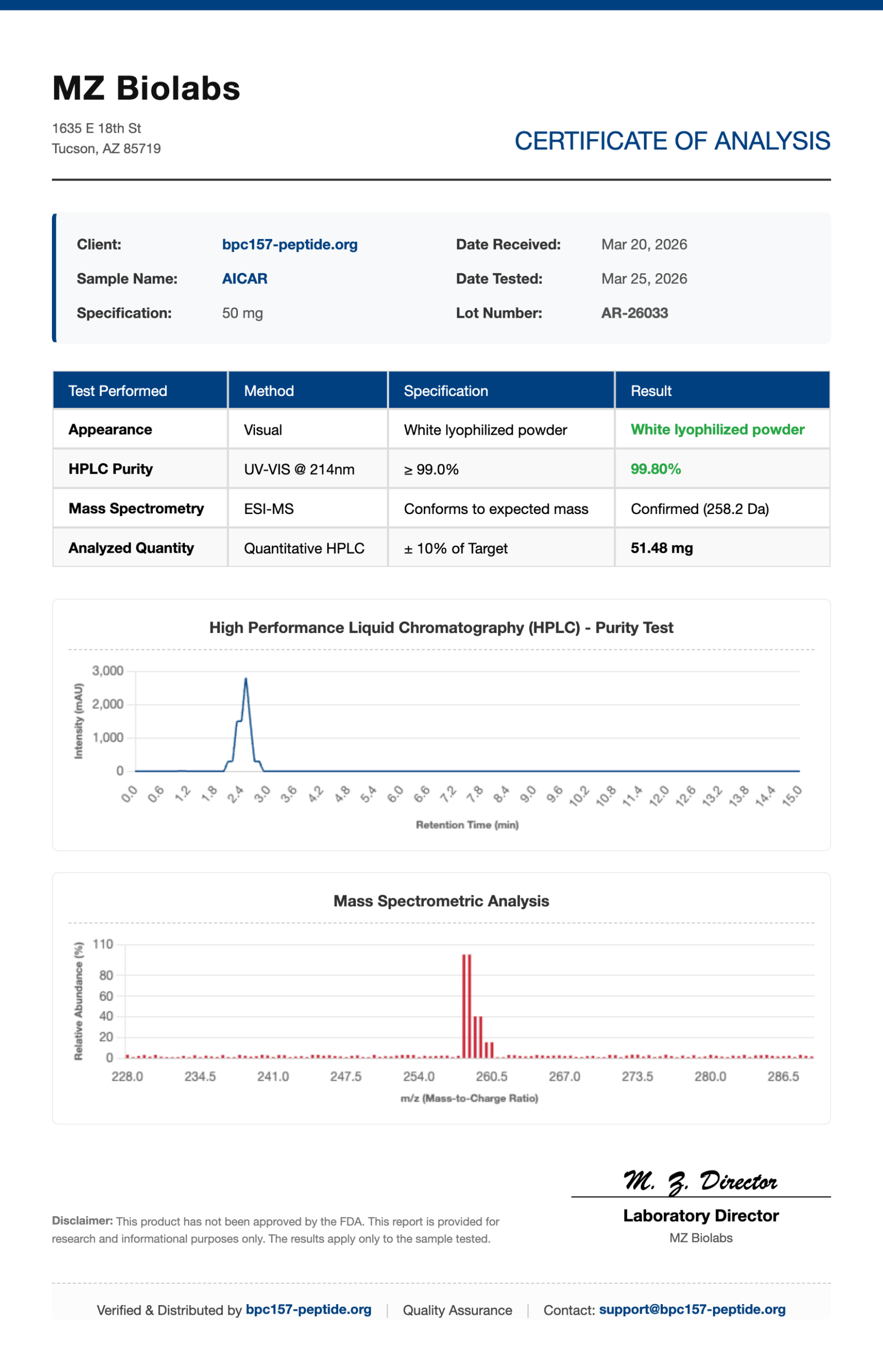
- Purity information
- Analytical data
- Product specifications
- Storage information
- Handling guidance
The >99% purity statement should be supported by applicable product or batch documentation.
Furthermore, researchers should distinguish between general scientific information about AICAR and verified information about the exact material supplied.
Accurate records can also support better research organization.
Therefore, product identification and batch information should be documented throughout the research process.
🧊 AICAR Storage and Handling
Proper handling is important for laboratory research.
Therefore, AICAR should be stored according to the instructions provided on the actual product label and applicable documentation.
Researchers should review:
- Storage conditions
- Light protection requirements
- Moisture protection requirements
- Container integrity
- Product identification
- Batch information
- Handling procedures
Do not publish a specific storage temperature unless it is confirmed by your actual product documentation.
Furthermore, laboratories should maintain clear procedures for receiving, storing, handling, and documenting research materials.
Accurate records can help researchers maintain consistency throughout the study.
⚠️ Important AICAR Research Use Notice
AICAR is intended strictly for research and laboratory purposes.
⚠️ Not for human consumption.
⚠️ Not for animal consumption.
This product is not presented as a medicine, dietary supplement, or approved treatment.
Furthermore, this page does not provide:
- Dosing instructions
- Administration instructions
- Personal-use recommendations
- Weight-loss instructions
- Athletic-performance instructions
- Medical treatment advice
Scientific research involving AICAR may examine multiple biological and biochemical pathways. However, general research findings do not automatically establish safety, effectiveness, or identical outcomes for a specific commercial research material.
Therefore, researchers are responsible for selecting appropriate methods, controls, and procedures.
🛒 AICAR 5mg × 10 Vials Research Kit
This AICAR product is supplied as a 5mg × 10 vials research kit.
The kit contains ten individual vials and provides 50mg total listed product content.
Before ordering, researchers should review the available product information. Additionally, they should confirm that the product specifications match their laboratory requirements.
Furthermore, applicable batch documentation should be reviewed where available.
This product may be relevant to controlled studies involving:
- AICAR research
- AMPK research
- Cellular energy signaling
- Metabolic pathway research
- Skeletal muscle research
- Glucose-related signaling
- Lipid metabolism research
- Mitochondrial research
Nevertheless, suitability depends on the specific experimental objective.
🔬 Research-focused product information.
🧪 5mg × 10 vials format.
📄 Review applicable product and batch documentation.
Reviews
There are no reviews yet.