



🧬 HGH 191AA Somatropin Overview
HGH 191AA Somatropin is a well-characterized form of human growth hormone consisting of 191 amino acids. It is widely studied within endocrinology, molecular biology, protein science, metabolic research, and muscle physiology.
Because of its defined protein sequence, HGH 191AA provides researchers with a useful subject for investigating growth hormone biology and related signaling pathways. Research can examine how growth hormone interacts with its receptor and how these interactions connect with downstream biological systems.
HGH 191AA research also extends into areas such as body-composition biology, protein metabolism, lipid metabolism, cellular signaling, and endocrine communication.
Furthermore, growth hormone research often involves the relationship between growth hormone and insulin-like growth factor 1, commonly known as IGF-1. This signaling relationship is an important area of biological investigation.
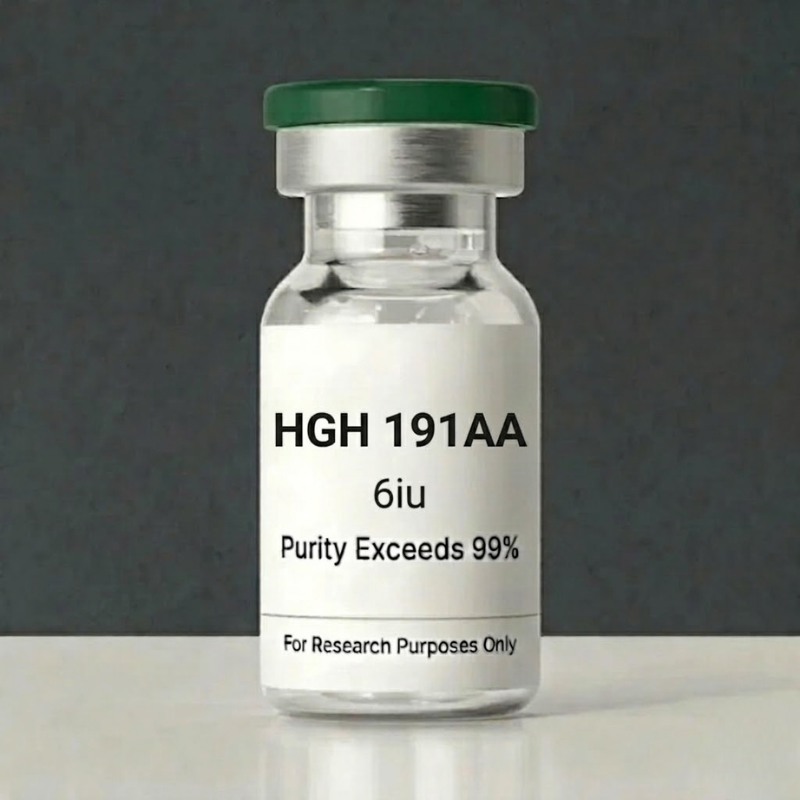
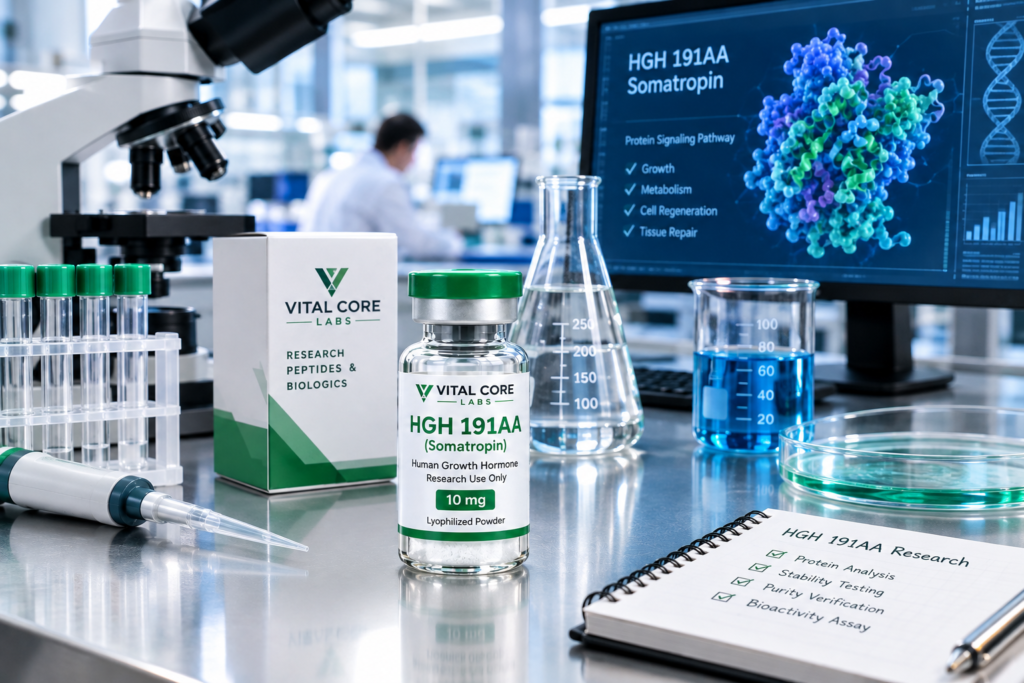
Vital Core Lab offers HGH 191AA in 6IU, 12IU, 24IU, and 36IU options, with a stated purity of >99%.
🔬 HGH 191AA and Human Growth Hormone Biology
Human growth hormone is a peptide hormone produced naturally by the pituitary gland. It plays a complex role in growth, metabolism, tissue biology, and endocrine signaling.
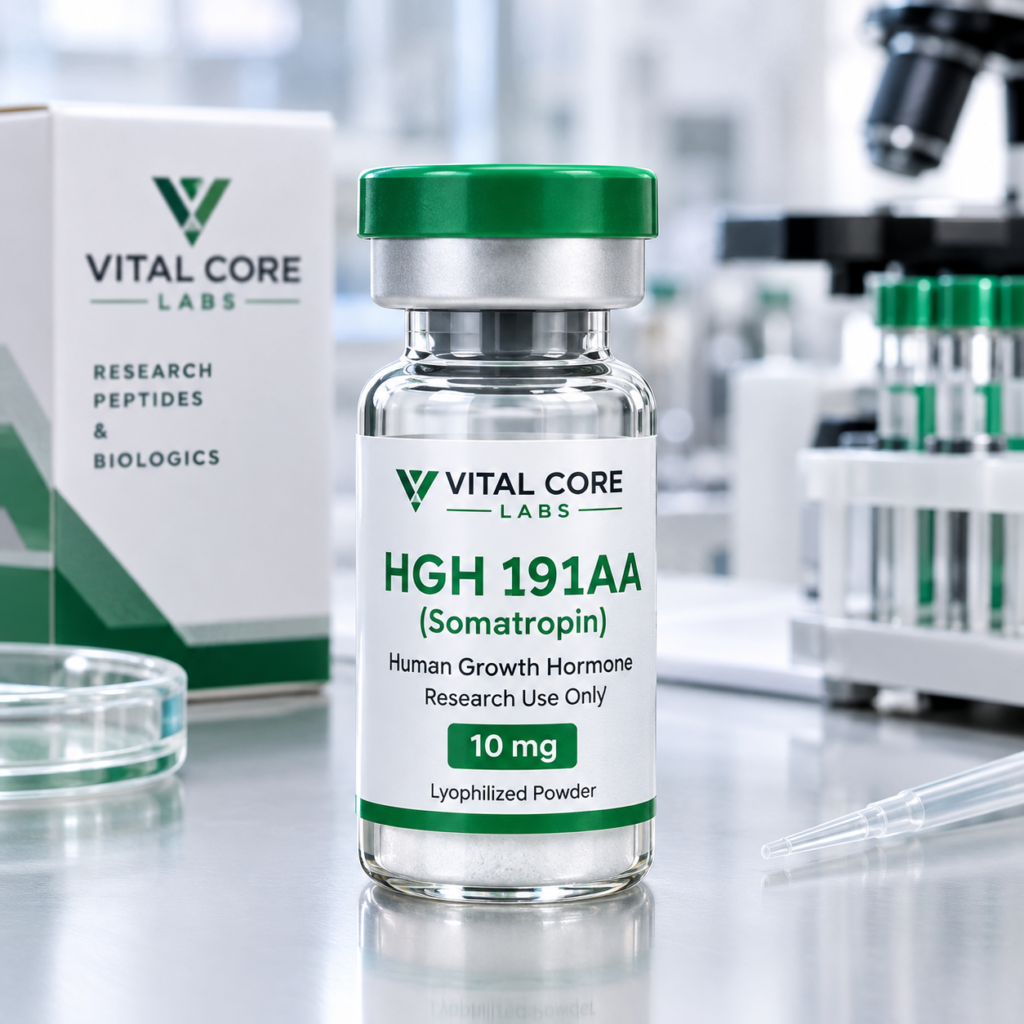
HGH 191AA refers to the 191-amino-acid form associated with human growth hormone.
Its structure provides an important foundation for research. Scientists can study the protein itself while also examining its interaction with biological systems.
Growth hormone signaling is not limited to one pathway. Instead, it involves several connected mechanisms. Therefore, researchers may examine receptor activity, intracellular signaling, IGF-1 production, metabolic processes, and tissue-specific responses.
This broad biological profile makes HGH 191AA relevant to several fields of scientific research.
HGH 191AA Somatropin and Growth Hormone Signaling
Growth hormone signaling begins when the hormone interacts with the growth hormone receptor.
This receptor interaction can activate intracellular signaling pathways. These pathways can then influence cellular activity and gene expression.
One important pathway involves the JAK2 and STAT signaling system. Other signaling mechanisms can also contribute to the biological response associated with growth hormone.
Consequently, HGH 191AA research can provide opportunities to investigate:
- Growth hormone receptor interactions
- JAK2-related signaling
- STAT pathway activity
- Cellular communication
- Hormonal signaling networks
- Downstream biological responses
These mechanisms are studied to better understand how protein hormones communicate with cells.
🧬 HGH 191AA and IGF-1 Pathways
One of the most important areas associated with growth hormone research is the relationship between HGH and IGF-1.
Growth hormone can influence IGF-1 signaling through complex endocrine and tissue-specific mechanisms. IGF-1 is involved in several biological processes, including cellular growth, protein metabolism, and tissue signaling.
For this reason, researchers often examine growth hormone and IGF-1 together.
Research into the HGH–IGF-1 relationship can include:
- Hormone signaling
- Receptor activity
- Cellular responses
- Protein metabolism
- Tissue biology
- Endocrine feedback systems
This provides a broader picture than examining HGH alone.
💪 HGH 191AA and Muscle Physiology Research
Muscle physiology is another important area of HGH 191AA research.
Growth hormone signaling has been studied in relation to skeletal muscle, protein metabolism, connective tissue, and body composition.
Researchers can examine how hormonal signals interact with muscle-related cellular processes. They can also investigate the relationship between growth hormone and other endocrine signals.
However, muscle biology is highly complex. Many factors contribute to muscle development and maintenance. Hormones represent only one part of that larger system.
Therefore, HGH 191AA research should be considered within the broader context of muscle physiology.
Research topics may include:
- Skeletal muscle signaling
- Protein turnover
- Cellular communication
- Growth-related pathways
- Body-composition biology
- Endocrine interactions
🔬 HGH 191AA Research on Lean-Tissue Biology
Lean-tissue biology provides another area for investigation.
Growth hormone and related endocrine pathways have been studied in connection with protein metabolism and tissue development.
Researchers can examine how growth hormone signaling relates to protein synthesis, protein breakdown, and tissue remodeling.
These processes involve multiple biological pathways. Therefore, laboratory studies can help isolate specific mechanisms and examine them under controlled conditions.
HGH 191AA can consequently serve as a research material for investigating the molecular basis of these processes.
⚗️ HGH 191AA and Lipolysis Research
Growth hormone is also associated with research into lipid metabolism.
Lipolysis refers to the breakdown of stored triglycerides into fatty acids and related components. Hormonal signaling can influence this process through several mechanisms.
Because of this relationship, HGH research can be relevant to investigations of lipid mobilization and metabolic signaling.
Researchers may examine:
- Lipid metabolism
- Fatty-acid availability
- Hormonal signaling
- Metabolic regulation
- Cellular energy pathways
Importantly, these areas involve complex biological systems. Research findings from one model cannot automatically be applied to every individual or situation.
💤 HGH 191AA and Sleep-Related Research
Sleep and endocrine biology are also connected areas of scientific research.
Growth hormone secretion naturally follows patterns influenced by sleep and circadian biology. In particular, growth hormone secretion has been studied in relation to different stages of sleep.
This makes HGH 191AA relevant to research examining the relationship between endocrine signaling and sleep physiology.
Researchers may investigate:
- Hormonal secretion patterns
- Sleep-stage biology
- Circadian regulation
- Endocrine feedback
- Hormone-related signaling
Such research can help scientists better understand how physiological systems communicate over time.
🧬 HGH 191AA Protein Structure
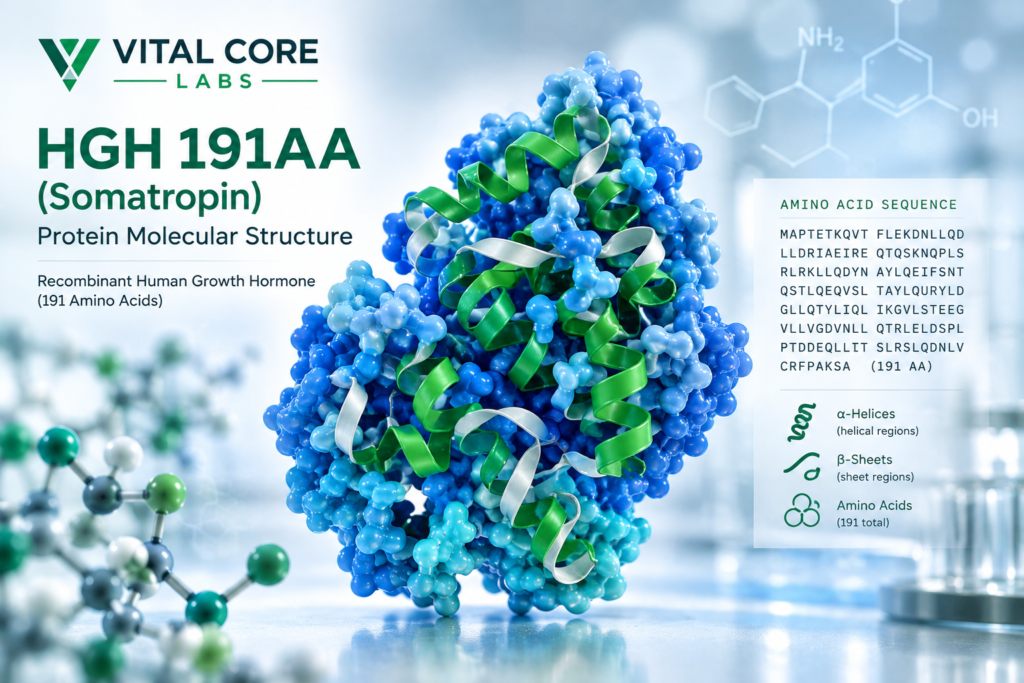
HGH 191AA is defined by its 191-amino-acid protein sequence.
Protein structure is important because biological activity depends on molecular shape and conformation. Changes in protein structure can influence how a molecule interacts with its target.
Consequently, structural research can examine the relationship between:
Amino-acid sequence → protein folding → molecular structure → receptor interaction → biological signaling
This framework is useful in modern protein science.
Protein Research Characteristics
| Characteristic | Research relevance |
|---|---|
| 191-amino-acid sequence | Defines the molecular identity |
| Protein structure | Supports structural and molecular studies |
| Molecular mass | Useful for analytical identification |
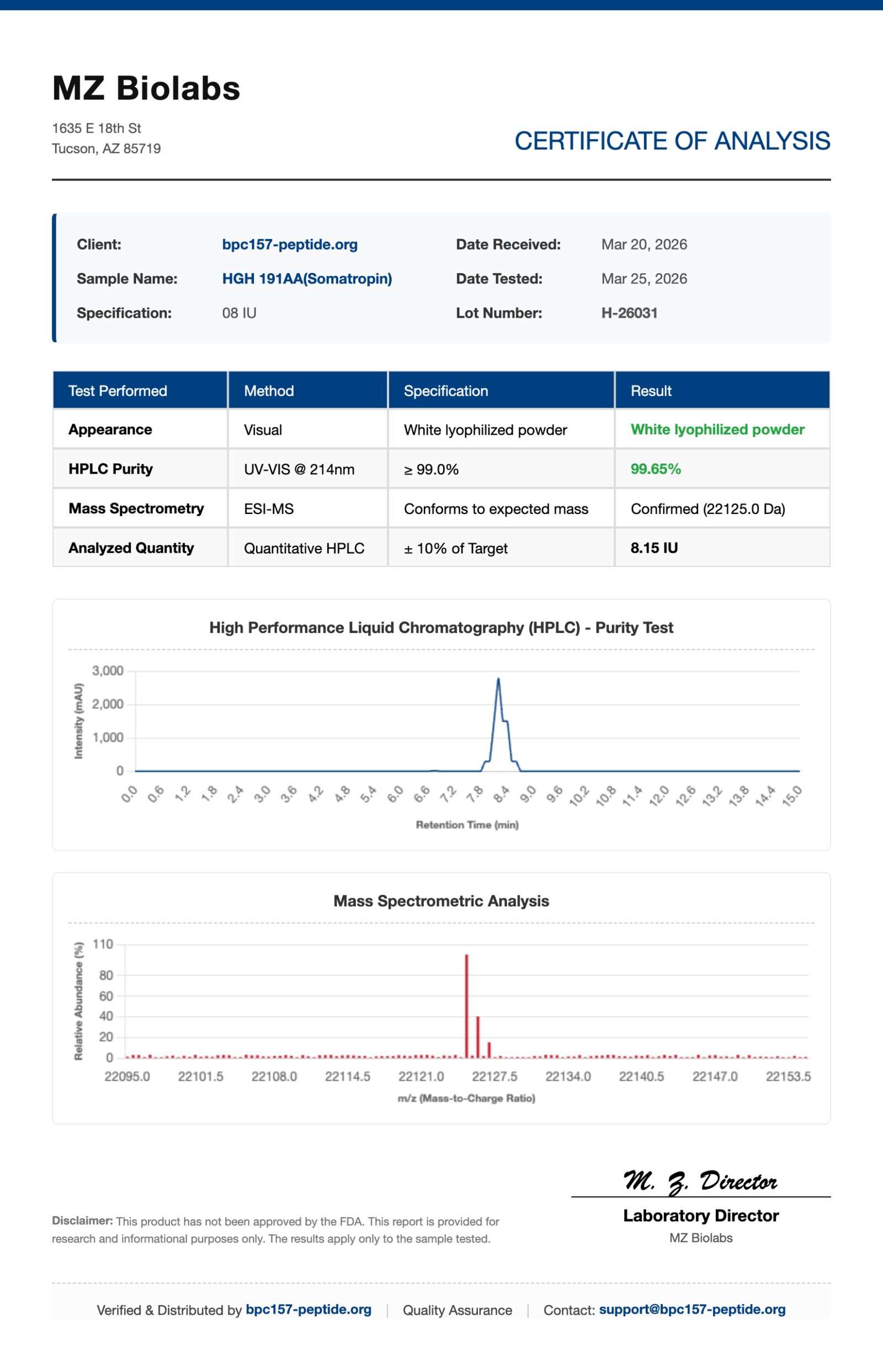
| Purity profile | Supports sample characterization |
| Stability | Helps evaluate behavior under different conditions |
These characteristics can be evaluated using appropriate laboratory methods.
🧪 HGH 191AA Analytical Characterization
Analytical characterization is an important part of peptide and protein research.
Researchers may use different analytical methods depending on the scientific question.
Chromatographic techniques can help evaluate sample composition. Mass spectrometry can assist with molecular identification. Other protein-analysis techniques may provide additional information about sample characteristics.
Together, these methods can create a more complete analytical profile.
For HGH 191AA, analytical research may focus on:
- Molecular identity
- Purity
- Molecular mass
- Sample composition
- Protein integrity
- Stability characteristics
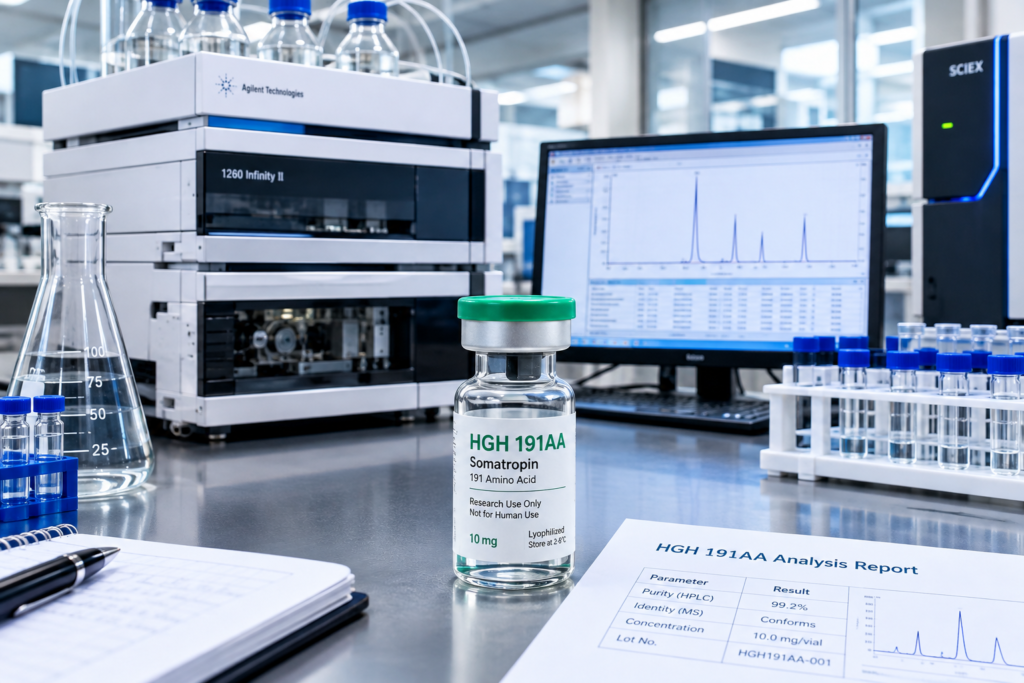
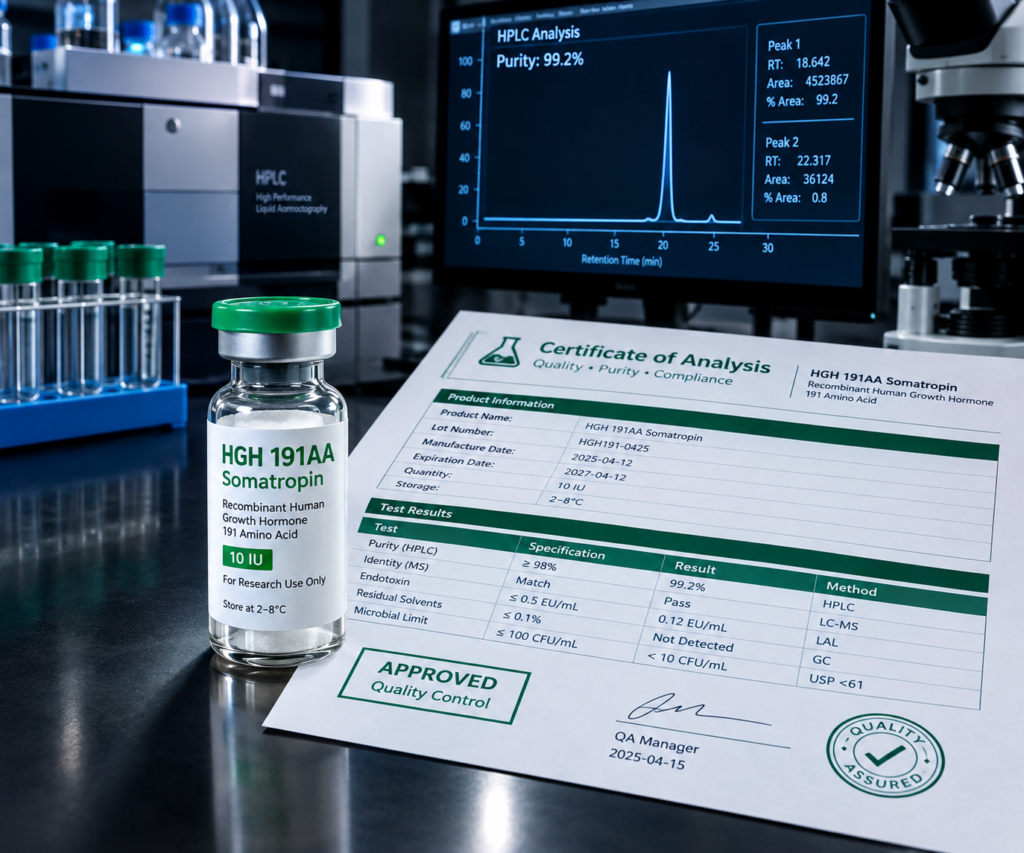
The stated >99% purity is a product specification. It should therefore be considered alongside available batch documentation and analytical data.
📊 HGH 191AA Product Specifications
Vital Core Lab HGH 191AA Somatropin is available in several quantity options.
| Option | Stated purity | Product format |
|---|---|---|
| 6IU | >99% | HGH 191AA Somatropin |
| 12IU | >99% | HGH 191AA Somatropin |
| 24IU | >99% | HGH 191AA Somatropin |
| 36IU | >99% | HGH 191AA Somatropin |
These options allow researchers and qualified buyers to select a quantity that fits their intended application.
Product specifications should always be evaluated together with the relevant batch information and available Certificate of Analysis.
🧪 HGH 191AA and Laboratory Quality
Quality evaluation is an important part of peptide and protein research.
A product’s stated purity provides one useful specification. However, researchers often consider several characteristics when evaluating a biological material.
These may include identity, purity, molecular mass, appearance, stability, and batch documentation.
A Certificate of Analysis can provide additional information about a particular batch. Therefore, COA information can be useful when maintaining laboratory records or comparing research materials.
Furthermore, researchers should consider the analytical method used to establish a particular result. Different methods provide different types of information.
This is why a complete quality profile is more informative than relying on one specification alone.
🔬 HGH 191AA and Endocrine Research
Endocrine research examines how hormones communicate throughout biological systems.
Growth hormone is an important component of this field because its signaling involves multiple tissues and pathways.
Researchers can examine growth hormone receptor activity, downstream signaling, endocrine feedback, and relationships with other hormones.
HGH 191AA therefore fits into a broad scientific area that includes:
- Hormone signaling
- Receptor biology
- Protein science
- Metabolic research
- Muscle physiology
- Cellular communication
- Endocrine regulation
These areas continue to be investigated through laboratory, preclinical, and clinical research.
🧬 HGH 191AA and Body-Composition Research
Body composition involves several biological components, including lean tissue and fat tissue.
Hormonal signaling can influence processes related to protein and lipid metabolism. Growth hormone is therefore frequently examined within body-composition research.
Researchers may investigate how growth hormone signaling interacts with:
- Protein metabolism
- Lipid metabolism
- Tissue growth
- Energy regulation
- IGF-1 signaling
- Muscle-related pathways
However, body composition is influenced by many variables. Nutrition, physical activity, genetics, age, sleep, and other hormones can all contribute.
Therefore, HGH research represents one part of a much larger scientific picture.
🧪 HGH 191AA and Modern Protein Research
Modern protein research combines molecular biology, analytical chemistry, structural biology, and biochemistry.
HGH 191AA is particularly relevant because its molecular identity is well defined.
Researchers can therefore study the relationship between protein structure and biological signaling.
Advanced analytical tools can also help investigate protein characteristics with increasing precision.
As a result, HGH 191AA can be useful within research programs that examine protein hormones and their biological pathways.
🔎 HGH 191AA Purity and Analytical Data
The stated >99% purity specification provides an important product reference.
However, purity is only one aspect of analytical characterization.
Researchers may also consider molecular identity, protein integrity, batch consistency, and other available quality information.
This broader approach helps create a more complete understanding of a research material.
For this reason, researchers should review available documentation associated with the specific product batch whenever possible.
🧬 HGH 191AA Somatropin Research Summary
HGH 191AA Somatropin is a 191-amino-acid form of human growth hormone that remains an important subject in peptide, protein, endocrine, and metabolic research.
Its scientific relevance includes growth hormone receptor signaling, IGF-1 pathways, muscle physiology, lean-tissue biology, lipid metabolism, sleep-related endocrine research, and protein characterization.
The molecule’s defined structure also makes it suitable for analytical investigation.
Vital Core Lab offers HGH 191AA in 6IU–36IU options with a stated purity of >99%.
For researchers and qualified buyers, product specifications, analytical information, and batch documentation can provide useful information when evaluating the material.



Reviews
There are no reviews yet.