
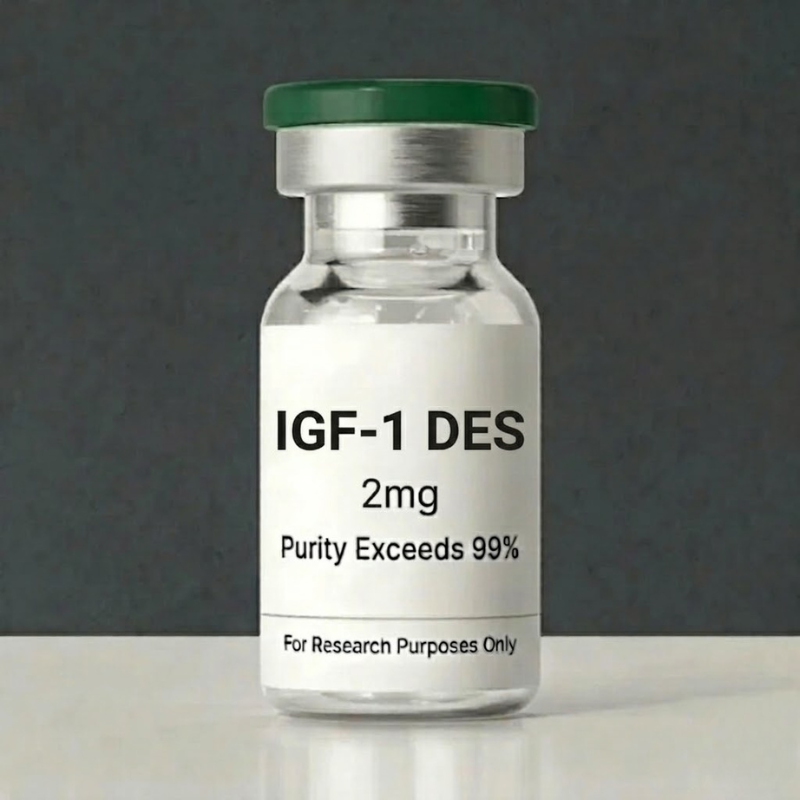



IGF-1 DES (Targeted Hyperplasia) >99% Purity
IGF-1 DES is a modified form of insulin-like growth factor 1 (IGF-1) that has attracted attention because of its distinct molecular characteristics and localized biological activity. This peptide is commonly discussed in connection with cellular signaling, muscle tissue studies, growth-factor pathways, and mechanisms associated with IGF-related activity. 🧬
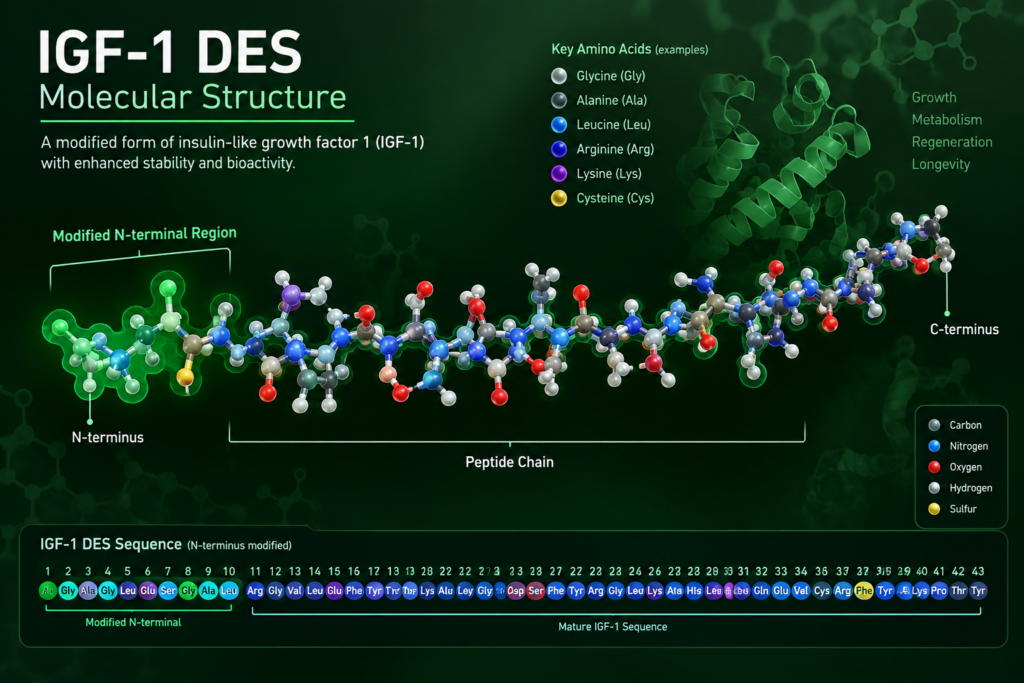
The IGF-1 DES sequence differs from standard IGF-1 because of a specific modification at the N-terminal region. This structural difference can influence how the peptide interacts with biological systems. Therefore, IGF-1 DES is an interesting subject for laboratory investigation involving growth-factor signaling and related cellular pathways.
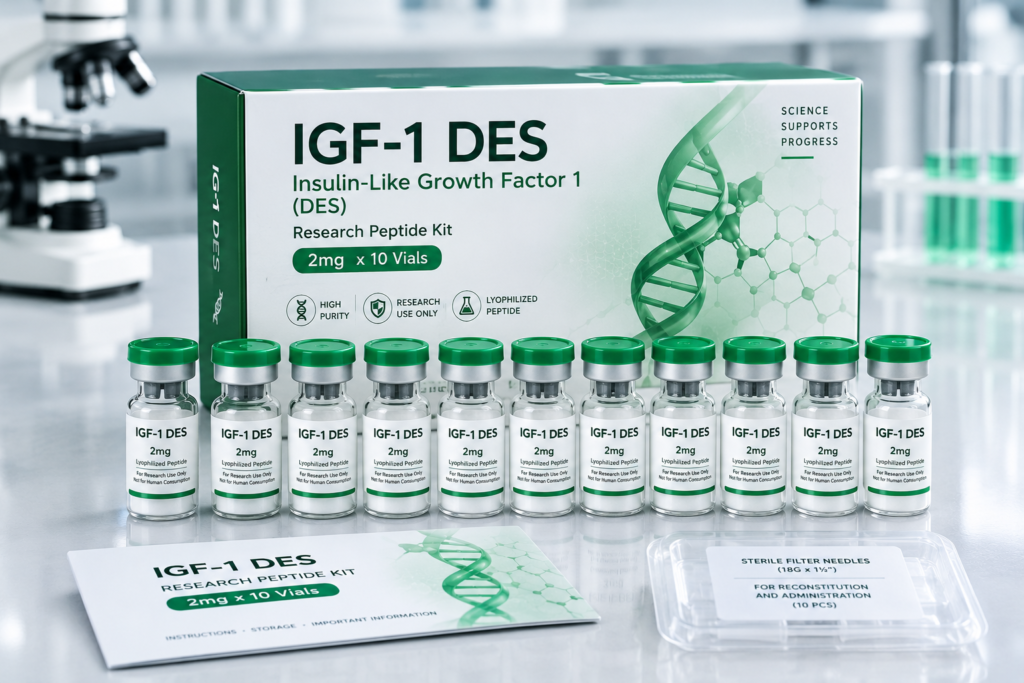
This product is supplied as a 2mg x 10 vials kit. Each vial contains 2mg of IGF-1 DES, providing a total kit quantity of 20mg. The product is listed at >99% purity, making documented composition and analytical quality important considerations when evaluating the material. 🔬
Understanding IGF-1 DES
IGF-1 DES is closely related to insulin-like growth factor 1, a naturally occurring peptide involved in complex cellular signaling processes. However, IGF-1 DES has a modified molecular structure that gives it a distinct profile from conventional IGF-1.
The name “DES” refers to the removal of three amino acids from the N-terminal portion of the IGF-1 molecule. This relatively small structural change is scientifically important. Even minor changes in peptide structure can alter receptor interactions, molecular behavior, and biological activity.
Because of this, IGF-1 DES is often examined separately from standard IGF-1. Researchers studying peptide structure and growth-factor signaling can use the differences between these molecules to better understand how sequence modifications influence biological behavior.
The peptide is particularly interesting when studying pathways associated with cellular growth, differentiation, and tissue signaling. 🧬
IGF-1 DES Molecular Characteristics
The structure of a peptide plays an important role in its activity. IGF-1 DES is derived from the IGF-1 framework but contains an N-terminal modification.
This modification creates a molecule with a different molecular profile compared with full-length IGF-1. As a result, IGF-1 DES can be considered a useful molecular model when examining how peptide structure affects biological interactions.
The peptide belongs to the broader IGF family of growth-related signaling molecules. These molecules are involved in communication between cells and can influence several interconnected pathways.
However, biological activity is not determined by molecular identity alone. Experimental conditions, peptide integrity, concentration, formulation, and analytical quality can all affect observed results.
For this reason, a clearly identified and well-characterized peptide is important when conducting controlled laboratory work.
IGF-1 DES and Growth-Factor Signaling
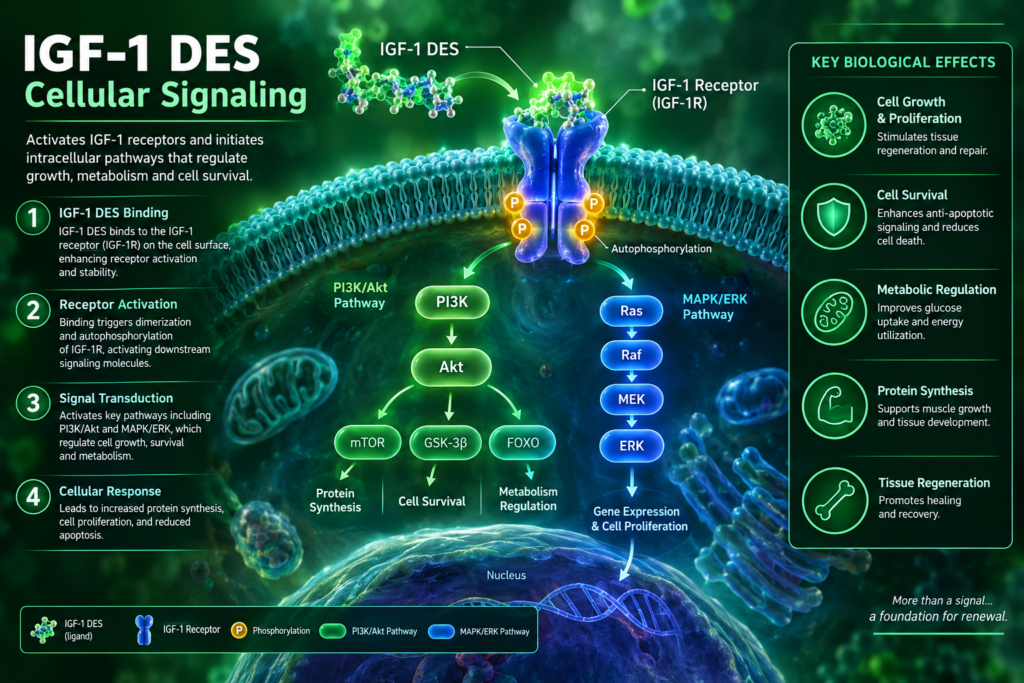
Growth-factor signaling is an important area of molecular biology. It describes the way specific molecules communicate with cells and influence cellular processes.
IGF-related pathways are especially interesting because they involve interactions between growth factors, receptors, intracellular signaling proteins, and cellular responses.
IGF-1 DES provides a distinct molecular model for examining these relationships. Its modified structure allows researchers to compare its characteristics with other IGF-related peptides.
These comparisons can help illustrate how changes in peptide sequence may affect biological interactions.
Furthermore, studying modified peptide molecules can provide broader insight into receptor binding, signaling pathways, and structure-function relationships.
The value of this type of investigation comes from controlled comparison. Instead of looking at a single peptide in isolation, researchers can examine related molecules and determine how specific structural differences correspond with different experimental observations.
IGF-1 DES and Cellular Activity
Cellular activity involves many interconnected processes. Growth factors can participate in signaling networks that influence cell communication, protein synthesis, differentiation, and other biological functions.
IGF-1 DES is of interest in this area because its modified structure may produce characteristics that differ from full-length IGF-1.
The peptide therefore provides a useful molecular subject for controlled studies involving IGF-related signaling.
Importantly, cellular responses can vary depending on the model being studied. Results observed in one experimental system should not automatically be applied to another system.
This is why controlled conditions and appropriate analytical methods are important when evaluating peptide activity.
In addition, the quality of the starting material can affect experimental consistency. A highly purified peptide can help reduce uncertainty associated with unwanted impurities.
Key Product Specifications
IGF-1 DES | 2mg x 10 Vials Kit | >99% Purity is designed as a clearly identified peptide product with defined vial quantities and stated purity.
| Product Attribute | Specification |
|---|---|
| Product | IGF-1 DES |
| Kit Size | 2mg x 10 Vials |
| Total Quantity | 20mg |
| Stated Purity | >99% |
| Format | Lyophilized peptide |
| Peptide Family | IGF-related peptide |
The 10-vial format provides multiple individually packaged units. This can be useful when separate experimental preparations or controlled sample handling are required.
The stated purity of >99% also provides an important reference point when evaluating product quality. Purity is one part of overall peptide characterization and should be considered alongside identity, analytical documentation, storage conditions, and batch information.
Why IGF-1 DES Is Scientifically Interesting
IGF-1 DES is interesting because a relatively small molecular modification can produce a peptide with characteristics that distinguish it from its parent molecule.
This makes it particularly valuable for structure-function investigations.
For example, scientists can examine how the removal of amino acids from the N-terminal region changes peptide behavior. Such comparisons are useful for understanding the relationship between molecular structure and biological activity.
Moreover, IGF-1 DES can be considered alongside other IGF-related molecules when studying growth-factor signaling.
This approach provides a broader view of peptide biology. Instead of focusing only on one molecule, investigators can compare related structures and examine their differences.
As a result, IGF-1 DES fits naturally into studies involving peptide chemistry, molecular biology, cellular signaling, and growth-factor pathways. 🔬
IGF-1 DES Structure and Peptide Quality
Peptide quality begins with accurate molecular identity.
For IGF-1 DES, the structural modification is an important defining characteristic. Therefore, product identity and analytical characterization are valuable when assessing the material.
Purity is also significant. A stated purity of greater than 99% indicates a high-purity material based on the applicable analytical measurement.
However, purity and identity are separate characteristics. A material may have a high purity percentage while still requiring appropriate identity confirmation.
Therefore, analytical documentation can provide additional information about a specific batch.
This is especially useful when reproducibility matters. Consistent materials help create better-controlled experimental conditions and make comparisons between samples more meaningful.
IGF-1 DES Compared With Full-Length IGF-1
IGF-1 DES and full-length IGF-1 share a closely related molecular framework. Yet they are not identical peptides.
The primary distinction is the modification at the N-terminal region of IGF-1 DES. This structural difference is central to understanding why the two molecules may demonstrate different characteristics.
| Feature | IGF-1 DES | Full-Length IGF-1 |
|---|---|---|
| Molecular family | IGF-related | IGF-related |
| Structure | Modified IGF-1 form | Full-length IGF-1 |
| N-terminal region | Modified | Complete |
| Scientific interest | Structure-function and signaling studies | Growth-factor signaling studies |
| Product identity | IGF-1 DES | IGF-1 |
This comparison highlights an important principle in peptide science: structural similarity does not necessarily mean identical biological behavior.
Even a limited sequence modification can change molecular interactions. Consequently, each peptide should be evaluated according to its own identity and characteristics.
Analytical Considerations for IGF-1 DES
Analytical testing is an important part of peptide characterization.
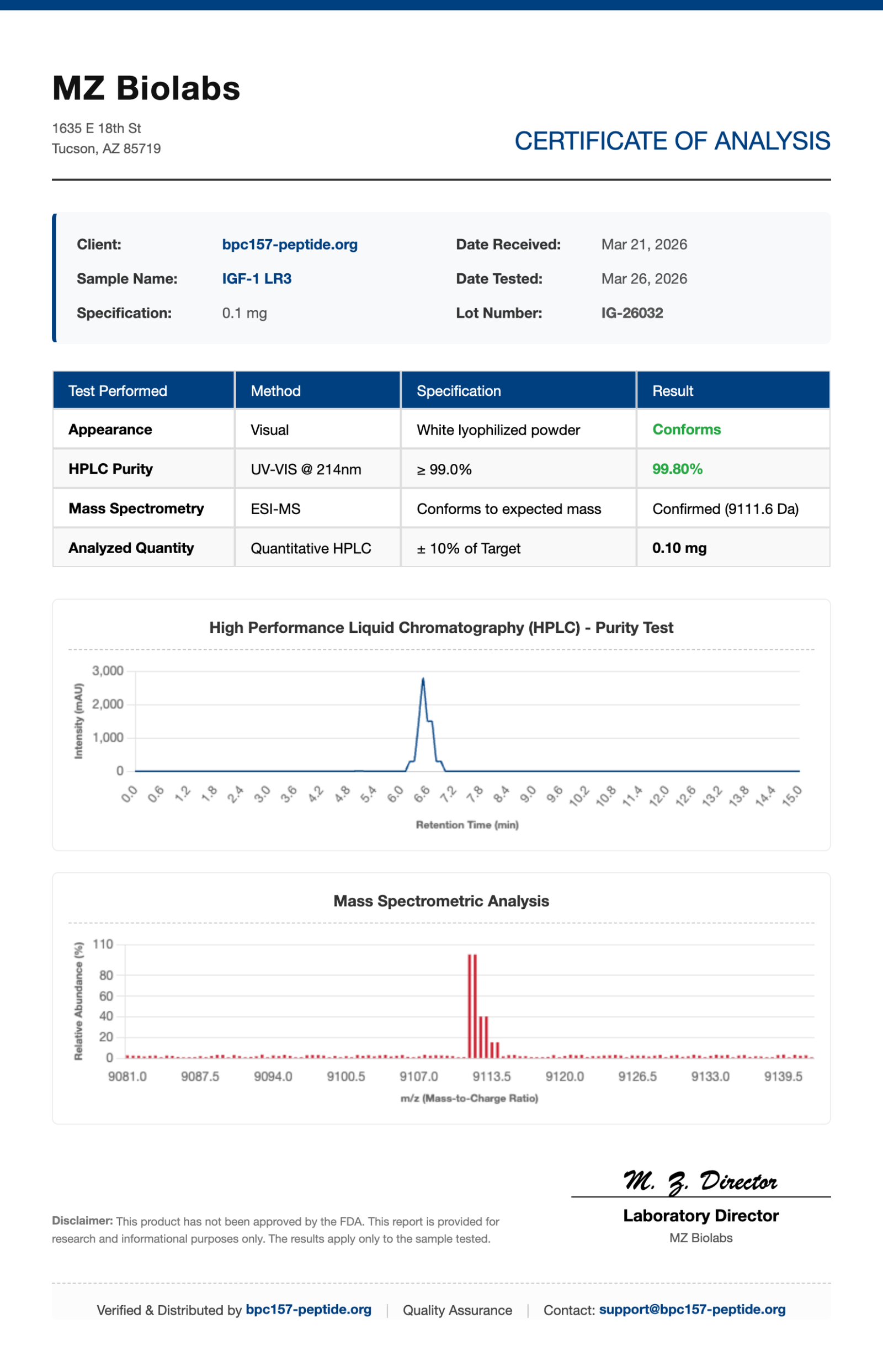
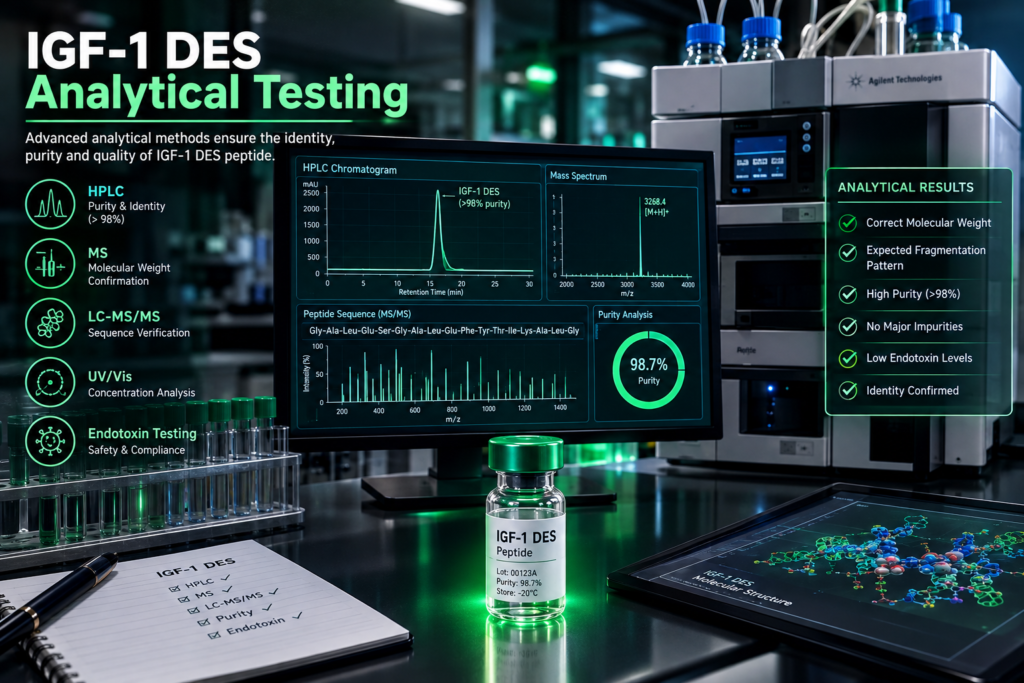
For IGF-1 DES, analytical information can help establish confidence in product identity and purity. Depending on the testing approach, analytical methods may examine molecular mass, chromatographic purity, peptide identity, or other quality parameters.
A certificate of analysis can also provide batch-specific information. Such documentation is useful because peptide quality can vary between production batches.
When evaluating an IGF-1 DES product, it is therefore useful to consider several factors together:
- Peptide identity
- Stated purity
- Batch information
- Analytical documentation
- Physical presentation
- Storage requirements
- Product quantity
Taken together, these details provide a more complete picture of the material.
IGF-1 DES in Molecular Biology Studies
Molecular biology examines how biological molecules interact and influence cellular systems.
Growth-factor peptides are particularly relevant because they can participate in signaling networks that connect extracellular molecules with intracellular responses.
IGF-1 DES provides a modified molecular model for examining these relationships.
Its structural characteristics allow comparisons with related peptides. These comparisons may help investigators better understand how peptide modifications influence receptor interactions and downstream signaling.
Furthermore, studying modified growth-factor molecules can contribute to broader knowledge about protein and peptide structure.
The value of such work comes from careful experimental design. Consistent materials, controlled conditions, and appropriate analytical methods all contribute to meaningful observations.
Handling and Product Presentation
Peptides are sensitive biological materials and should be handled according to appropriate laboratory procedures.
The physical condition of a peptide can be affected by environmental factors such as temperature, moisture, light, and repeated exposure to unsuitable conditions.
Therefore, appropriate storage and handling practices are important for maintaining material quality.
The 2mg x 10 vial format also provides individually packaged units. This format can help with organized sample management and controlled preparation.
Users should always review the product documentation supplied with the specific batch for applicable storage and handling information.

IGF-1 DES Product Quality
Quality is an important consideration when evaluating any peptide material.
For IGF-1 DES, the stated purity of >99% provides a useful quality specification. However, product evaluation should consider more than one number.
Identity, purity, batch documentation, packaging, and appropriate storage all contribute to overall product quality.
Clear product information also makes it easier to understand exactly what is being supplied.
The 2mg x 10 vial kit format clearly identifies both the individual vial quantity and the total number of vials. This provides straightforward information when organizing peptide materials.
IGF-1 DES and Peptide Research Applications
IGF-1 DES has attracted scientific interest because it represents a modified form of an important growth-factor peptide.
Its applications can be discussed in the context of molecular and cellular investigations involving:
- Growth-factor signaling
- Peptide structure and function
- Cellular communication
- Receptor interaction studies
- Protein and peptide chemistry
- Comparative peptide analysis
- Molecular biology
- Cell-based experimental models
These areas provide a broad scientific context for understanding IGF-1 DES.
At the same time, experimental findings depend heavily on the model and conditions used. Therefore, results should always be interpreted within the specific experimental framework.
A Closer Look at the 2mg x 10 Vial Format
The IGF-1 DES product is supplied as ten individual 2mg vials.
That creates a total stated quantity of 20mg per kit.
The multi-vial format can provide practical organization for laboratory workflows. Individual vials can be tracked separately, while batch information can remain associated with the supplied product.
Clear labeling is also important. Proper identification helps reduce confusion between related peptide products.
For laboratories working with several peptide materials, consistent packaging and clear product specifications can make inventory management easier.
IGF-1 DES: Structure, Purity, and Scientific Context
Three characteristics are particularly useful when evaluating IGF-1 DES: molecular identity, stated purity, and product format.
First, molecular identity distinguishes IGF-1 DES from other IGF-related peptides.
Second, the stated purity of >99% provides a defined quality specification.
Third, the 2mg x 10 vial format clearly communicates how the product is supplied.
Together, these details provide a straightforward overview of the product.
IGF-1 DES is therefore a specialized peptide with a distinct molecular structure and an established place within discussions of IGF-related signaling and peptide biology.
Its modified sequence makes it particularly interesting for studies that examine the relationship between peptide structure and biological behavior.
Final Product Overview
IGF-1 DES (Targeted Hyperplasia) | 2mg x 10 Vials Kit | >99% Purity combines a defined peptide identity with a high-purity specification and convenient multi-vial format.
The product contains ten 2mg vials, providing a total of 20mg per kit. Its molecular identity distinguishes it from full-length IGF-1, while its modified N-terminal structure makes it an interesting subject for peptide structure and signaling investigations. 🧬
For scientists and laboratories evaluating IGF-related peptides, understanding molecular structure is essential. Equally important are product documentation, purity information, batch details, and appropriate material handling.
IGF-1 DES offers a clearly defined peptide format for controlled scientific investigation and comparative molecular studies. Its unique structural characteristics continue to make it an important molecule within the broader field of peptide and growth-factor biology.



Reviews
There are no reviews yet.